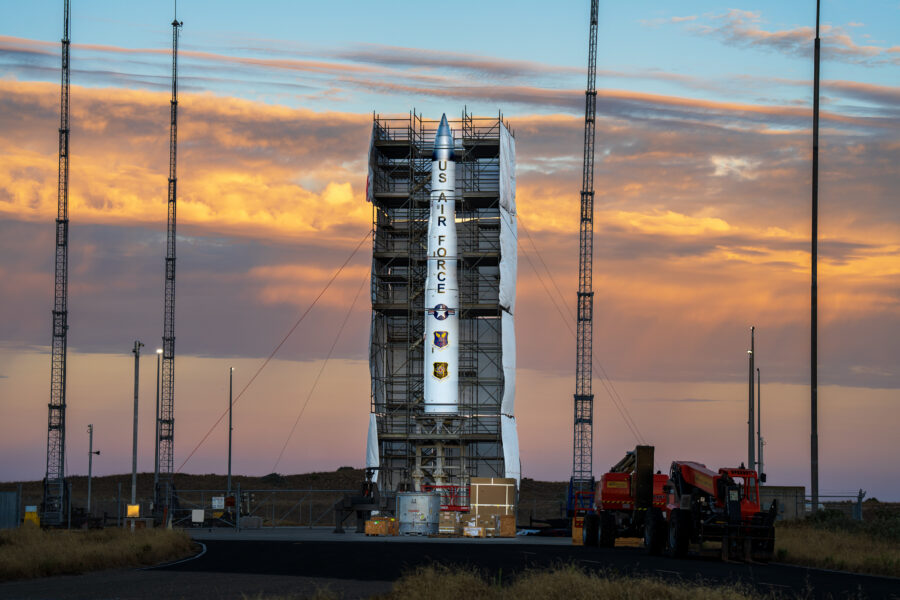
NATIONAL HARBOR, Md.—The Air Force has erected an inert version of its LGM-35A Sentinel intercontinental ballistic missile at Vandenberg Space Force Base, Calif., the service announced Sept. 14.
Officials also confirmed at AFA’s Air, Space & Cyber conference that they still expect to finish restructuring the long-troubled Sentinel program by the end of the year and conduct a first test launch in 2027.
The announcement did not specify when the vertical stacking was completed but said that it showed “the maturity of the missile’s design and verified that all critical subsystems are on track.”
An accompanying image shows the missile with “US AIR FORCE” running vertically down its side, along with the Air Force roundel and the emblems of Air Force Global Strike Command and the Air Force Nuclear Weapons Center.
In its own announcement, contractor Northrop Grumman said the stacking was a four-month test process that involved transporting missile components “on specially designed vehicles from across the U.S.” to Vandenberg, where technicians “rigorously tested mechanical operations including transportation, mobile crane use, and safe vertical integration while validating all interface connections on the test pad.”
The successful stacking “proved the viability of all missile stages, propulsion elements, shroud, and subcomponents to be assembled into a single configuration on the test pad,” both Northrop and the Air Force said in their releases.
The service has tested the different stages of the Sentinel’s solid rocket motor multiple times in recent years, as well as the new reentry vehicle that will sit atop them. But it has yet to put them all together for a single test of the entire system.
The Air Force also said that its 719th Test Squadron used the stacking event to complete its first “flight test design review” of the Sentinel to ensure it meets requirements for “performance, safety, and mission assurance ahead of flight testing.”
This February, officials announced they were targeting 2027 for the first test launch. Air Force Secretary Troy E. Meink confirmed in his keynote address at Air, Space & Cyber that the 2027 timeframe still holds.
Holding steady represents a win for the program; in 2024, officials were hoping for a first launch in early 2026. But massive cost and schedule overruns forced the program to restructure and slowed progress, leading the Government Accountability Office in 2025 to project a first launch in March 2028.
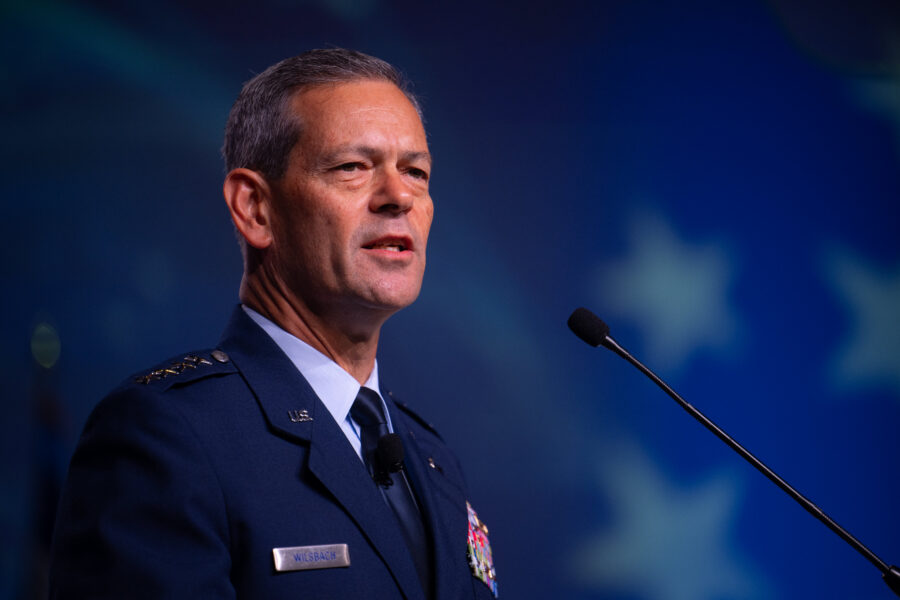
Gen. Dale R. White, director of critical major weapons systems, is overseeing Sentinel as the program tries to rebuild momentum from those overruns, which triggered a congressional notification and a Pentagon review under the Nunn-McCurdy Act.
As part of that process, Pentagon leaders rescinded Sentinel’s Milestone B decision, which authorizes officials to work on engineering and manufacturing development. Program leaders were instructed to restructure to manage the cost growth and schedule slip.
White told reporters during a roundtable at the Air, Space & Cyber conference that the restructuring process is nearing completion.
“We’re still on track for Milestone B. … That is going very well,” White said. “That was one of the areas I had concern early on about how you kind of navigate those waters and make sure you get that recertification right.”
Sentinel first received a Milestone B certification in 2020, but officials found over time that some of their baseline assumptions were no longer accurate.
The ground facilities in particular were the source of most of the problems rather than the missile itself. Those led to some “hard conversations” during the restructuring, White acknowledged, but senior leaders have now “pretty much locked down the majority of the design” for the infrastructure.
As part of that process, officials agreed Sentinel will no longer use the same silos as the Minuteman III, which are already around 60 years old. In March, the Air Force and Northrop broke ground on a new prototype silo in Promontory, Utah.
Broadly speaking, White said, the Air Force now has a better handle on the program as it progresses toward Milestone B once more.
“In terms of the cost piece, we’re learning as we go along because of just the sheer amount of data that we have now,” he said. “It’s so much more mature than when we did this [six] years ago, and so it’s been really fantastic, because we’ve integrated both the Air Force Cost Analysis Agency and [the office of Cost Assessment and Program Evaluation] with us, and we’re going through this together.”
White declined to say what the restructured program may cost. The previous baseline from 2020 was $77.7 billion; officials said in 2024 it would be closer to $141 billion. White has said he is treating the latter as a cap on the program’s cost.
“I don’t think we’re anywhere near a number right now,” White said Sept. 14. “I’m very comfortable with what I have seen, though, and I think that we’re certainly within the realm of what we have talked about all along. So I don’t think you’ll see any surprises from a cost perspective.”
The post Air Force Stacks Inert Sentinel ICBM Ahead of First Test in 2027 appeared first on Air & Space Forces Magazine.
AFA National, Nuclear, Air Force Secretary Troy E. Meink, Gen. Dale R. White, Northrop Grumman, nuclear modernization, Sentinel ICBM, Troy E. Meink, Vandenberg Space Force Base
Air & Space Forces Magazine
[crypto-donation-box type=”tabular” show-coin=”all”]