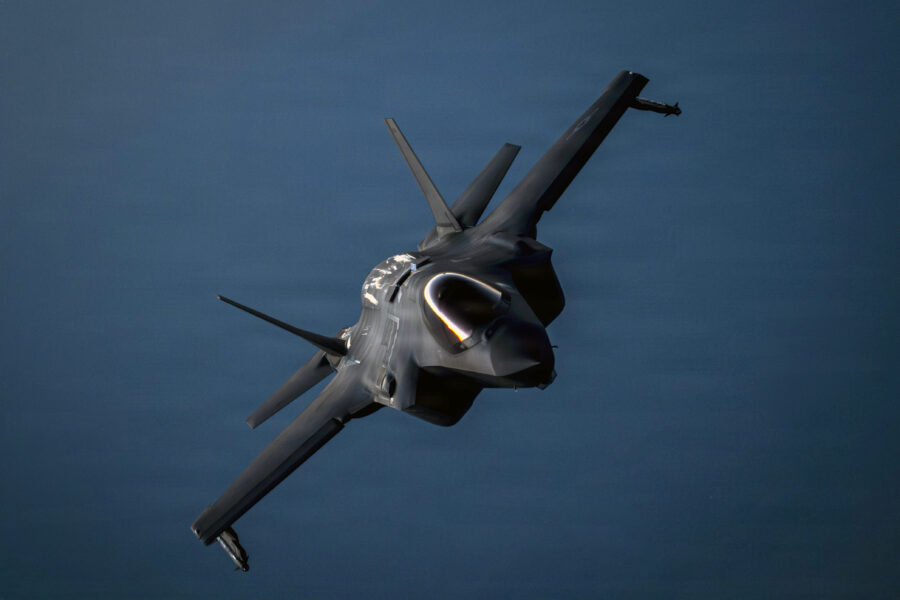
NATIONAL HARBOR, Md.—For years, sustainment challenges and spare parts shortages have hindered the F-35 Joint Strike Fighter’s readiness. But the Air Force’s experience flying F-35s heavily in operations against Iran have showed what the jet can be capable of, if maintainers get all the supplies and support they need.
Brig. Gen. Brian Laidlaw, director of operations for Air Combat Command, said during a Sept. 14 panel discussion at AFA’s Air Space & Cyber conference that the F-35 “absolutely proved itself” during Operation Epic Fury—and keeping a steady flow of spare parts was critical.
“When properly resourced, we showed without a doubt how well this airplane can perform in combat,” Laidlaw said. “When we send our aircraft into harm’s way and they go downrange, they enjoy a higher priority for spare parts and all the things that the logistics trail can get to them. What we saw is how remarkably well the F-35 airplane withstood and maintained really high mission capable rates over a long period of time in the toughest of combat situations.”
The challenge now facing the Air Force, F-35 prime contractor Lockheed Martin, and other parts of the Joint Strike Fighter enterprise: how to keep that level of readiness up, even for aircraft not on the front lines of combat?
A Government Accountability Office report released this June made clear the F-35’s readiness woes are still an issue—just one in four U.S. jets were considered “fully mission capable,” or ready to carry out all their missions at any given time, in fiscal 2025. The Air Force’s full mission capability rate was highest of all U.S. services at 28.5 percent, while the Navy and Marine Corps’ F-35s ranged between 15.3 to 22 percent.
The GAO report cited multiple problems, including spare parts shortages and the military’s decision years ago to prioritize buying more F-35s early in the program’s life cycle instead of investing in critical depot and repair capability. That choice led to a historic underinvestment in sustainment, GAO officials said, that has resulted in a sustainment system that can’t fully support the F-35 fleet.
Yet recent development have shown the Air Force’s larger sustainment enterprise kicking into high gear. In his keynote address Sept. 14, Air Force Secretary Troy Meink continued to harp on the importance of readiness, a frequent theme in his tenure, and said targeted campaigns such as the North Star Readiness Campaign for bombers is helping improve aircraft availability.
During Operation Epic Fury, Meink said, sustainment centers surged procurement of parts by nearly 120 percent to keep aircraft flying. Contractors have also spent billions of their own dollars to stock up on parts military aircraft need, he said.
“The result: our fleet health is showing meaningful progress,” Meink said. “And with Congress’ support, we’ll follow that up with record-high spare parts investment in the next year, and years to come.”
For the F-35 in particular, Dina Halvorsen, vice president of F-35 global sustainment at Lockheed Martin, pointed to several steps the company and the U.S. military have taken to turn around the fighter’s lagging availability in a briefing with reporters at the conference.
In early 2024, Halvorsen said, Lockheed and the F-35 Joint Program Office teamed up to create a “joint model” that spelled out what kind of parts, and how many, would be needed to make F-35s 80 percent mission capable—able to carry out at least one mission—and 65 percent full mission capable.
“It had become very clear that jointly, we [Lockheed and the military] had underinvested in sustainment for the number of jets that we had and flight hours that we wanted to fly,” Halvorsen said.
The team spent about 18 months working on that model, she said, and when it was ready in late summer 2025,, Lockheed made its first $1 billion investment in spare parts.
“We knew what parts were needed, and we didn’t want to wait another year, which is the cycle it would take to get through a congressional budget and get that funding aligned,” Halvorsen said.
Buying that first tranche of spare parts cut out nine or 10 months of lead time, Halvorsen said—and started to position the F-35 for the intense pace of operations that 2026 would bring. Flight hours on all F-35s worldwide are up 25 percent year over year, Halvorsen said, which she said is “putting even more stress on the system.”
But that major infusion of cash didn’t solve everything.
“With all the work we did to buy those initial parts, we realized there were some capacity gaps within the supply chain,” Halvorsen said. “So I could go buy parts, but I wasn’t going to get them in time.”
So Lockheed invested another $1 billion to try to fill that shortfall, Halvorsen said, and figure out what critical components it needed to invest in. That led to a second tranche of spare parts purchases, she said.
In July, the F-35 Joint Program Office awarded Lockheed a record $1.6 billion contract for critical spare parts, which Halvorsen said “liquidated” some of the first tranche of parts Lockheed had bought.
Halvorsen also said Lockheed plans to do more advanced procurement of spare parts to be ready for 2027 and further shrink supply times. That kind of buy-ahead is needed to fully engage the vast array of subcontractors that make F-35 parts, she said—and shows why multiyear purchase agreements for both production and sustainment are so important for the fighter.
“We’re going to keep the supply chain engaged, because to build the capacity, you have to have the demand,” Halvorsen said. “So if you don’t put your total demand into the supply chain, they will never build to the capacity that you need. … We think it’ll drive down overall cost, because if you buy year-to-year, you’re certainly paying for that sort of thing.”
The post F-35 Readiness Surged in Epic Fury; Now Pentagon and Lockheed Eye Broader Gains appeared first on Air & Space Forces Magazine.
AFA National, Air, F-35 Joint Program Office, F-35 Joint Strike Fighter, F-35 sustainment, Lockheed Martin, mission capable rates, spare parts, sustainment
Air & Space Forces Magazine
[crypto-donation-box type=”tabular” show-coin=”all”]