Tyler Durden
Bessent: Aim Is To ‘Collapse’ Iran Regime Through Economic Warfare, But US Unlikely To Restart Major Combat
Summary
- US shifts toward economic warfare, away from military strikes: Bessent says maximum sanctions likely mean no major new military campaign for now.
- Regime change rhetoric persists: Bessent says Washington intends to “collapse” Iran’s regime.
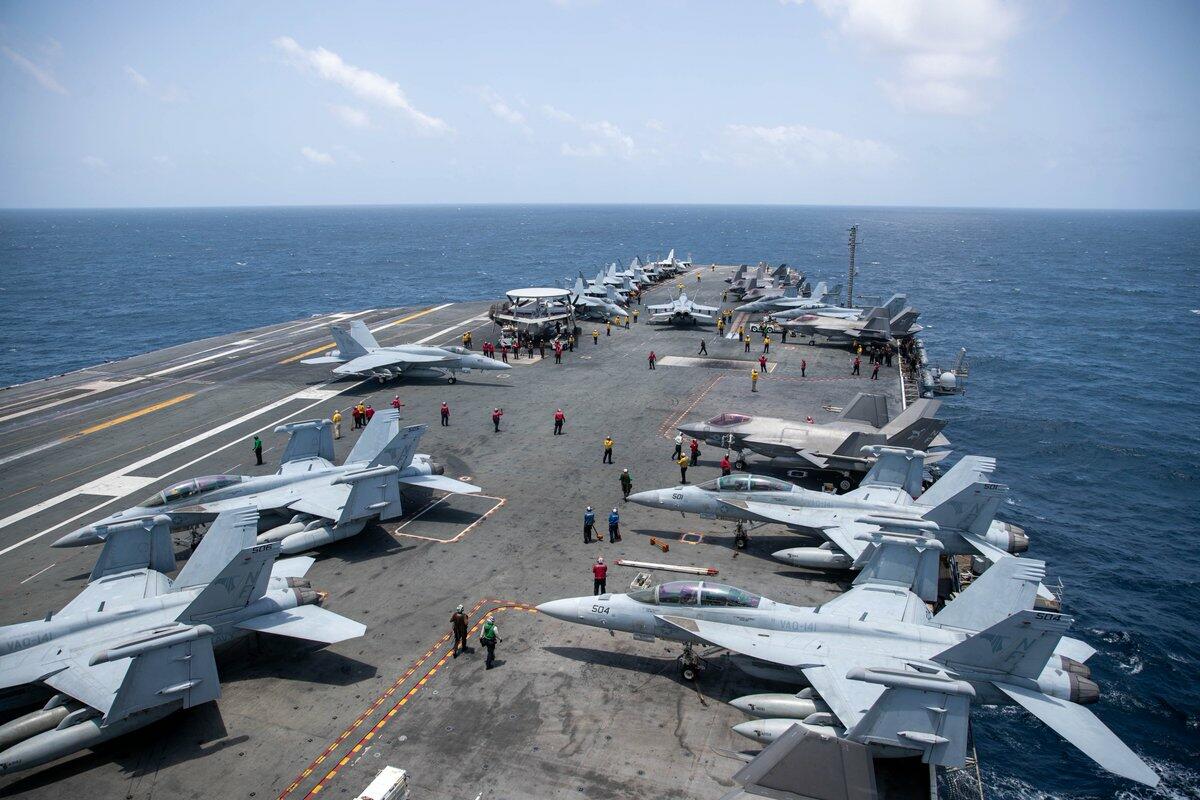
- USS George Washington arrives: A new US carrier is now operating in the Middle East, relieving the over-extended USS Lincoln.
- Iran rejects US threats as a Trump “diversion”: Tehran calls the campaign “economic terrorism” and says Washington is seeking an exit.
- Axios claim of ‘stealth corridor’ where oil is moving steadily through Hormuz results in skepticism & some pushback.
Yes 6% · No 95%
View full market & trade on Polymarket
* * *
Bessent: Going to ‘Collapse this Regime’
US Treasury Secretary Scott Bessent in a CNBC appearance seemed to give additional confirmation that further Pentagon operations targeting Iran are unlikely to happen down the line. He also furthered Trump’s ‘Economic D-Day’ plan and threat.
“If we are doing the maximum economic pressure, then that means that likely there will not be a large-scale kinetic restart,” Bessent said in a “Squawk on the Street” interview.
He previewed a press conference which the administration plans to give Monday to “talk about exactly what we’re going to do.” Apparently the White House is keen on resurrecting Bush-Cheney era talking points in the effort to push global countries to comply with a full economic siege and strangulation of the Islamic Republic. According to CNBC:
In a preview of the plan, he said that the U.S. will be telling all of its allies, “You are either with us or against us.”
“If you insist on doing business with [Iran], either transferring money, buying their oil or doing seaborne ship transfers, then the U.S. Treasury and the U.S. government … will put its full might and force toward enforcing against you,” Bessent said.
“This is going to be the greatest coordinated economic isolation in the history of the world,” he said.
He also said in the interview at one point that “we are going to collapse this regime.” Of course, none of this is necessarily new in terms of talking points’…
Bessent: “I’m not sure why oil has popped up on this, because for now — and it’s at the president’s discretion — if we’re doing the maximum economic pressure, then that means that likely there will not be a large scale kinetic restart. But I would emphasize that is for now …… pic.twitter.com/IYsWhsomgN
— Aaron Rupar (@atrupar) August 20, 2026
USS Washington Carrier now in Region
The US Central Command (CENTCOM) has on Thursday confirmed the USS George Washington is now deployed in the Middle East, following the lengthy, over-extended deployment of personnel onboard the USS Lincoln, which has sparked crisis and media frenzy over poor conditions, lack of supplies, and worsening morale.
“The George Washington Carrier Strike Group is operating in Middle East during a scheduled deployment after arriving in the CENTCOM theater yesterday,” the command said in a statement posted on X.
The USS Washington will now be the military’s frontline carrier leading the mission in regional waters, which has featured an ongoing blockade of Iranian ports.
Iran Responds to Trump’s ‘Economic D-Day’
President Trump had the evening prior issued a Truth Social post describing a new “ECONOMIC D-DAY” against Iran, declaring that his total economic war against Tehran will be the “MOST CRUSHING ECONOMIC OPERATION EVER TAKEN AGAINST ANY COUNTRY.”
Trump said that with Tehran’s military and military-industrial base reduced to “now rubble” and its “currency worthless,” he will unleash severe economic consequences against “ANY country that allows its financial institutions, businesses, airports, or government entities to provide any type of lifeline to Iran.”
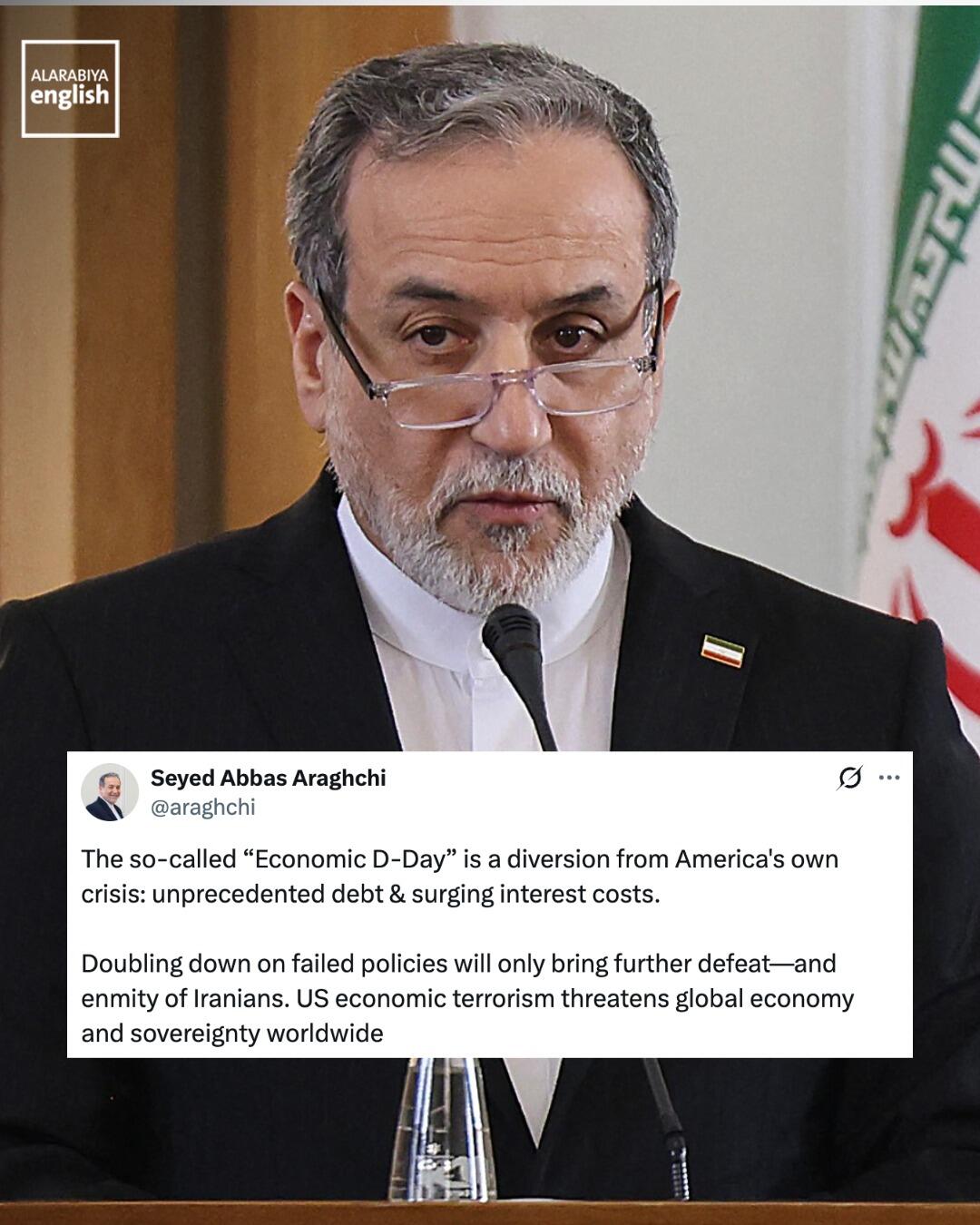
On Thursday Iranian leaders responded to the D-Day threat, with Iranian Foreign Minister Abbas Araghchi stating on X that Trump’s announcement is designed to distract from Washington’s “unprecedented debt & surging interest costs”. He said the new economic measures will “bring further defeat” to the US. He added that “US economic terrorism threatens [the] global economy and sovereignty worldwide.
US Desperately Seeks Exit, Says Iranian Official
Another top Iranian official elsewhere asserted the US seeks exit from the region:
Iranian Parliament Speaker Mohammad Bagher Ghalibaf visited Iraq on Wednesday and said that the US was seeking to exit the region, comments that come following a report from The Washington Post that said the Pentagon is considering pulling back from the Persian Gulf after many of its bases in the area were heavily damaged by Iranian strikes.
Iran’s Deputy Foreign Minister Kazem Gharibabadi also weighed in with another message, saying Washington is headed towards its next defeat. “They claim Iran is on the verge of defeat, hanging by a thread, yet they are begging all their allies to help them,” he posted on X.
Meanwhile Qatar is still seeking mediation and de-escalation, with Qatar’s Foreign Minister Sheikh Mohammed bin Abdulrahman bin Jassim Al Thani having said Thursday that traffic in the Strait of Hormuz must go back to what it was before. He urged that no party go back to “blackmailing” the other.
“The consequences of this war were grave, not only on the Gulf region but elsewhere in the world,” Sheikh Mohammed told reporters at a press briefing following high-level discussions in El Alamein, Egypt.
“We need the situation to go back to what it used to be before” he said. “We condemn any threats in this regard in any obstacles.”
Axios Report on ‘Stealth’ Hormuz Corridor
On the question of global shipping flows through the strait, much remains to be seen following a controversial Axios report issued Wednesday which said the Pentagon has successfully established a stealth corridor in and out of the strait. Here are the key untested claims, which await verification:
- Under the operation, which has been underway for the last several weeks, 15–20 tankers have entered and exited the strait each night through a southern channel along the coast of Oman.
- About 10 million barrels of oil a day — roughly half the pre-war volume — are being transported out of the strait and injected into the global energy market, the officials said.
If this is the case, then it’s likely to lead to further rounds of war, given Iran is unlikely to sit back and allow the corridor to run smoothly…
I fully agree: “Iran is unlikely to accept a situation in which it cannot export oil while other Gulf producers continue to do so. Paradoxically, therefore, America’s relative operational success could become a driver of further Iranian escalation.” https://t.co/I2IuU0deyU
— Hamidreza Azizi (@HamidRezaAz) August 20, 2026
‘Stealth’ Corridor Story True?
Of course, many analysts have pointed out that Axios has not been reliable on oil and Iran related reports, which tend to come out at sensitive moments timeline-wise, perhaps for maximum impact on markets.
Regional watcher and Atlantic Council author Danny Citrinowicz writes, “There is a fundamental paradox at the heart of the current U.S. approach to Iran: Washington wants to avoid another major military campaign, yet the very strategy it is pursuing to achieve that goal may make renewed military escalation increasingly difficult to avoid.”
“The administration appears to believe that it can dramatically intensify economic pressure, including through aggressive enforcement of secondary sanctions, while keeping the confrontation largely within the economic domain,” he continues. “But that assumption misunderstands both Iran’s position and the incentives facing its current leadership.” Indeed Washington has seemed to miscalculate and underestimate Tehran at every turn of this nearly 6-month long conflict.
Tyler Durden
Thu, 08/20/2026 – 11:39
ZeroHedge News
[crypto-donation-box type=”tabular” show-coin=”all”]