Tyler Durden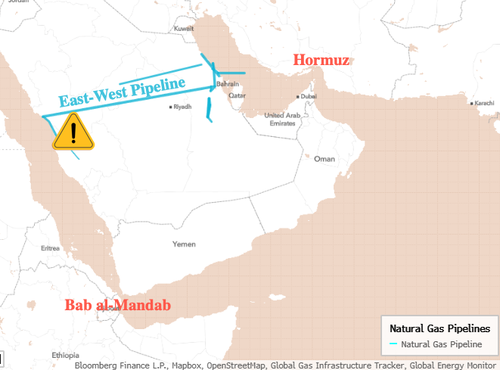
Saudis Cancel September Crude Cargoes To Europe As East-West Pipeline Shutdown Deepens Energy Crisis
Summary:
- Saudis Cancel September-Loading Crude Cargoes to Europe
- Europeans are paying between $9-$11 per gallon for diesel amid Global Refining Crisis
- Saudi Oil Routes Narrow: Kingdom Eyes Hormuz Export Surge After Pipeline Attack
Saudis Cancel September-Loading Crude Cargoes to Europe
“Refining is super short. Between Europe’s woes, Russias war on Ukraine and a drop in refined products from the Arabian Gulf its really bad. As many of my amazing followers showed yesterday… Europeans are paying between $9-$11 per gallon for diesel,” CNBC’s Brian Sullivan wrote on X.
Refining is super short. Between Europe’s woes, Russias war on Ukraine and a drop in refined products from the Arabian Gulf its really bad.
As many of my amazing followers showed yesterday… Europeans are paying between $9-$11 per gallon for diesel. https://t.co/TG0NmfDkVE
— Brian Sullivan (@SullyCNBC) September 15, 2026
Europe’s energy supply outlook is deteriorating after Reuters reported Tuesday that Saudi Arabia had notified some European refiners that their September-loading crude cargoes would be canceled following the shutdown of its critical East-West pipeline after a drone attack.
Beyond a diesel shortage in the West, Europeans are also dealing with low natural gas stockpiles heading into the Northern Hemisphere winter, with prices reaching their highest level since December 2022.
Saudi Oil Routes Narrow: Kingdom Eyes Hormuz Export Surge After Pipeline Attack
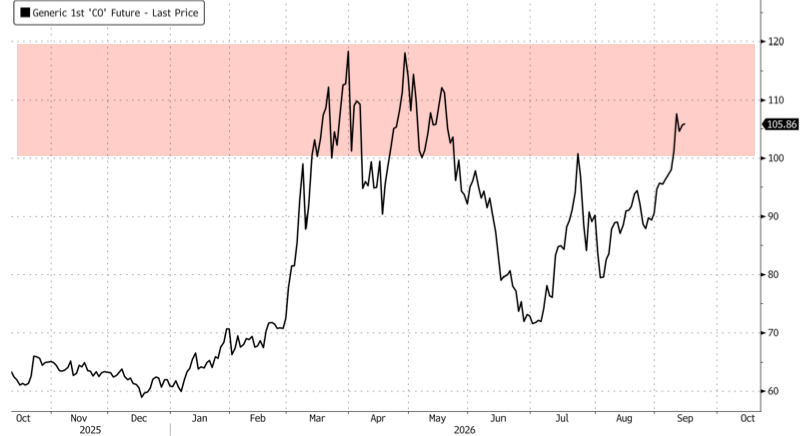
Middle East tensions remain high, with Brent crude futures trading around $105 a barrel and US diesel crack spreads near $110 a barrel amid an ongoing global refining crisis. Disruptions to Russian fuel production from the war in Ukraine are compounding supply constraints across the Middle East.
Saudi Arabia’s options for maintaining exports have significantly narrowed following a drone attack that shut down its critical East-West pipeline last week. With that alternative pipeline route disrupted, possibly for up to a month, and shipping risks elevated around the Arabian Peninsula, Riyadh is seeking to move more crude through the highly contested Strait of Hormuz.
US Energy Secretary Chris Wright told reporters Monday that the US Navy is escorting a large number of vessels through the Oman shipping corridor in the Hormuz chokepoint. Those escorts could support increased Saudi shipments and bolster Riyadh’s confidence in US naval protection.
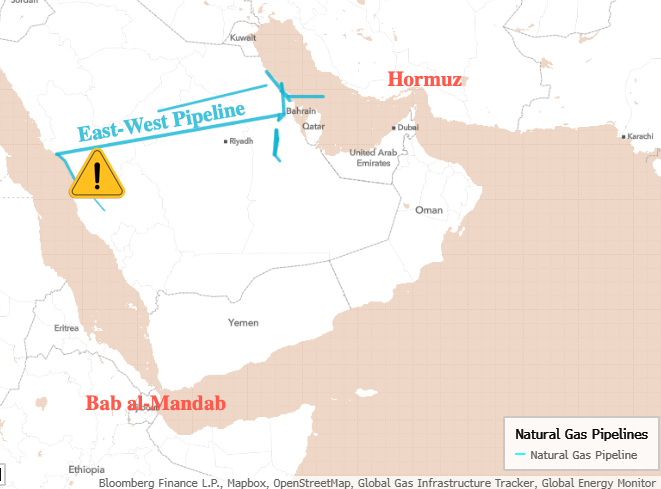
Bloomberg reported that Riyadh has already begun ramping up crude transits through Hormuz. The report cited sources, and the kingdom did not confirm it.
Saudi exports had recovered toward 4 million barrels a day in early September, with about 1 million moving through Hormuz and the balance through Yanbu on the Red Sea. That leaves the kingdom facing a substantial export shortfall.
Riyadh has two options right now:
- Restore East-West pipeline pumping infrastructure in a timely manner; or
- Sharply increase Gulf shipments (with US naval protection).
Geospatial intelligence shows high-resolution satellite imagery of the aftermath of the drone attack that destroyed pumping infrastructure.
BREAKING: New high-resolution satellite imagery shows the pumping station on Saudi Arabia’s East-West oil pipeline burned out end to end, with the entire process area blackened and crude oil that escaped the site pooled across the desert beyond the perimeter, per Vantor imagery. https://t.co/DFJAplGNcC pic.twitter.com/uQEdn2YVFe
— The Hormuz Letter (@HormuzLetter) September 14, 2026
“The pipeline, with capacity of 7mb/d, had played an important role in re-routing oil away from the Strait of Hormuz, and the impact of the pipeline’s closure on Red Sea exports (combined with recent Houthi efforts to disrupt Red Sea flows) will continue to support oil prices for the foreseeable future,” UBS energy expert Dominic Ellis told clients.
Wright joined Bloomberg TV to calm energy markets and said pipeline operations could resume “very soon,” yet no timeline was given.
U.S. Energy Secretary Chris Wright says Saudi Arabia’s East-West pipeline will be back up and running “very soon.” pic.twitter.com/vengmvxLG7
— Clash Report (@clashreport) September 14, 2026
Meanwhile, AP News reported that flows through the pipeline could resume in three to five weeks.
Riyadh’s most immediate response is to ramp up Hormuz shipments with what appears to be US naval protection, but tanker availability remains another big problem. Also, tanker freight rates from Saudi Gulf ports to China topped $1 million at the end of last week.
Tyler Durden
Tue, 09/15/2026 – 11:26
ZeroHedge News
[crypto-donation-box type=”tabular” show-coin=”all”]