
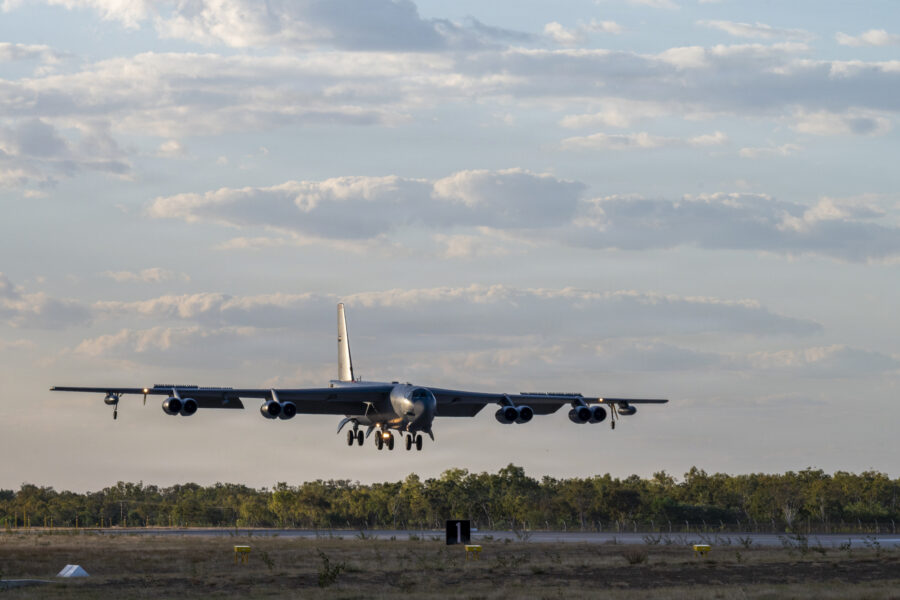
Air Force B-52 Stratofortress bombers landed at a northern Australian air base this week, a major display of the U.S. military’s ability to project force in the Pacific.
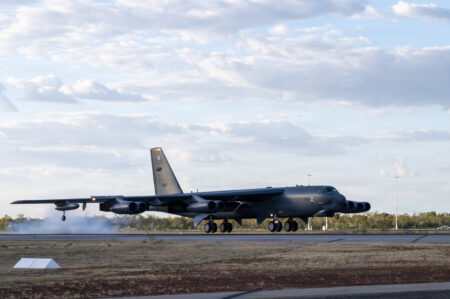
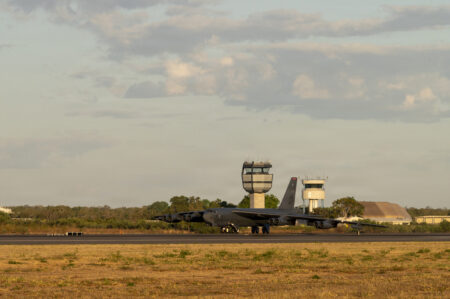
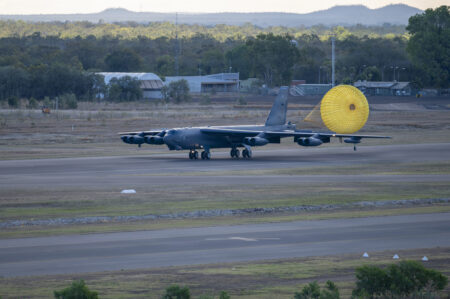
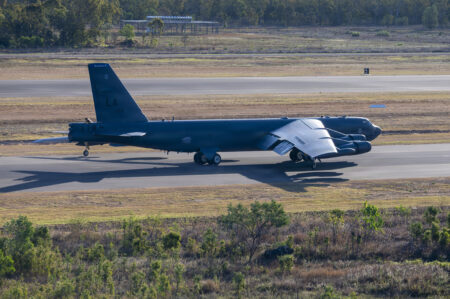
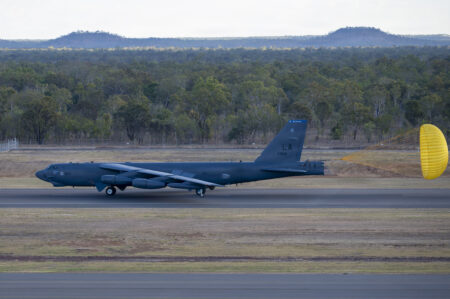
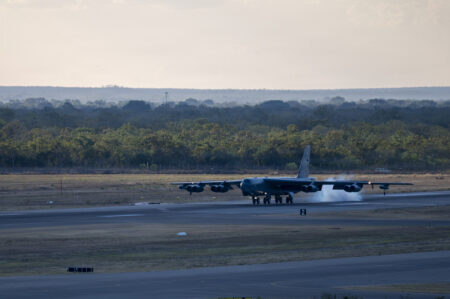
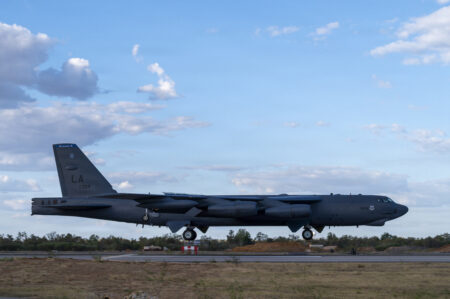
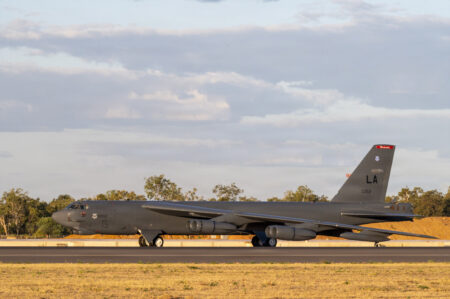
Multiple B-52s landed at Royal Australian Air Force Base Tindal in the country’s Northern Territory on Sept. 1, according to official Air Force imagery released Sept. 3.
The joint military-civilian airfield near the town of Katherine, which the Pentagon plans to use as a launching pad for operations in the Pacific, has undergone a $1.1 billion upgrade in recent years.
That work enables it to support the deployment of a half-dozen B-52s, giving the U.S. more locations to stage bombers in the region amid China’s growing military might.
The base also houses Australian F-35A Lightning stealth fighter jets and MQ-4C Triton remotely piloted surveillance aircraft.
Australia is south of the U.S. territory of Guam, where Andersen Air Force Base serves as America’s current bomber hub in the Western Pacific. RAAF Base Tindal would give the U.S. Air Force more basing options for long-range missions in the region.
“Operating from RAAF Base Tindal marks our ability to project, sustain, and regenerate decisive airpower across an expanding extended network,” states one photo caption released by Pacific Air Forces. The deployment from the base “deepens our partnership and interoperability” and “highlights our shared commitment to regional stability, ensuring our forces remain agile and responsive in support of a Free and Open Indo-Pacific,” PACAF added in other captions.
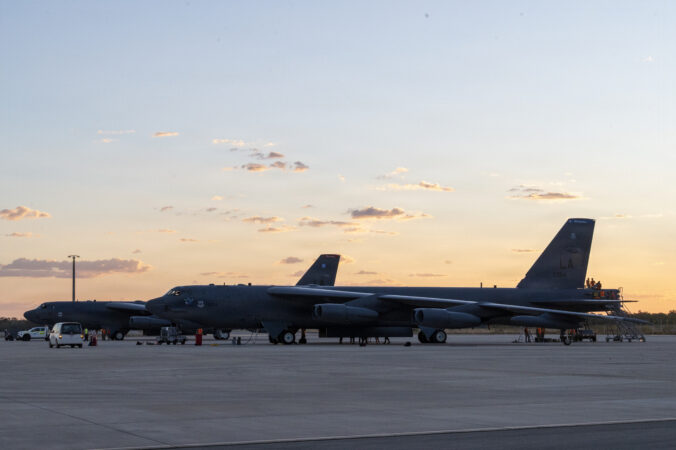
Air Force Global Strike Command and the Eighth Air Force, which oversees the nation’s bomber force, declined to comment, citing operational security, and referred questions to Pacific Air Forces on Sept. 2 when asked about the deployment. PACAF did not immediately respond to a request for comment. It is unclear how long the bombers will be deployed to the region and how many aircraft are operating from Australia. The bombers hail from the 2nd Bomb Wing at Barksdale Air Force Base, La.
Multiple wargames on potential conflicts with China have highlighted the strategic and operational value of Australia’s airbases and naval facilities, said retired Col. Mark Gunzinger, a former B-52 pilot and deputy assistant secretary of defense for forces transformation and resources.
“That has been a constant in our wargames: using Australia’s multiple airfields—and not just in northern Australia but in the south too—to generate long-range bomber strikes and tanker sorties to support bomber and fighter operations,” said Gunzinger, the Director of Future Concepts and Capability Assessments at AFA’s Mitchell Institute for Aerospace Studies.
“China has a limited number of very long-range ballistic missiles that can reach U.S. air forces stationed at Diego Garcia, in Australia, and other air bases that are not located along the First Island Chain.” Bombers’ longer ranges would allow them to be stationed at airfields even further from China if necessary, Gunzinger added.
Washington and Canberra are increasingly aligned under the AUKUS security pact, which also includes the United Kingdom. The agreement will give U.S. nuclear-powered subs to Australia and allow the U.S. to stage subs out of Australia starting next year. Conceived under the Biden administration, AUKUS has also been embraced by the second Trump administration.
Australian Deputy Prime Minister and Defense Minister Richard Marles met with Secretary of Defense Pete Hegseth at the Pentagon on Sept. 2 to commemorate the 75th anniversary of the ANZUS Treaty, a mutual defense pact, during which the two defense chiefs “discussed how both nations will continue to advance the alliance and strengthen deterrence in the Pacific.”
“The Secretary noted the alignment between U.S. and Australian National Defense Strategies and also acknowledged that Canberra recognizes the gravity of maintaining a favorable balance of power in the region to ensure that both countries remain safe and prosperous,” the Pentagon said in a readout provided from the meeting. “Both leaders agreed to accelerate force posture initiatives at Australian bases, bolster cooperation in combined logistics, and build greater interoperability through joint exercises.”
The U.S. has operated fighters and bombers from other Royal Australian Air Force Bases, such as RAAF Base Amberley, and the two countries conduct the biennial Talisman Saber, one of the largest and most complex military training exercises held. By 2030, the U.S. Navy expects some 2,300 Americans to be based in Western Australia.
“What we’re seeing is a real increase in U.S. posture in Australia,” said Zack Cooper, a senior fellow and expert on U.S. strategy in Asia at the American Enterprise Institute. “Sometimes it can take a really long time to build out the infrastructure, but in this case, I think we’re seeing the U.S. and Australia move pretty quickly on both the air and the naval side. I think it’s emblematic of the step-up in effort we’re seeing from both Canberra and Washington.”
“The U.S. needs to diversify the locations from which it can operate air and naval assets. Australia’s northern bases do that on the air side and the naval facilities in Perth are critical on the nuclear submarine side,” he added.
Equipping a base to handle large bombers with heavy payloads is no small task: runways must be long, sturdy, and adequate, with ramp space, fuel infrastructure, and safe weapons storage facilities.
“That can all drive some considerable investment in airfields, which Australia has made and continues to invest in to bolster regional deterrence,” Gunzinger said.
The post B-52s Deploy for Bomber Task Force to Australia’s New BUFF Base appeared first on Air & Space Forces Magazine.
Air, National Security, 2nd Bomb Wing, AUKUS, Australia, Barksdale Air Force Base, Bomber task force, bomber task force deployments, Pete Hegseth, RAAF, RAAF Base Tindal, Richard Marles
Air & Space Forces Magazine
[crypto-donation-box type=”tabular” show-coin=”all”]