 Tyler Durden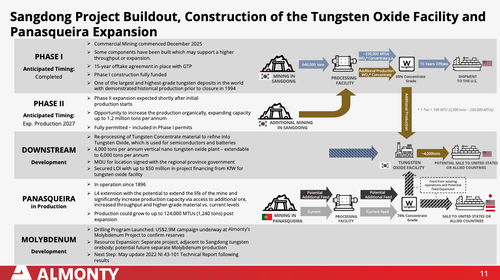
The West’s Answer To Break China’s Tungsten Stranglehold Before Historic Rearmament Cycle Ramps
New reports emerged late Tuesday during the US cash session that the US military had struck targets inside Iran. If confirmed, the operation would mark a rare instance of US strikes occurring during regular market hours. Market(ing) tactics aside, the now six-month military campaign against Iran has also exposed a critical operational vulnerability: the US military is facing an alarming shortage of advanced missiles and interceptors.
However, the crisis extends well beyond procuring replacement missiles from major defense firms. The deeper vulnerability lies farther upstream, where the rare earths and critical materials required for guidance systems, seekers, propulsion components, warheads, and interceptors remain scarce and heavily concentrated in China, even as Beijing increasingly weaponizes export controls of metals against the West.
On Monday, the Department of War said it had secured seven-year agreements with General Dynamics Ordnance and Tactical Systems and Lockheed Martin to rapidly expand US missile-production capacity and replenish depleted inventories.
The agreements are intended to increase output and accelerate deliveries of critical missile subcomponents supporting the Terminal High Altitude Area Defense (THAAD) system and the Patriot Advanced Capability-3 Missile Segment Enhancement interceptor.
A separate report from AP News highlighted another driver of defense demand: the US Army’s new Precision Strike Missile, or PrSM, is intended to replace the Army Tactical Missile System, or ATACMS, which has served as the service’s primary deep-strike weapon for decades. The PrSM’s fragmentation warhead requires large quantities of tungsten pellets.
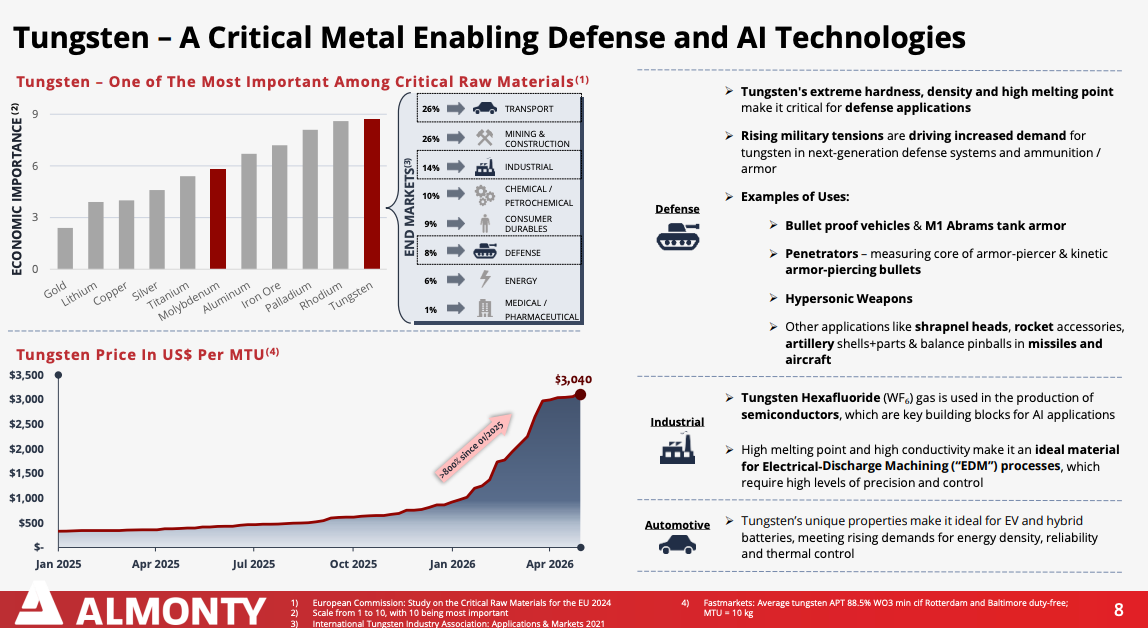
Tungsten is extremely effective as a penetrator because it combines one of the highest densities of any metal with the highest melting point. When a PrSM warhead detonates above its target, thousands of small, lethal tungsten pellets are dispersed at extreme speeds. The metal’s density and ability to retain its shape enable those fragments to penetrate building walls, vehicle panels, equipment housings, and many forms of advanced armor after the initial blast wave has dissipated like a shotgun blast.
This is where the DoW’s historic weapons rearmament cycle collides with a critical materials supply crisis spreading across the Western world.
The State Department and DoW already understand the vulnerability. Tungsten, one of the most strategically important metals used across the defense-industrial base, is entering what investment research firm The Oregon Group has described as a major structural supply crisis.
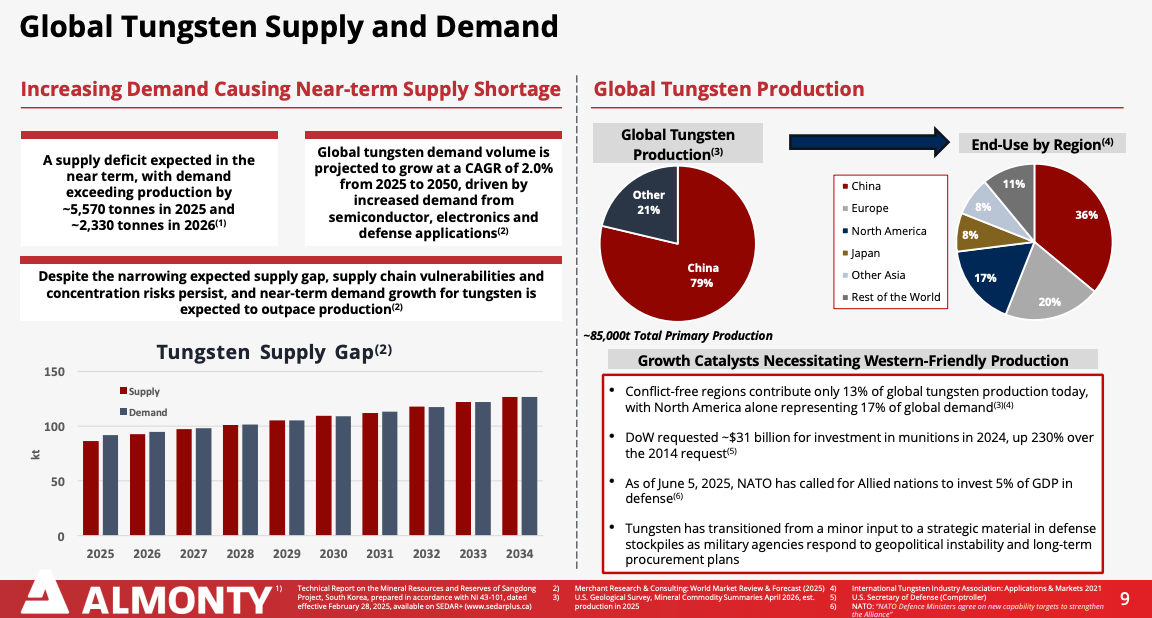
A frantic effort is now underway across the West to secure non-Chinese tungsten. China accounted for about 79% of global mined tungsten production in 2025 and controls roughly 85% of refining capacity. Meanwhile, Chinese mine output has dropped 10% year over year, even as Beijing restricted tungsten exports to Western markets since early 2025.
The Oregon Group highlighted one of the clearest warnings yet: Even if every announced tungsten project ex-China reaches production by 2030, the global market could still face a massive structural deficit.
“Eleven announced mine projects are forecast to add nearly 20,000 tonnes of annual capacity by 2030, lifting accessible ex-China supply to an estimated 34,000 tonnes WO₃, against projected primary demand of roughly 50,000 tonnes after recycling, which would leave the market facing a deficit of 16,000 tonnes WO₃,” the research firm stated in a new report.
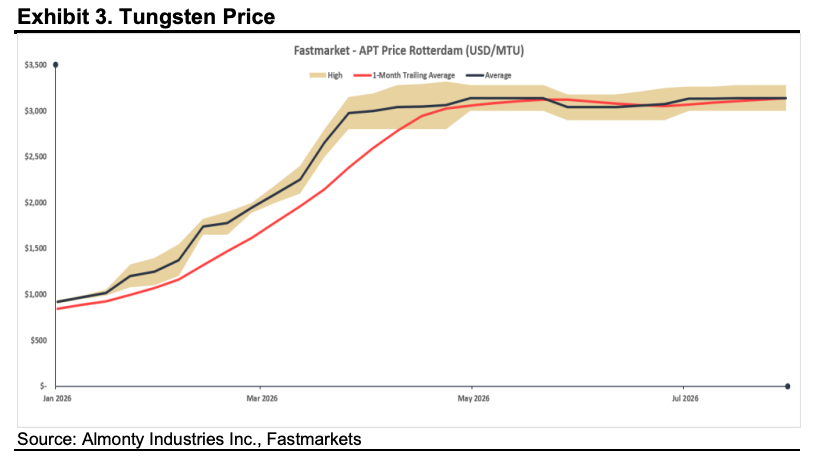
#Tungsten prices surged 310% from Jan-July as China export controls squeezed supply.
And, by 2030, ex-China primary mine supply still projected to be in deficit by 16,000 tonnes.
📣 Tungsten price shock signals deeper supply crisishttps://t.co/enxErVsINb #mining #invest pic.twitter.com/ooovQTqibw
— The Oregon Group (@TheOregonGroup) August 31, 2026
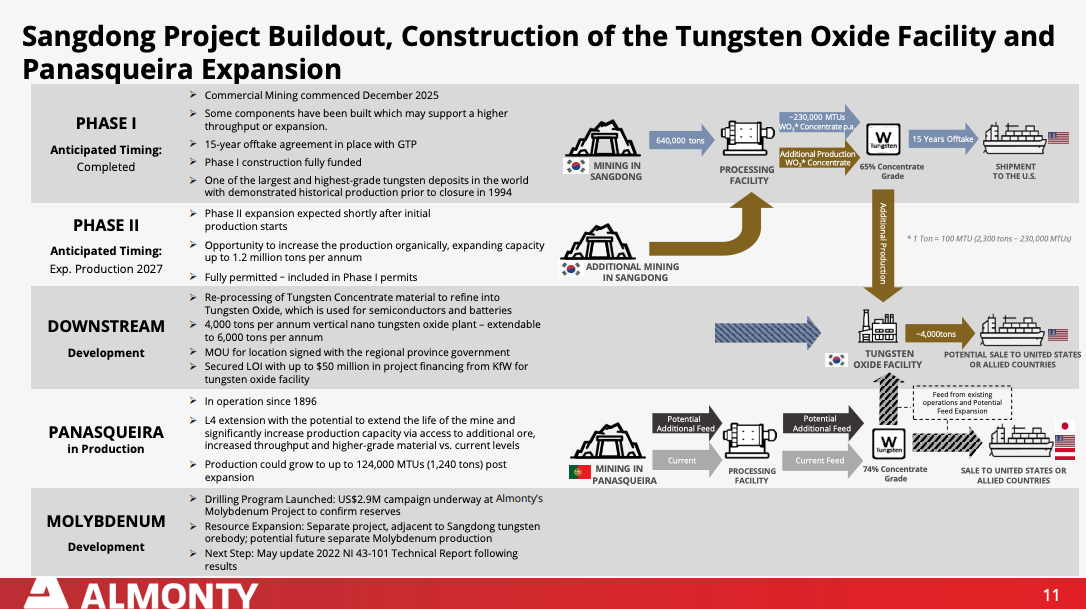
That tightening physical market picture brings us to Almonty Industries, which controls the Sangdong mine in South Korea, one of the largest and highest-grade tungsten deposits outside China, as well as Panasqueira Mine in central Portugal, which is considered one of Europe’s largest and oldest continuously operating tungsten and tin mines.
With Sangdong ramping toward full production, Almonty has transitioned from a junior mining company into an increasingly important supplier to the Western defense-industrial base, one which is on the radar of the Trump administration.
At planned Phase II capacity, Sangdong could produce roughly 4,000 tons of tungsten annually. That would represent about 4% to 5% of global mine production and around 20% of current tungsten output outside China.
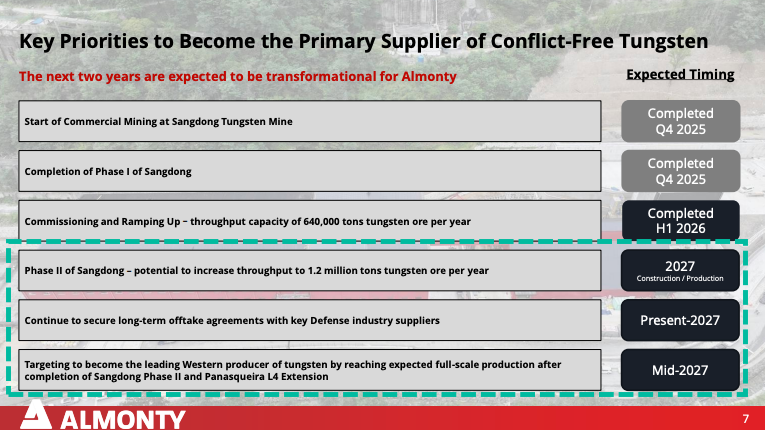
In its latest investor deck, Almonty said it is “targeting to become the leading Western producer of tungsten by reaching expected full-scale production after completion of Sangdong Phase II and the Panasqueira L4 extension” by mid-2027.
Almonty CEO Lewis Black has previously said, “Almonty controls one of the largest and highest-grade tungsten deposits outside of China at precisely the moment Western governments and defense manufacturers are rebuilding their critical-minerals supply chains around non-Chinese sources.”
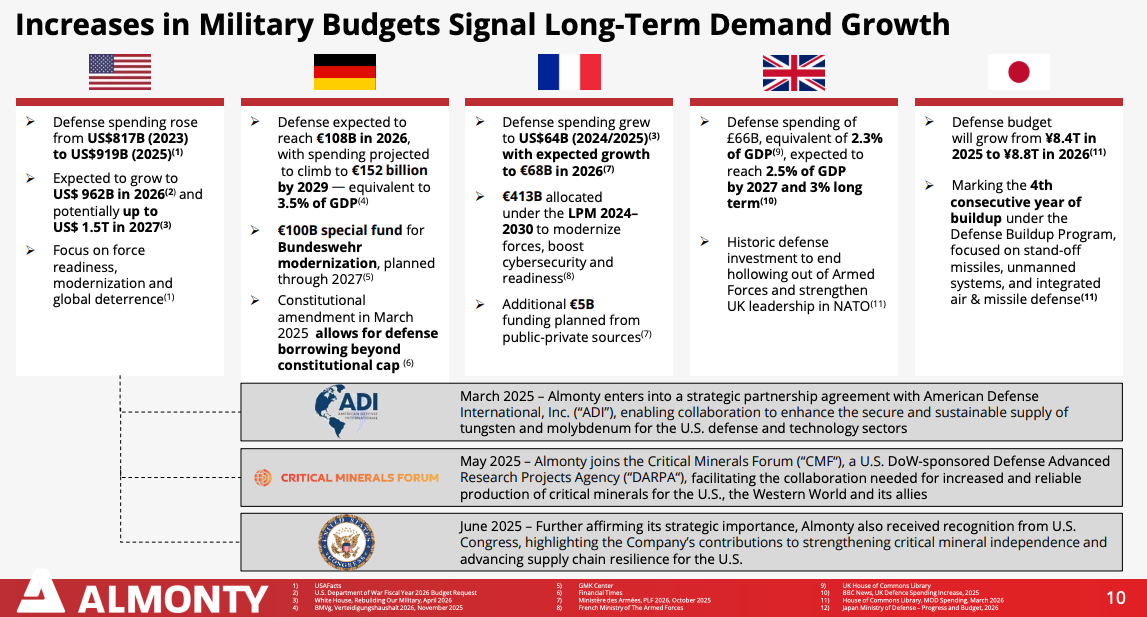
The timing of Sangdong’s planned move toward full-scale production by mid-2027 is significant because the DoW’s supply clock is already ticking. The West’s effort to break China’s stranglehold over critical materials is colliding with a historic military rearmament cycle.
Tungsten demand extends well beyond defense, including as a critical building block in AI chips (read here).
That convergence places Almonty at the center of the emerging conflict-free tungsten supply chain and could transform Sangdong and Panasqueira mines into one of the world’s most important sources of non-Chinese tungsten.
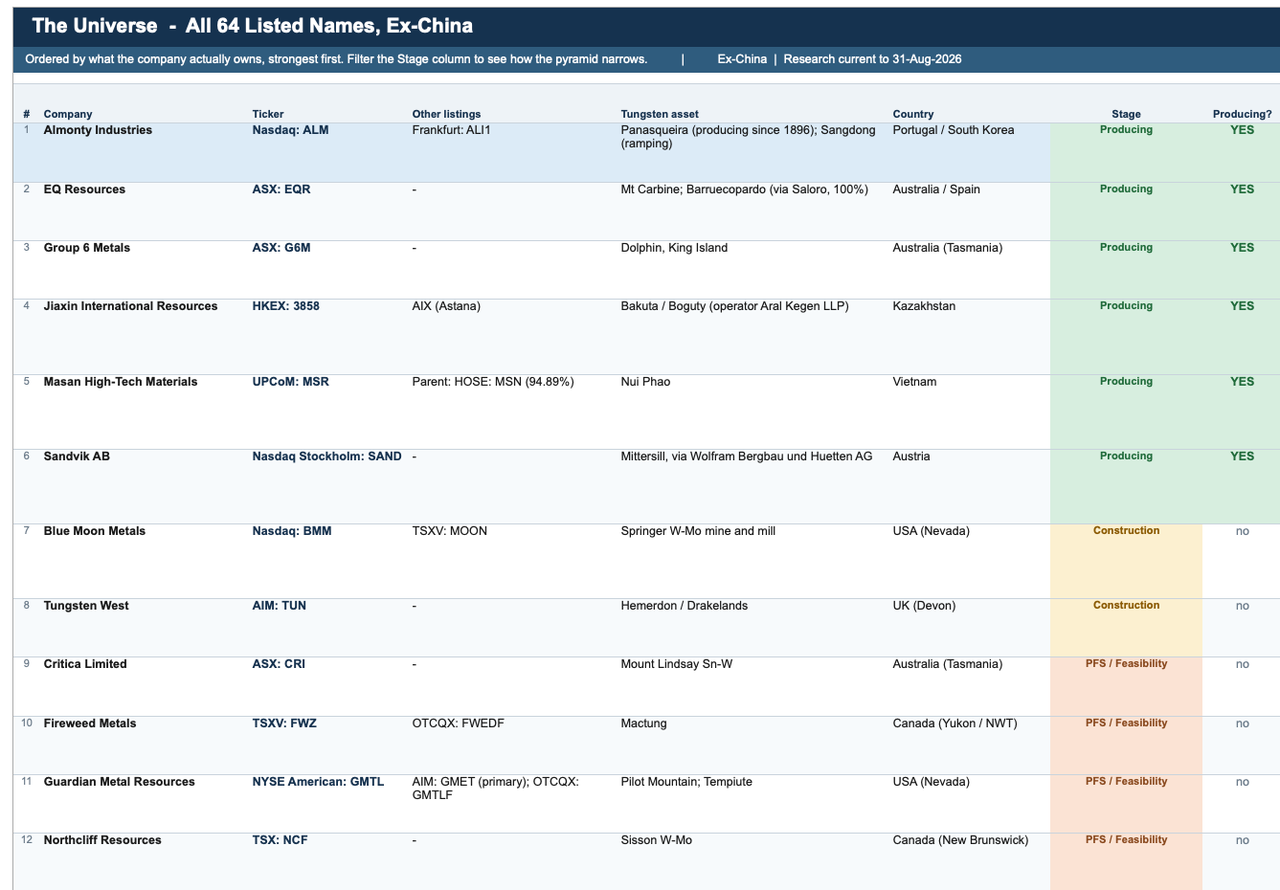
Almonty is one of the handful of pure-play publicly traded miners positioned for the accelerating decoupling from Chinese critical materials . Among all publicly traded global tungsten miners, it’s the only US-listed producer.
Any post-Trump-Xi summit escalation next month, including potential sanctions against Chinese banks (Politico warns), could trigger further metal restrictions and sharply increase the value of tungsten currently priced above $3,000 a ton.
That makes Almonty more than a tungsten trade.
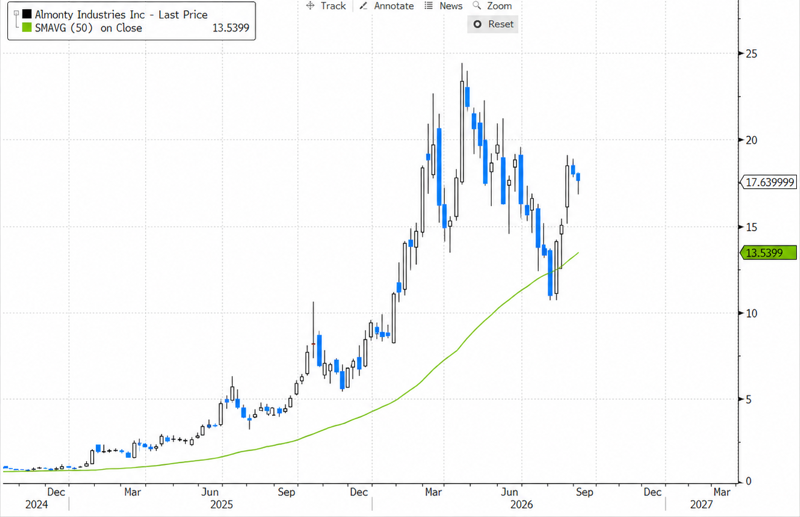
Almonty is a pure-play bet on the West’s first real shot at breaking China’s 79% grip on mined tungsten before the rearmament cycle ramps up and before further possible export controls turn an already tight market into a severe shortage. Sangdong is already producing, Phase II begins next year, and the balance sheet is funded. This is a concentrated bet that one producer can help break Beijing’s grip and become the swing supplier the US and its allies can rely on.
And in a preview of what is to come, Jefferies just initiated coverage (full report available to pro subscribers) on Almonty today with a Buy rating and a $26.25 price target, more than 50% upside from today’s price.
Tyler Durden
Wed, 09/02/2026 – 12:40
ZeroHedge News
[crypto-donation-box type=”tabular” show-coin=”all”]