
The Air Force has pulled a piece of testing equipment for its Minuteman III intercontinental ballistic missiles after discovering some appeared to be contaminated with a possible carcinogen.
The order to stop using the AN/PRM-10 test oscillator set came after an Airman discovered polychlorinated biphenyl, or PCB, residue on one of the units during a routine inspection in August, Air Force Global Strike Command said in an Aug. 28 statement.
The Airman, who was at F.E. Warren Air Force Base, Wyo., reported the residue and received medical attention for the exposure before returning to duty, according to the statement
The EPA has concluded PCBs are a probable cause of cancer in humans, as well as having negative immune system, reproductive, developmental, and neurological effects. PCBs were regularly used in electrical, heat transfer, and hydraulic equipment for about 50 years due to the compound’s electrical insulating properties, high boiling point, and nonflammibility, until they were banned in 1979 as evidence grew that the compound was toxic to people and the environment.
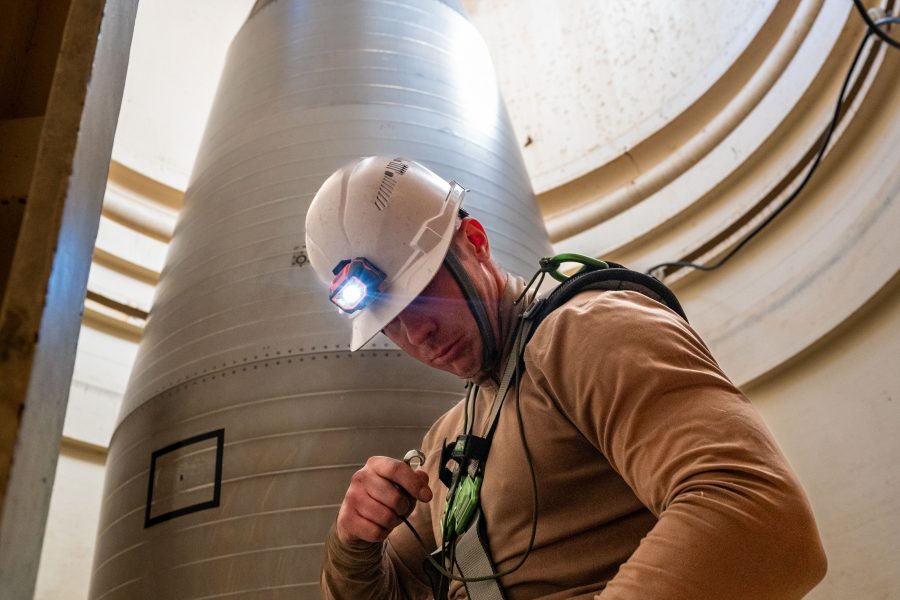
The AN/PRM-10 test oscillator set is a signal generator used to examine ICBM communications systems, per the Global Strike Command statement. After the Airman reported the issue and tests confirmed the presence of PCBs on that test unit, the 20th Air Force—which oversees ICBM bases—ordered all AN/PRM-10 kits be inspected.
That review of all AN/PRM-10 kits was done within three days, and officials found potential PCB residue on six of eight systems. Samples collected from those systems are now being tested. Officials also ordered safety warnings, precautions, and mandatory personal protective equipment requirements be updated where other legacy test units are still used.
But all AN/PRM-10 systems have been pulled from use in the 20th, and units are transitioning to a modern replacement tester that is free of PCBs, Air Force Global Strike Command said. Leaders are working with the Minuteman III systems program office to dispose of any existing AN/PRM-10 kits and identify any other test equipment pieces that may have PCBs.
The “20th Air Force takes the responsibility to protect our Airmen very seriously,” Commander Maj. Gen. Colin Connor said in a statement. “As our Airmen are our greatest asset, their safety and health are my top priority.”
Concerns about rates of cancer among missileers and other Airmen who work with ICBMs has grown in recent years. In 2023, the Air Force launched a study dubbed the Missile Community Cancer Study to review the possibility of clusters of non-Hodgkin’s lymphoma at ICBM bases, as well as other specific cancer concerns raised by the community.
The Torchlight Initiative, an organization made up of current and former ICBM community members and their families that pushes the government to address higher rates of cancer and other illnesses among ICBM airmen, called the swift removal of those units “a great start.” But more work remains to be done, the organization said on social media.
“We need to create a culture where Airmen recognize hazards, speak up, and leaders respond—making the mission safer for those serving today and tomorrow,” Torchlight said in a post on LinkedIn.
Torchlight Initiative public affairs director Erin Dick said in an interview with Air & Space Forces Magazine that while it was encouraging the Airman in this situation knew enough to recognize the potential PCB exposure and say something, it is concerning to think of how many Airmen may have used such contaminated equipment over the decades before PCB hazards were fully known.
Dick said the Air Force should work to determine how widespread potential exposures were, identify and document anyone who may have been exposed, and make sure their health is monitored over the long term, potentially including screenings.
The Air Force said in its release that the Airman in this incident returned to duty “with no adverse effects.” But Dick said it could be too soon to make that conclusion.
“It’s really not possible to say, because of the way these chemicals work, if there will be long-term health effects for this particular Airman,” Dick said. “There is often a very long latency period before illnesses appear. But at least now he’s got [PCB exposure] documented, and that is something we’re trying to encourage all people who are currently serving [and those who previously served] in the community to make sure that their service is documented.”
Retired Air Force Col. Jennifer Reeves, a former commander of the 341st Missile Wing at Malmstrom Air Force Base, Mont., told Air & Space Forces Magazine the recent discovery of PCBs underscores how important it is for the Air Force to remain vigilant against these kind of contaminants.
As part of the Missile Community Cancer Study, the Air Force in 2023 took air and swipe samples from all three of its active ICBM bases: Malmstrom, F.E. Warren, and Minot Air Force Base, N.D. The swipe tests involve gauze wetted with a solution run over surfaces and then analyzed for suspected contaminants. The tests showed a few samples with elevated PCB levels at Minot and Malmstrom, while F.E. Warren had trace amounts not in excess of the EPA’s acceptable limit.
“Typically the command has been actually pretty good, once [PCBs have] been found, about dealing with them,” Reeves, now a senior resident fellow for space studies at AFA’s Mitchell Institute for Aerospace Studies, said. “It’s really old stuff from back when we really weren’t tracking major chemicals and other things that are not good for humans. So now it’s about how well the command can react when things like this are found.”
Reeves said that because ICBMs still use many components from the years before PCBs were banned, the chemicals may still be out there in facilities. It’s crucial for the Air Force to keep looking for PCBs, she said, and the service needs to keep track and follow up with Airmen who may have come down with unusual conditions.
Air Force Global Strike Command also needs to come up with a way to go through its legacy equipment systematically and test them for PCBs, to make sure more potentially harmful gear isn’t out there, she said.
“The bigger context is not, ‘we found an isolated thing’” contaminated with PCBs, Reeves said. “This may be building a bigger picture that we may not yet be fully witting of.”
The post Air Force Pulls ICBM Testing Device After Finding Likely Carcinogen appeared first on Air & Space Forces Magazine.
Nuclear, Personnel, AFGSC, Air Force, Air Force Global Strike Command, F.E. Warren Air Force Base, ICBM Cancer, Malmstrom Air Force Base, Minot Air Force Base, Minuteman III, Missile Community Cancer Study
Air & Space Forces Magazine
[crypto-donation-box type=”tabular” show-coin=”all”]