 Tyler Durden
The ‘Daejon Love’ Stock Market
Submitted by QTR’s Fringe Finance
Words cannot do justice to the sheer idiocy of the story that broke this past week. It is hilarious, depressing, fascinating and deeply embarrassing for the human race all at once…a story that is proof that we may collectively be both far more gullible and far more comfortable with deception than even the most cynical among us previously imagined.
The story centers on a man named Daejon Love who, according to federal prosecutors, allegedly spent years convincing women that he was a professional football player for the San Francisco 49ers when he wasn’t.
Not trying out for the 49ers. Not once affiliated with the team. Not played professionally somewhere else and exaggerated the details. He convinced women that he was an actual NFL player for one of the most famous franchises in American sports when we wasn’t.
Yes. You read that right. In an era in which the entirety of all human knowledge is accessible from a 6 inch by 2 inch rectangle sitting in literally everyone’s front pocket, this 35 year old allegedly constructed an elaborate fictional life around himself that everyone believed and no one took the time to fact check. He did it by, among other things, carrying a 49ers helmet and gear around with him and wearing them…no matter how absolutely f*cking ridiculous it looked…all the time.
He even had a 49ers birthday cake made with his name on it and apparently created a video of himself “signing” with the team. He carried the helmet everywhere, including to the beach, where he filmed himself running some of the worst wide receiver routes ever captured on camera while some rando with a vermicelli noodle for an arm underthrew him passes as he lumbered around full sized telephone company construction cones set up on a beach.
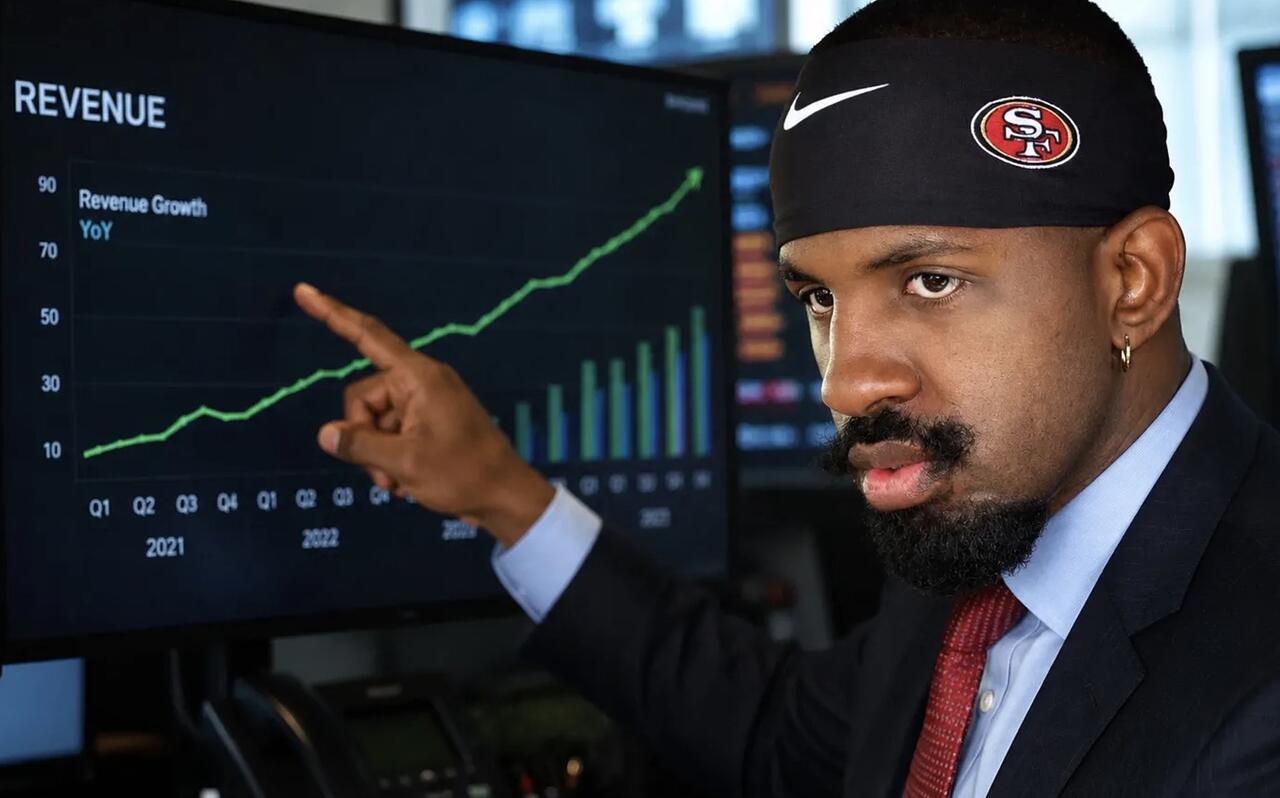
Eventually, according to reporting on the FBI investigation, Love’s fake online footprint became convincing enough that search engines and artificial intelligence occasionally helped perpetuate it. AI started listing him as a professional NFL wide receiver when he wasn’t.
I couldn’t help but read the story yesterday and realize it is a perfect analogue to our modern stock market. You don’t have to be an actual NFL player anymore. You just need the helmet, the jersey, some followers, a few pictures standing next to expensive shit and enough people repeating the story. Eventually an algorithm looks around, sees that everybody else appears to believe you’re an NFL player and concludes that you must, in fact, be an NFL player.
But there’s also a growing number of Daejon Love companies in today’s market, because somewhere along the way Wall Street decided that actually turning a profit no longer mattered. If Jerry Rice is a fat free cash flow yield, Daejon Love is the 10-K of a company posting massive losses while pointing to its revenue, narrative and bullshit future projections instead of its net income and capital needs.
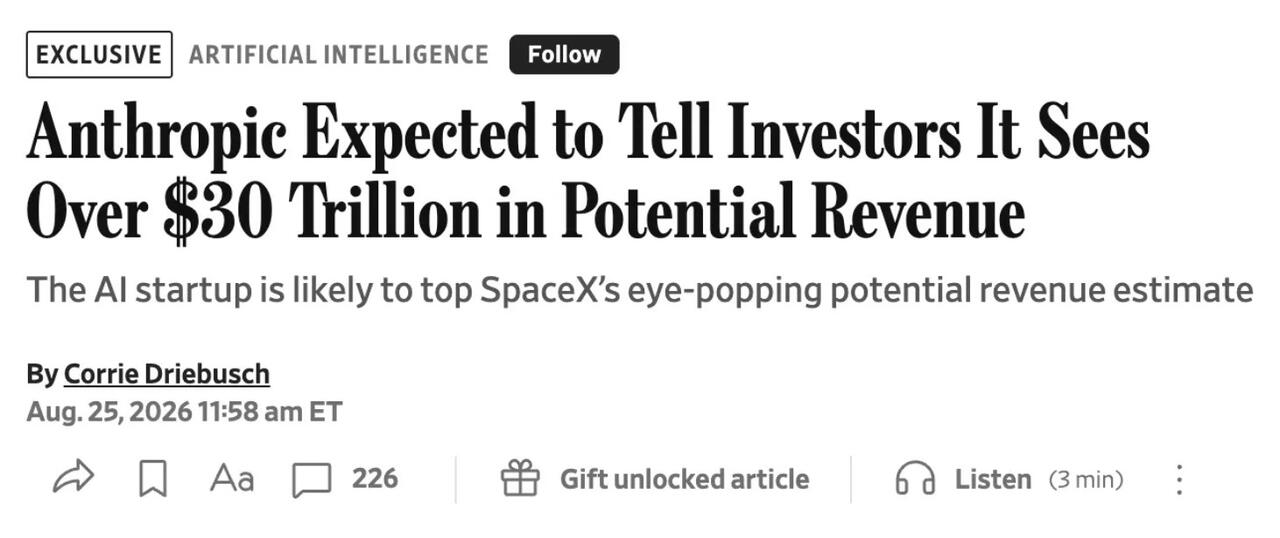
Nowadays, revenue can be projected decades years into the future and slapped with a multiple that would have gotten you involuntarily committed in 1995.
Revenue projections are faking you’re an NFL player when you’re not. Like with Daejon, narratives get you “investors”. If you’re a 35 year old dipshit pretending to be someone else with all your free time instead of working an actual job for a living, revenue projections get you laid under false pretenses by women who’d never want to talk to you otherwise.
Net income, on the other hand, is terribly inconvenient. The line of thirsty women dries up quick when it comes down to profit and loss. The second that reality starts inching into the picture, you become the guy no one can stand or wants to talk to.
The modern market would much rather hear that revenue grew 48% than that you lost $2 billion last year.
Nowadays, when investors ask, “Did the company actually make any money?” analysts respond, “Why are you being so negative? Revenue grew 48%!”
When investors ask, “Okay, but did free cash flow grow?” analysts respond, “You’re missing the opportunity. Revenue grew 48%.”
When investors ask, “How much capital expenditure did it take to generate that growth?” analysts respond, exasperated, “This guy just doesn’t understand AI. Revenue. Grew. 48%.”
This is essentially the Daejon Love method of equity valuation: don’t ask whether I play for the 49ers. Just look at my helmet.
Federal prosecutors say Love and his alleged accomplice, Taylor Jamie Chan, built an elaborate system designed to convince women that Love was extraordinarily wealthy. Fake investment accounts were allegedly displayed. Chan allegedly played the role of Love’s successful financial adviser. Three way FaceTime calls reportedly showed supposed investment gains. The government says at least 26 women ultimately sent approximately $1.3 million.

The appearance of wealth established credibility. Credibility attracted money. The incoming money helped finance the appearance of wealth. That appearance attracted additional money. Every additional participant therefore helped validate the story for the next participant. Daejon invented the public relations department of a Ponzi scheme.
The stock market has developed its own similar loop. A company projects enormous future revenue, investors bid up the stock, and the higher valuation gives the company access to more capital. It raises money, makes acquisitions, increases spending, and uses its expensive stock as currency to generate the growth needed to justify its valuation. That growth pushes the valuation higher, allowing the cycle to repeat. In effect, the company is trying to grow into a valuation that is itself financing the growth. It works until the market stops providing cheap capital, the promised cash flows fail to materialize, and the entire loop begins to reverse.
This is when everyone in the world discovers you don’t play for the 49ers.
This is what makes the Love story such a wonderful metaphor. Again, Love’s fabricated internet presence became substantial enough that Google searches and AI generated results occasionally identified him as an actual 49ers player. The internet had effectively begun marking his bullshit to market. He could point toward the search result and say, effectively, don’t take my word for it. Google says I’m an NFL player.
Wall Street does this every day. Don’t believe the narrative? Look at the stock price. Don’t believe the stock price? Look at the market capitalization. Don’t believe the market capitalization? Look at the revenue growth. Don’t believe the revenue growth? Look at total addressable market. Don’t believe total addressable market? Look at the analyst price targets.
Why did the analysts raise their price targets? Because the stock price went up. Excellent. Due diligence complete. Look at the f*cking helmet.
Then, at some point nobody remembers which piece of evidence was originally supposed to independently validate which other piece of evidence. The machine is simply validating itself.
This isn’t entirely irrational. Rapidly growing companies should often prioritize expansion over maximizing near term profits. Amazon famously spent years reinvesting enormous amounts of money into its business. Many of the greatest companies in history would have been badly misunderstood if investors had looked exclusively at current year earnings.
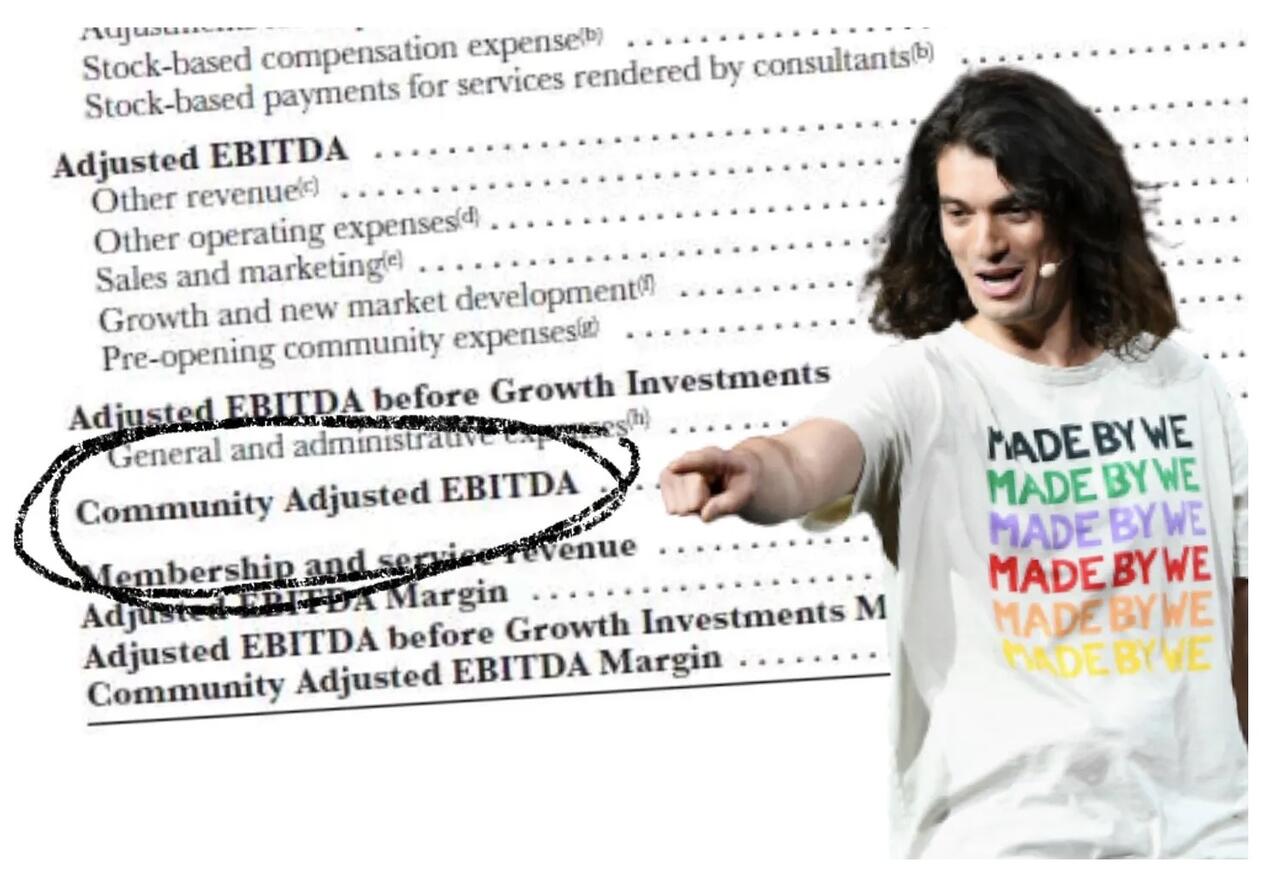
But Wall Street has taken a reasonable idea and, as Wall Street tends to do, driven it directly through the guardrail. Remember WeWork’s “Community Adjusted EBITDA”?
We have entered an environment where investors can seemingly forgive almost anything if the revenue chart points northeast. No profits? Growth company. Negative free cash flow? Investing for the future. Massive stock based compensation? Noncash expense. Enormous capital expenditures? Building the infrastructure for the future. Constant dilution? Funding growth. Acquisition spending? Expanding the platform. Adjusted EBITDA? Now we’re talking.
This becomes especially entertaining when discussing AI. The AI revolution is real. The demand is real. The infrastructure buildout is real. The revenues are real. And some of the companies supplying the boom are producing extraordinary amounts of actual free cash flow and net income.
But the market doesn’t stop with those companies. It takes the legitimate economics at the center of the boom and radiates them outward. The chip company makes enormous profits, therefore the data center company deserves a giant multiple. The data center company is growing rapidly, therefore the electricity provider deserves an AI premium. The electricity provider needs generation, therefore nuclear is an AI trade. Nuclear needs uranium, therefore uranium is an AI trade. Data centers need cooling, so cooling is an AI trade. They need copper, so copper is an AI trade. They need buildings, so buildings are an AI trade. They need financing, so private credit is an AI trade.
Eventually the non-English speaking man on an e-bike from Senegal delivering the DoorDash lunch to another man responsible for emptying the portable shitters at the construction site of a data center will soon trade at 28x revenue himself…because he has “exposure to the AI infrastructure ecosystem.” This is how things lead up to a crash.
🔥 85% OFF IF YOU SUBSCRIBE TODAY: Anyone who becomes a paid annual subscriber to Fringe Finance today gets 85% off a subscription — a discount they can keep for as long as they wish to remain a subscriber: Get 85% off forever
Once the narrative attaches itself to a company, investors begin valuing revenue differently. Revenue is where imagination lives. Net income is where imagination goes to die. Free cash flow is worse because it asks the deeply antisocial question of whether shareholders will ever actually receive any money.
You can build magnificent valuation models when you don’t concern yourself with that detail. Take a company with $1 billion in revenue. Assume the addressable market is $100 billion. Assume it captures 20% of that market. Assume 30% margins once it reaches scale. Assume the market continues paying a premium multiple in 2032. Discount everything back using whatever rate produces the number you wanted before opening Excel. Congratulations. Your $15 billion company is worth $60 billion.
Valuation increasingly seems to work the same way. A company worth $20 billion can look speculative. At $50 billion, it becomes interesting. At $100 billion, institutions start paying attention. At $250 billion, analysts explain why it has a defensible moat. At $500 billion, portfolio managers explain why they have to own it. At $1 trillion, CNBC installs a permanent camera outside headquarters. At $2 trillion, somebody explains that you’re thinking too small. At $4 trillion, the valuation itself becomes part of the bull case. Obviously the market wouldn’t value it at $4 trillion if it weren’t worth $4 trillion. Right?
Price creates legitimacy. Legitimacy attracts capital. Capital pushes up price. Price creates more legitimacy. It’s the custom 49ers helmet of finance.
And if the stock gets there before the earnings do, simply extend the forecast another five years. Again: look at the jersey. Don’t ask who’s wearing it.
But when someone asks Daejon to suit up on Sunday? That’s where things get interesting. And that day is coming for the market and AI eventually…
—
QTR’s Disclaimer: Please read my full legal disclaimer on my About page here. This post represents my opinions only. In addition, please understand I am an idiot and often get things wrong and lose money. I may own or transact in any names mentioned in this piece at any time without warning. Contributor posts and aggregated posts have been hand selected by me, have not been fact checked and are the opinions of their authors. They are either submitted to QTR by their author, reprinted under a Creative Commons license with my best effort to uphold what the license asks, or with the permission of the author. I cannot guarantee the accuracy of all facts and figures included in this article though I made my best effort to get them right. I have been wrong before and will be wrong again, and encourage you to always double check, do your own research and speak to a licensed financial professional.
This is not a recommendation to buy or sell any stocks or securities, just my opinions. I often lose money on positions I trade/invest in. I may add any name mentioned in this article and sell any name mentioned in this piece at any time, without further warning. None of this is a solicitation to buy or sell securities. I may or may not own names I write about and are watching. Sometimes I’m bullish without owning things, sometimes I’m bearish and do own things. Just assume my positions could be exactly the opposite of what you think they are just in case. If I’m long I could quickly be short and vice versa. I won’t update my positions.
As of May 20, 2026 I am attempting to no longer actively trade as much as I once did (read my story here). My eventual goal is for investing/saving to be mostly done by recurring contributions mostly to sector ETFs and a few select equities, trusted third parties who oversee my accounts, and advisors. Such advisors or funds, through individual equities, options, index funds, mutual funds, ETFs, or other securities, may have positions in, exposure to, or holdings of names mentioned herein that I know nothing about. Basically, via index funds, ETFs and individual equities it is possible I could own, have exposure to, or not own anything at any point. As of the same date, May 20, 2026, in an attempt to lead a healthier lifestyle, I’ve also excluded myself from fantasy sports, sports betting, online and in-person casinos and prediction markets.
And all positions can change immediately as soon as I publish this, with or without notice and at any point I can be long, short or neutral on any position. You are on your own. Do not make decisions based on my blog. I exist on the fringe. If you see numbers and calculations of any sort, assume they are wrong and double check them. I failed Algebra in 8th grade and topped off my high school math accolades by getting a D- in remedial Calculus my senior year, before becoming an English major in college so I could bullshit my way through things easier.
The publisher does not guarantee the accuracy or completeness of the information provided in this page. These are not the opinions of any of my employers, partners, or associates. I did my best to be honest about my disclosures but can’t guarantee I am right; I write these posts after a couple beers sometimes. I edit after my posts are published because I’m impatient and lazy, so if you see a typo, check back in a half hour. Also, I just straight up get shit wrong a lot. I mention it twice because it’s that important.
Tyler Durden
Mon, 08/31/2026 – 11:40
ZeroHedge News
[crypto-donation-box type=”tabular” show-coin=”all”]