
A new Navy missile could fill a long-range air-to-air need for the U.S. Air Force’s fourth-, fifth-, and sixth-generation fighters.
The Navy’s portfolio acquisition executive for munitions posted information on the AIM-424 Long Range Air-to-Air Missile online on Aug. 22, the same day it unveiled the project at the service’s annual Tailhook Symposium in Reno, Nev.
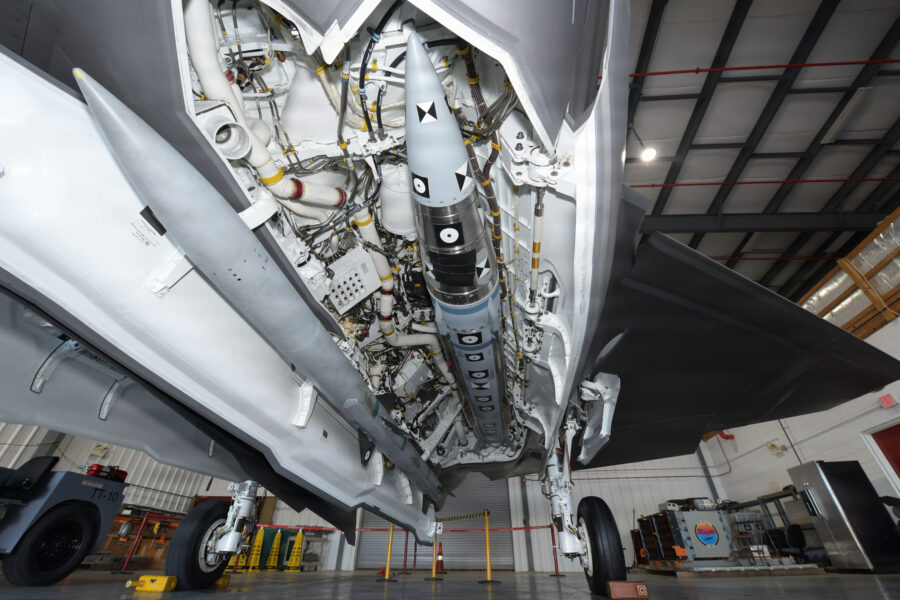
The Raytheon missile is geared for Marine and Naval aviators’ fighter platforms, from the Boeing F/A-18 Super Hornet to the Lockheed Martin F-35 Lightning II, with a range “in excess of 250 nautical miles.”
“Also known as Malice, the LRAAM directly supports the Department’s contribution to integrated deterrence by increasing range, lethality, and combat effectiveness for Marine and Naval Aviation forces that are defending our fleets, our interests, and our homeland,” according to a Navy statement emailed to media. “Further details regarding specific capabilities and deployment timelines remain classified to protect operational security.”
Malice’s advertised range is well more than that of the Lockheed Martin AIM-260 Joint Advanced Tactical Missile, said to be beyond 120 miles, and the Raytheon AIM-120D Advanced Medium-Range Air-to-Air Missile, around 100 nautical miles. The Air Force is taking the lead in developing JATM for itself and the Navy.
“With increased range, lethality, and combat effectiveness for naval forces, the AIM-424 delivers a generational leap in long range air-to-air combat capability that can out range any threat,” Phil Jasper, president of Raytheon, said in an email statement.
Malice Data
- Contractor: Raytheon
- Propulsion: Solid-propellant rocket motor
- Length: 13.5 feet
- Diameter: 13.5 inches
- Wingspan: 26.2 inches
- Weight: 1,500 pounds
- Range: In excess of 250 nm
- Warhead: Blast fragmentation
Source: Navy
But while Malice represents a major increase in range over current missile programs, it falls short more ambitious efforts early in development like the Air Force Long Range Weapon, which seeks distances of more than 1,000 nautical miles. The Air Force first revealed plans for the AFLRW in June.
“The Air Force is closely following the progress of the Navy on the AIM-424 Long Range Air-to-Air Missile Program,” an Air Force spokesperson told Air & Space Forces Magazine on Aug. 24. The spokesperson declined to answer additional questions.
The two services often partner on missiles for their aircraft, such as JATM, AMRAAM, and the AIM-9X Sidewinder.
“The Navy and Air Force have different operational requirements, but in areas such as fighter-launched offensive weapons, each can benefit from the other’s technological advances, testing, and development,” said retired Air Force Col. John “JV” Venable, senior resident fellow at the Mitchell Institute for Aerospace Studies. “Malice appears to be another example of how parallel efforts can accelerate capability and produce benefits across the Joint Force.”
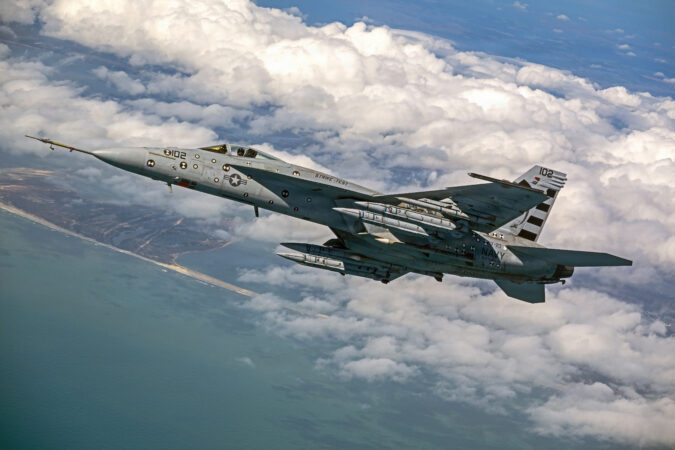
The Navy has also developed the AIM-174B Gunslinger, which has a range of 150-200 nautical miles, but that missile won’t fit in the internal weapon bays of the F-35 and F-22, limiting its usefulness to the Air Force.
The new Malice missile, on the other hand, is meant to go a wide range of aircraft, including sixth-gen fighters like the Navy’s not-yet-named F/A-XX and the Air Force’s parallel project, the Boeing F-47.
“The long-range missile fight is much like a jousting contest: the fighter with the longer lance has a major advantage,” said Venable, a former F-16 pilot and commander. “Chinese beyond-visual-range missiles are assessed to outrange many current U.S. weapons, potentially giving Chinese fighters the opportunity to shoot first by dozens of miles.”
The Malice missile would “extend U.S. engagement range, improve first-shot opportunities, and help restore our tactical advantage against peer adversaries,” he said.
Beyond the tactical level, Venable noted, having a missile like Malice in the fighter community’s quiver would give commanders greater flexibility in operational planning and offset numerical disparity with a potential peer fight.
“The People’s Liberation Army Air Force (PLAAF) already holds a significant advantage in the numbers of fighters it can generate over Taiwan compared with the U.S. and allied forces,” he said. “We need every technological advantage available to offset that numerical disparity.
Roots
Aviation Week reported that Malice has a two-stage design—reminiscent of a decade-old program known as the Long Range Engagement Weapon, developed in the mid-2010s under then-Secretary of Defense Ash Carter.
Flight Global reported at the time the LREW effort was also a two-stage design that would eventually transition to multiple services. The Air Force was known to be working on the weapon while also developing the JATM – both efforts sought to replace the decades-old AMRAAM, which debuted in the mid-1980s.
The JATM is seen as a direct replacement for fighters to carry instead of the AMRAAM. But the LREW’s two-stage design promised a far greater range.
The post Air Force ‘Closely Following’ Navy’s New Long-Range Air-to-Air ‘Malice’ Missile appeared first on Air & Space Forces Magazine.
Air, Air Force missiles, Air Force munitions, air-to-air missiles, Malice, Navy
Air & Space Forces Magazine
[crypto-donation-box type=”tabular” show-coin=”all”]