Tyler Durden
Iran Oil Exports Plunge To Four Year Low As Blockade Tightens, While Inflation Soars To World War 2 Levels
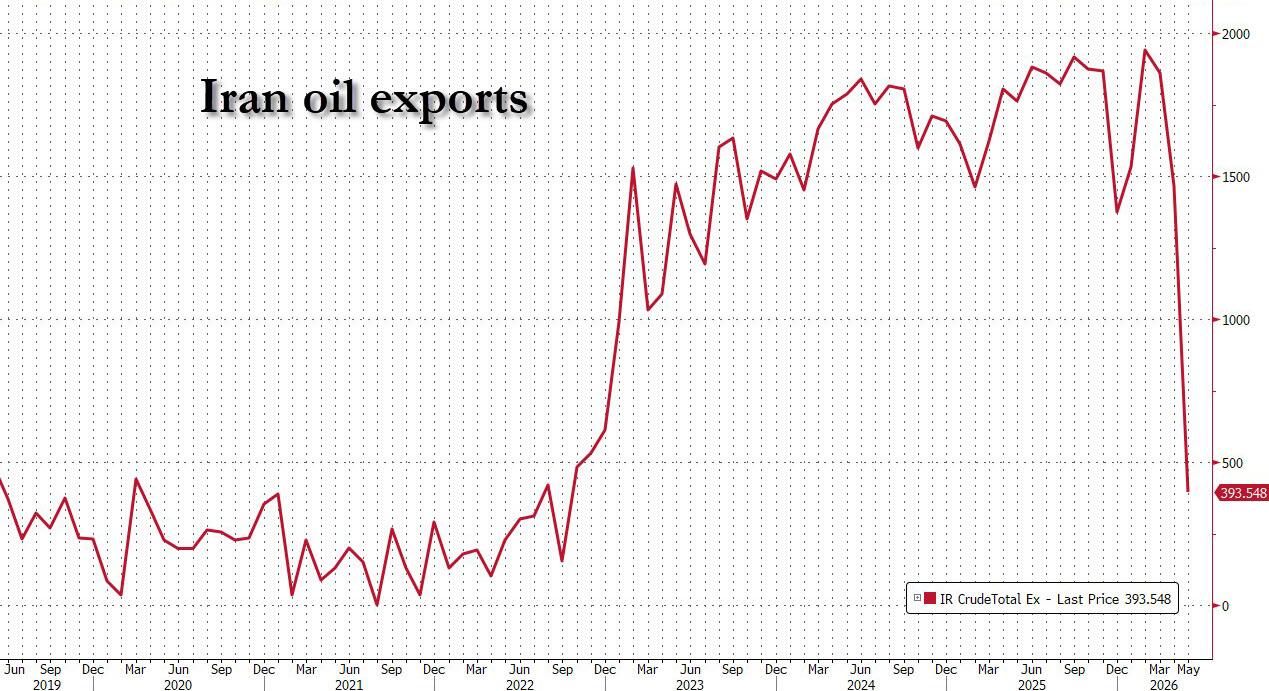
If it was indeed Trump’s intention to starve Iran’s economy of oil export revenue, the plan may just be working: Iran’s oil exports fell to their lowest level in at least six years in May as the US naval blockade has succeeded in choking off crude shipments and leave tens of millions of barrels stranded at sea.
According to shipping data from Vortexa, Iran exported just 209,000 barrels per day of crude oil and condensate in May, down from 1.34 million bpd in April and nearly 1.9 million bpd in March. Kpler had estimated May exports slightly higher at 260,000 bpd, but still the lowest level since the height of the Trump administration’s “maximum pressure” campaign in 2019-2020.
When the blockade first took effect in April, analysts expected Tehran to lean on floating storage while waiting for an opportunity to move barrels, which it did with ease as it had control of the strait thanks to its own blockade (much to our surprise, as we asked back in early March why the US didn’t do the same). But storage is no longer growing. According to Kpler, floating inventories have fallen from roughly 190 million barrels in late April to about 147 million barrels today as cargoes continue trickling into China and production slows.
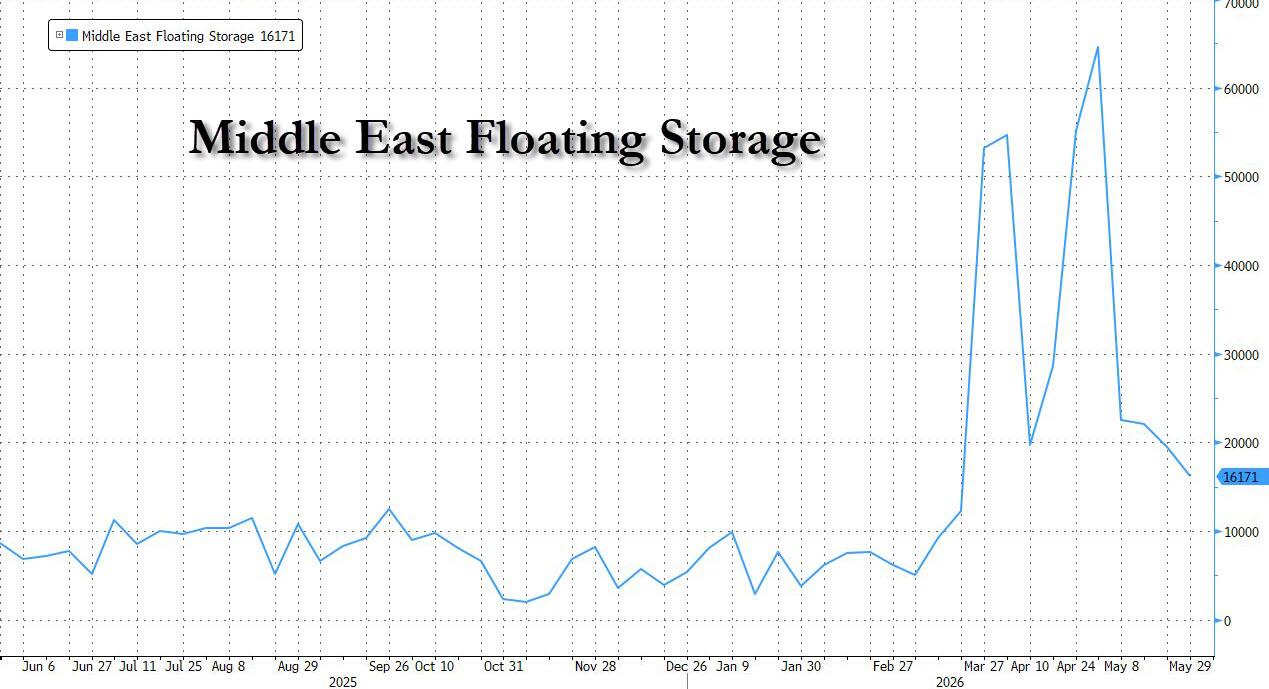
Meanwhile, another problem for Tehran is that China’s appetite for oil is not only not growing, it is crashing just as Iran needs buyers most (see “Traders Puzzled As Physical Oil Prices Tumble Amid Surging Chinese Crude Sales, Plunging Imports“).
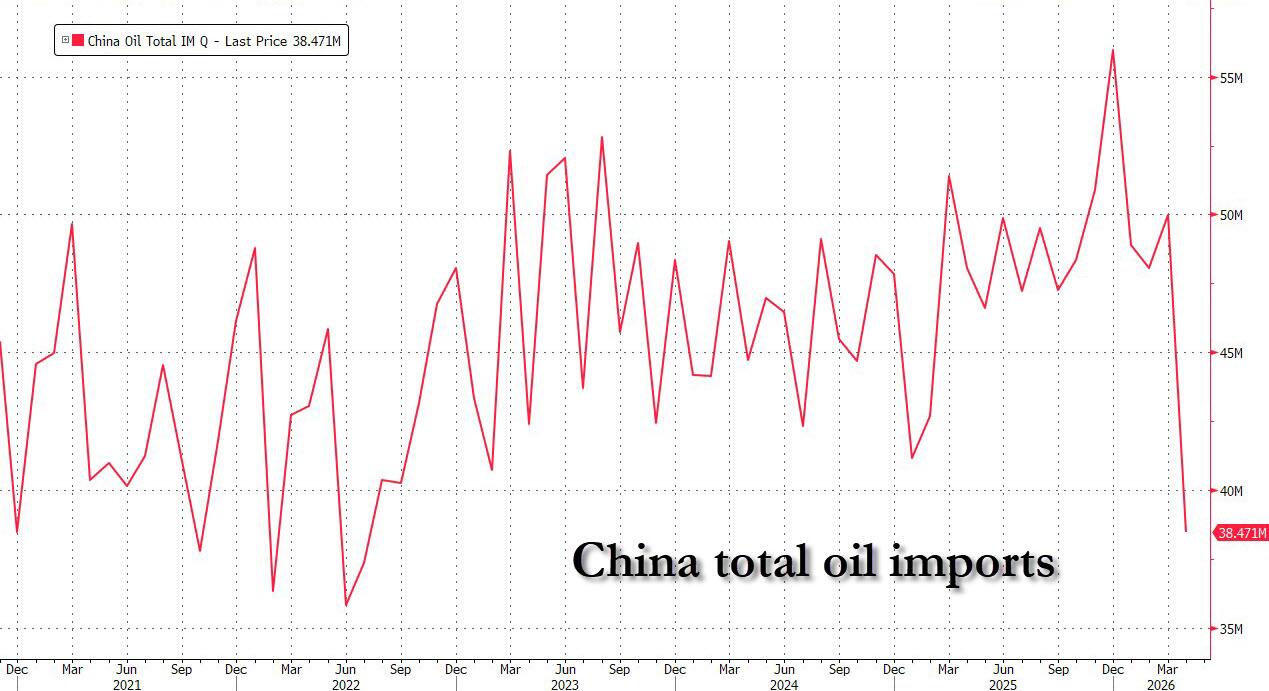
Independent Chinese refiners have begun cutting processing rates amid weak margins and comfortable fuel inventories, reducing demand for sanctioned barrels.
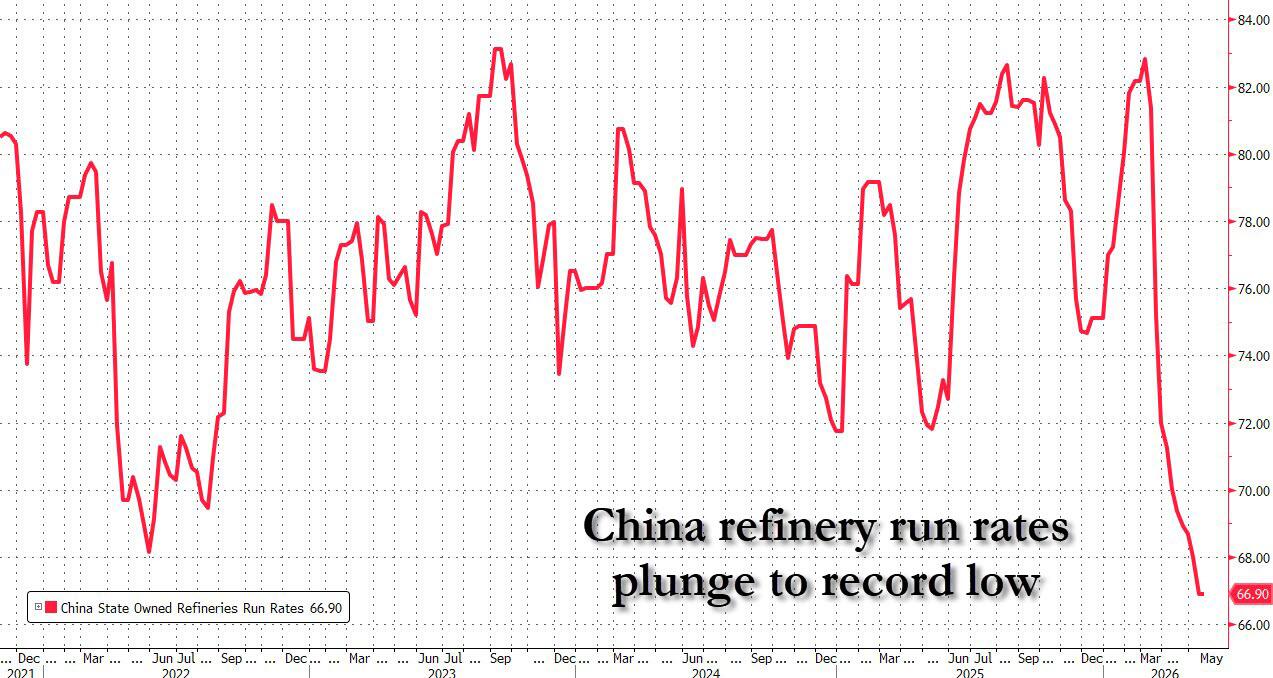
That shift has already pushed Iranian Light crude from a premium to a discount. As Reuters notes, plunging demand from Iran’s top crude buyer, China, has dragged Iranian flagship oil prices into discounts to ICE Brent for the first time in two months, trade sources told Reuters on Thursday, noting that Iranian Light crude is offered at discounts ranging from $0.50 to $1 per barrel to ICE Brent for delivery in June into the province of Shandong, the home of the teapots. As recently as a month ago, Iranian Light cargoes were sold at premiums of $1–2 per barrel over ICE Brent in April and May.
Meanwhile, roughly 67 million barrels of Iranian crude and condensate remain stranded inside the Gulf and Gulf of Oman, according to Kpler estimates.
Worse, analysts say time may be running short. Kpler’s Homayoun Falakshahi warned that if the blockade remains in place for another two months, Iran could effectively run out of available oil to ship to China.
The market implications extend beyond Iran. Every barrel removed from export markets tightens an already strained global supply picture at a time when Middle East disruptions have already slashed regional exports. For now, fewer tankers leaving Iran means fewer barrels reaching buyers. Eventually, it will mean fewer barrels being produced.
But the implications certainly also impact Iran, whose economy is now imploding, as a decline of 1 million barrels from the 1.3 million April daily average translates into a roughly $80 million drop in export revenues per day, or $2.5 billion per month, which Iran’s IRGC leadership no longer collects to control the population and the local army.
As a result, inflation in Iran reached a level in May unseen since World War II, underlining the economic pain average Iranians face as the Islamic Republic worries about the war with Israel and the United States restarting.
A report Monday by Iran’s Central Bank represents the first official acknowledgment of what Iranians shopping, paying for a taxi or visiting a medical clinic already know: The rial currency is being crushed by the war and uncertainty around it resuming.
Iran’s Central Bank said the consumer price index reached 77.2% in May compared to the year before. It added the rate is 8.5% higher than in April. Inflation in daily and general needs – like medicine, taxi fares, tobacco and communication fees – rose 113.8% from the year before. May as well call it hyperinflation: the rial, which traded at 32,000 to $1 in 2015, now trades at over 1.7 million to $1.
“We will definitely have higher prices,” Iranian President Masoud Pezeshkian warned in May. “We are fighting and we must accept this hardship.”
Iran only saw worse inflation in 1942 during World War II, sparked by the British and Soviets invading the country and taking over its railway, disrupting food supplies. The lack of food, worsened by a poor harvest, sparked hyperinflation and a famine. Hunger and a typhus outbreak killed many.
A private economic think tank in Iran, the Bamdad Institute of Economic Studies, described the current figures as “an unprecedented rate since World War II.” Iran’s Central Bank did not acknowledge the significance of the figures.
Which begs the question: is Iran about to have another round of violent protests? In 2017 into 2018, soaring food prices sparked demonstrations that killed over 20 people and saw hundreds arrested. An increase in government-subsidized gasoline prices caused protests that saw over 300 people reportedly killed.
Then came the protests over the rial at the start of this year, the most intense demonstrations to shake the Islamic Republic since its 1979 revolution and chaotic years that followed.
Tehran-based economist Saeed Leilaz, speaking to The Associated Press, warned that annual inflation in Iran could reach 80%.
“Iran’s society cannot tolerate above 25%” annual inflation, he warned.
Tyler Durden
Fri, 06/05/2026 – 09:45
ZeroHedge News
[crypto-donation-box type=”tabular” show-coin=”all”]