Editor’s Note: This is the first in a two-part series on Air Education & Training Command’s new aircraft simulators. Part 2, on the T-7 Ground-Based Training System, will publish next week.
JOINT BASE SAN ANTONIO-RANDOLPH, Texas—Lt. Col. Seth Hoffman still has the poster in his office, the same one thousands of Air Force pilots received as they learned their craft, showing all the switches, gauges, handles, and knobs in the T-38 cockpit.
The poster was a learning aid, Hoffman explained. “You were supposed to just glue the poster to the wall, grab your folding chair, sit there and pretend to push buttons or interact with things throughout the mission.”
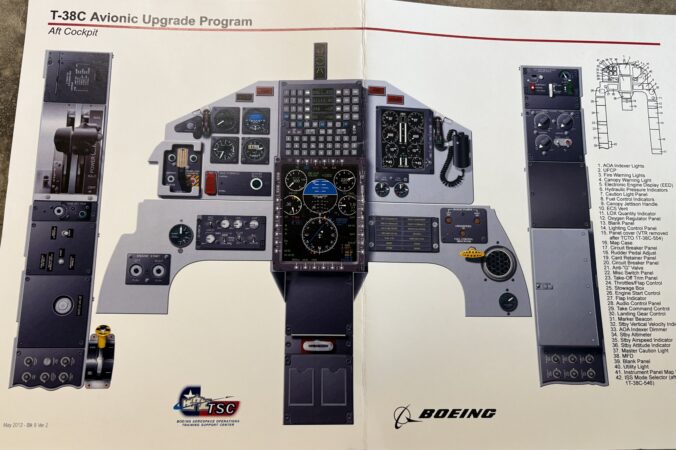
“Chair flying,” as the practice is called, is just one of the ways officials have tried over more than a century of military aviation to get pilots more training on the ground. From the Link Trainers made famous in World War II to early computer technology introduced in the 1960s and ’70s, the Air Force has added more and more technology and realism into its simulators.
At Air Education & Training Command’s Detachment 24, rethinking how new pilots get their start is the name of the game. Det 24 is working on screens that can wrap all the way around trainees, and cockpit “sleds” featuring the same controls as real aircraft.
Early immersive trainers combined commercially available components and plywood structures; though better than “chair flying,” they were nothing like the real thing, Hoffman said. “This is like the Thrust Master 3000 or whatever that you can buy off the internet, buy off Amazon, and then plug in,” he explained to a visitor, tapping the throttle, joystick and a switchbox. “Generic—generic even to the point where you’re manipulating it yourself with a keyboard to start your profile, start your mission, end your mission and all of that stuff.”
AETC, aided by the Defense Innovation Unit, fielded more than 200 such devices across the pilot training enterprise.
Detachment 24 kept going. The next version added “cockpit-representative symbology,” Hoffman said—panels and switches more akin to what students would see in the actual jet. “If I don’t need to pay for them to develop me a rheostat for the lighting, then I’m not going to buy it for this,” he explained. “Because the whole thing is, we’re trying to find that nexus between cost and fidelity, so that we’re doing things as efficiently as we can.”
Now comes the next phase: Enchanced Immersive Training Devices. “We actually got to molding a T-38 stick,” Hoffman said. “We have the actual T-38 throttle and all of the switches necessary to do all of your bold face actions, so you can fully do all of your critical action emergency procedures training within this device.”
AETC has already ordered more than 30 of the eLTDs, which can be plugged into either 35-inch monitors or combined with headsets into a mixed-reality experience.
Next up: New “advanced visual systems,” providing student pilots with 360-degree video. This will enhance training because virtual reality headsets, while useful, fatigue students’ eyes in just “about 40 to 45 minutes.”
“The advanced visuals—how fast everything’s moving, all of that—what it’s doing to your eyes over the course of that 40 to 45 minutes, that gets to the part of the point of discomfort,” Hoffman said.
To do advanced maneuvering like fighter pilots require, something more was needed.
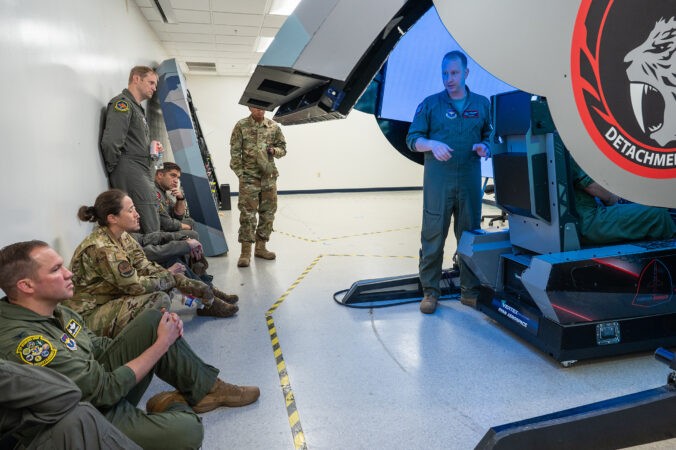
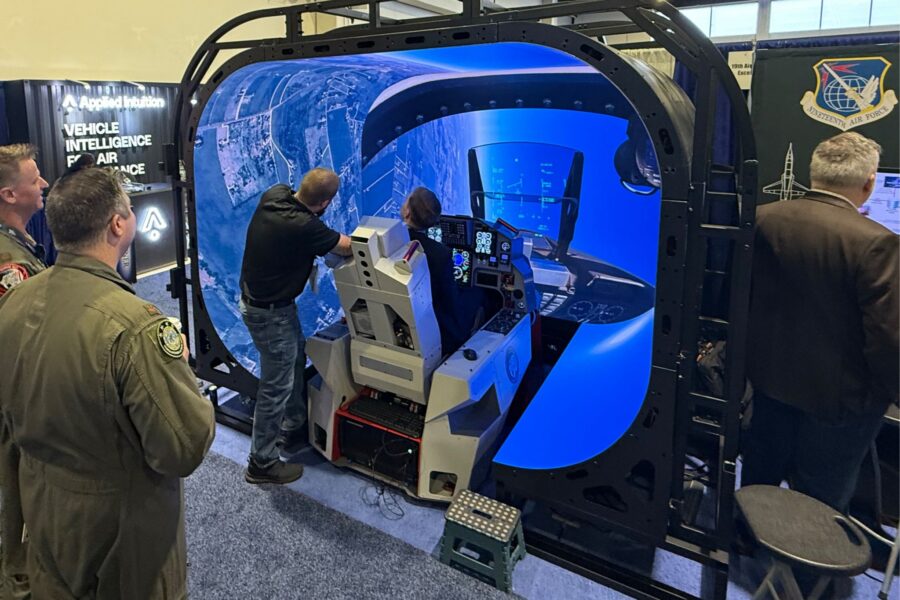
Like the ITDs, the visual systems have progressed over time. While previous versions didn’t let students see beneath or behind them and tried to mitigate issues of depth perception by using small panels around curves, the latest iteration is a full-fledged pod with curved LED screens that opens and shuts around the eITD to provide a 360-degree field of view.
The detachment has taken its new system on the road to AFA’s Air, Space & Cyber Conference, showing off the top-of-the-line system on the expo floor. Hoffman said his team is already working on a lighter version to take it to more external events.
Not every eITD will get an advanced visual system—the pods, built by Voltron Technologies, run $1 million apiece, so the cost of outfitting all 30-some is prohibitive for now, Hoffman said. Instead, a few of the pods will be used for simulating the most advanced maneuvers.
Yet even if the system is never adopted across the entire AETC enterprise, the development that went into it has inspired industry to up the training game, argued Hoffman: “We can sort of apply the pressure to move the contractors and industry to deliver the next best thing for what up-and-coming pilots need.”
AETC officials say one example of that is the new T-7 Red Hawk’s Ground-Based Training System. Like Detachment 24’s newest devices, it features a cockpit laid out and equipped identically to the real jet, with an immersive display that encases pilots within a 360-degree view.
Where the T-7 simulator goes a step further, though, is to integrate the simulators on the ground with jets in the air in a way the Air Force has never seen before, making moving from one to the other as seamless as possible.
Part 2 of this series, on the T-7 Ground-Based Training System, will publish next week.
The post AETC Preps Next-Gen Simulators for Future Pilots appeared first on Air & Space Forces Magazine.
Technology, Warfighter Training, AETC, Air Education & Training Command, Air Force simulators, aircraft simulators, Detachment 24, Simulation training
Air & Space Forces Magazine
[crypto-donation-box type=”tabular” show-coin=”all”]