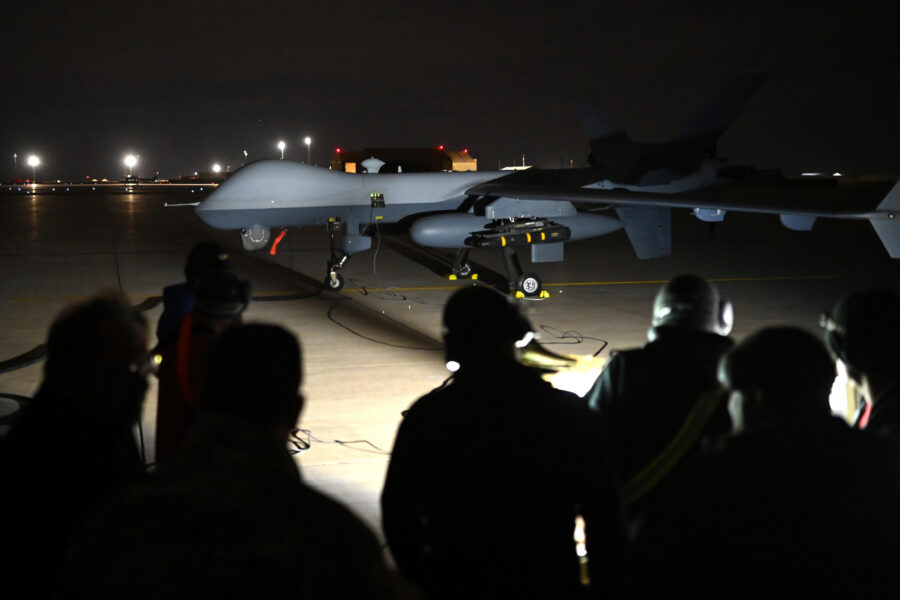
U.S. Air Force MQ-9 Reaper drones have been the standout platform in Operation Epic Fury against Iran, Chief of Staff Gen. Kenneth S. Wilsbach said May 20.
“For Epic Fury, perhaps the most valuable player was unmanned: the MQ-9,” Wilsbach told the House Armed Services Committee, responding to a question from Rep. Mike Rogers (R-Ala.) on the Air Force’s plans for future unmanned and autonomous systems.
It was a strong endorsement by Wilsbach, a career fighter pilot, for a platform the Air Force had been looking to retire in the coming years.
“The MQ-9 made many, many strikes,” Wilsbach said, who declined to give a precise number. The U.S. military as a whole conducted 13,000 strikes against Iran during the six weeks after heavy fighting from late February to early April, when a ceasefire took hold.
Nearly every type of fighter and bomber in the Air Force’s inventory has been employed against Iran—F-15Es, F-16s, F-22s, F-35s, A-10s, B-52s, B-1s, and B-2s. But it is the stalwart Reaper that Wilsbach said has been an unsung hero of the conflict. “No other platform is even close to the MQ-9” in terms of the number of strikes against Iran, Wilsbach said, and it has done so without putting its pilots, who remotely operate the aircraft, in danger.
The aircraft’s heavy use against Iran has come at a cost. Around 30 MQ-9 Reapers have been lost in operations against Iran, people familiar with the matter told Air & Space Forces Magazine. Many aircraft were lost to air defenses, though some were attacked while on the ground at bases in the region.
“It’s an unmanned platform, so we get a lot of utility out of them, and don’t put our folks at risk,” Wilsbach said.
Reapers continue to be used in operations against Iran.
They are active around the Strait of Hormuz to enforce the ongoing U.S. military blockade against Iranian ports, according to people familiar with the operations. In addition to weapons, Reapers can carry a payload of radar, sensors, and cameras. Data links allow Reapers to be operated from around the world and transmit data back to their operators and commanders.
Wilsbach’s comments about the Reaper’s extensive use suggest they have likely spent a large portion of their time in higher-threat areas, though the U.S. military has declined to break down sorties flown during Operation Epic Fury in detail. U.S. Central Command has also declined to comment on the specific role the Reapers played in the air war against Iran.
In the heat of the air war, Reapers flew around a dozen orbits over Iran at a time, focused on striking or providing intelligence to other platforms to hit so-called “dynamic targets,” such as missile and drone launchers, airfields, and moving targets, people familiar with the matter said. MQ-9s also protected the weapons system officer of a downed F-15 Strike Eagle last month by striking Iranian military-aged males believed to be a threat who got within three kilometers of the Airman, Air & Space Forces Magazine previously reported.
The slow-flying Reaper, which can remain aloft for over 24 hours, has been vulnerable to Iranian air defenses. While the U.S. claims to have largely destroyed those defenses, Iran has managed to shoot down one F-15E and damage a U.S. Air Force F-35 Lightning II. Iran possesses infrared systems that have proved vexing to American aircraft over Iran and Yemen, which are harder to detect.
“There’s an unknown out there in terms of comparing manned to unmanned survivability,” which is the number of hours flown within the range of Iranian air defense systems, said retired Brig. Gen. Houston Cantwell, a former F-16 and MQ-9 pilot and former commander of the 732nd Operations Group, a key MQ-9 unit. “For all the people who are questioning their survivability, we need that statistic first to come to a conclusion.”
In the past few years, Iranian-backed Houthis in Yemen have also shot down at least a dozen Reapers, adding to the losses. But losses against Iran and the Houthis have led the Air Force to decide to buy more Reapers, and the U.S. will be seeking money from Congress this year to purchase more aircraft. A senior Air Force official told Congress the service is seeking to procure some remaining MQ-9As, which are no longer in production by maker General Atomics. The last MQ-9s purchased by the Air Force cost $16 million a piece.
“We are concerned about how they’ve attrited,” said Lt. Gen. David Tabor, Air Force deputy chief of staff for plans and programs, on May 13, testifying before the Senate Armed Services air-land subcommittee. “We’re looking at options to buy back as many of the MQ-9As as we possibly can right now, so there’s a bit of a short-term effort to buy back things immediately, in this fiscal year.”
Official figures show the Active-Duty Air Force had 158 MQ-9s and 24 more in the Air National Guard at the end of 2025. Tabor told the committee last week that the USAF MQ-9 fleet now numbers about 135, a number which he did not break down by Active and Guard components.
“We are not divesting the MQ-9,” Secretary of the Air Force Troy Meink said May 20. “We have had some losses in that aircraft, and we’re working to fill those losses, but in parallel, we are looking at what is the follow-on to the MQ-9 aircraft. It’s probably going to be not one platform, it’ll probably be multiple platforms.”
General Atomics spokesperson C. Mark Brinkley said the firm has less than 10 new or company-owned MQ-9As to offer to the Air Force. He also noted that there are a number of decommissioned Reapers that could be brought back online and refurbished by the company. There are also some MQ-9As in the Boneyard at Davis-Monthan Air Force Base, Ariz.
Boosting Reaper inventory beyond that would likely entail buying MQ-9Bs, the larger successor to the original Reaper. A standard MQ-9B costs around $30 million, but the price could be lower depending on how the aircraft is kitted out.
“All of these tired predictions about ineffectiveness in a highly contested environment were simply wrong,” Brinkley said of the MQ-9A’s use of Operation Epic Fury. “While people were saying it couldn’t be done, Reaper was out there doing it.
“We’re taking all of these lessons learned and pouring them back into better products, increased survivability, and enhanced lethality,” Brinkley added of the MQ-9B.
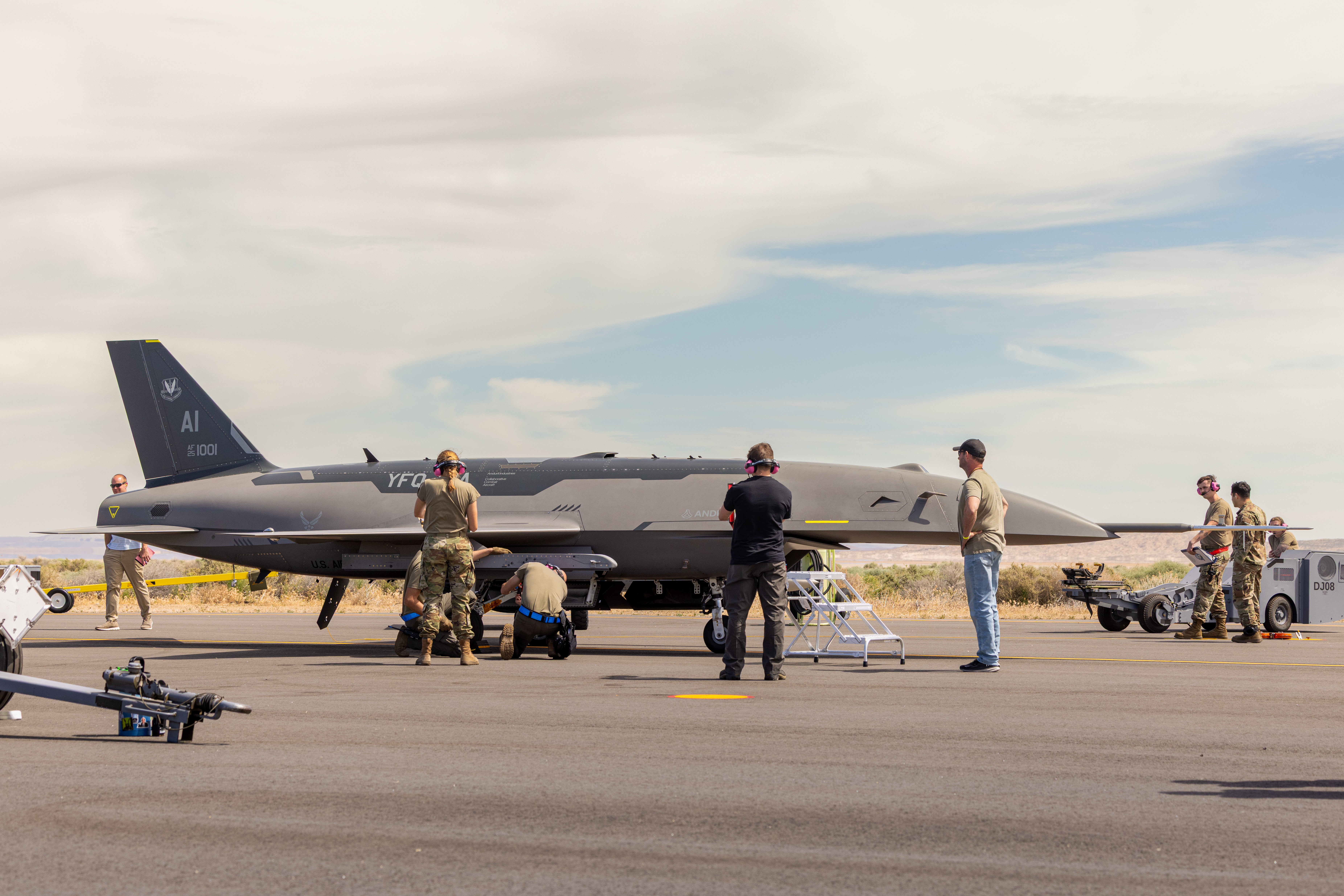
Air Force officials previously said they had received strong interest from industry in a follow-on platform for the MQ-9, which will be distinct from the Collaborative Combat Aircraft unmanned “loyal wingman” fighters the service will soon begin fielding. CENTCOM has also employed LUCAS one-way attack drones against Iran. But the MQ-9 is valuable even as the Air Force and Pentagon explore newer drones.
Drones such as LUCAS and the first batch of CCA do not yet have “extensive sets of sensors able to find, fix, run through the entire kill chain by themselves,” said Cantwell, now a senior resident fellow at AFA’s Mitchell Institute for Aerospace Studies. “The MQ-9 has sensors, including pods that are collecting electronic intelligence and full motion video sensors that are able to close the entire kill chain.”
The post Air Force Chief: MQ-9 Reaper ‘Most Valuable Player’ of Iran War Despite Losses appeared first on Air & Space Forces Magazine.
Air, Congress, C. Mark Brinkley, CENTCOM, Epic Fury, Gen. Kenneth S. Wilsbach, General Atomics, houston cantwell, Iran, MQ-9, Operation Epic Fury, Strait of Hormuz, U.S. Central Command
Air & Space Forces Magazine
[crypto-donation-box type=”tabular” show-coin=”all”]