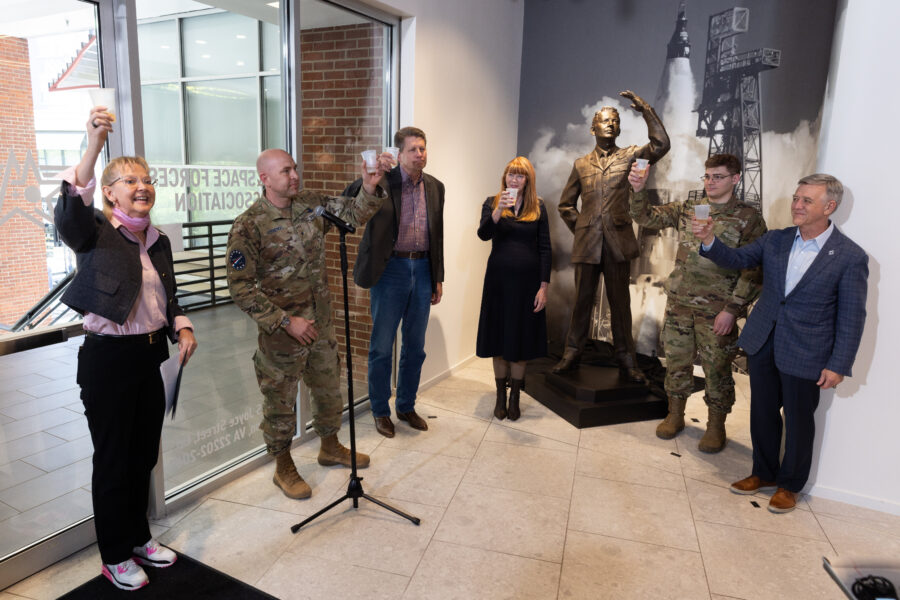
Top Air Force and Space Force leaders past and present celebrated the legacy of Gen. Bernard A. Schriever—the “father of the U.S. military space and missile program”—and the growth of the new space service by unveiling of his bronze statue during the Air & Space Forces Association’s inaugural “Salute to Space” ceremony on May 1.
The sculpted figure of Schriever now stands at the association’s Arlington headquarters entrance, his left hand above his head, shielding his eyes, as a photograph on the wall behind him shows the Atlas rocket rumbling skyward with astronaut John Glenn aboard.
“There are moments in history when a single individual changes not just the trajectory of a service but the trajectory of a nation, and Gen. Schriever was one of those individuals,” said retired Lt. Gen. David Deptula, dean of the Mitchell Institute for Aerospace Studies. “He didn’t just imagine the future, he delivered it.”
The ceremony was held on National Space Day, established by Lockheed Martin in 1997 and expanded to become International Space Day in 2001 by Glenn, who then served as a U.S. senator.
The pairing of the sculpture and photograph was no coincidence. The late Schriever’s efforts to advance rocket and space technology, beginning in the 1950s, were instrumental in developing technologies, concepts, and personnel that helped defeat the Soviet Union in the space race.
Schriever began his military career as a U.S. Army Air Corps pilot in 1933, according to the National Museum of the USAF. He flew combat missions in B-17 bombers in World War II and later worked in jet and rocket technology development.
Retired Air Force Lt. Gen. Burt Field, AFA president and CEO, noted that Schriever and his team were critical to the development of technology that would enable intercontinental ballistic missiles and push U.S. industrial production capacity into the space age.
“What they did in that timeframe makes it almost magic, in my opinion,” Field said.
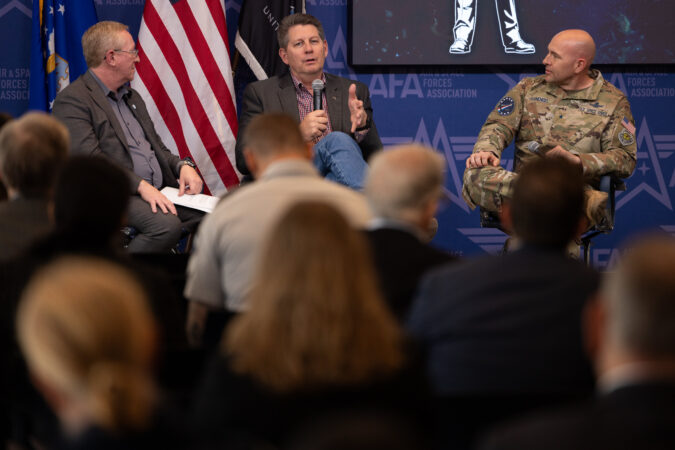
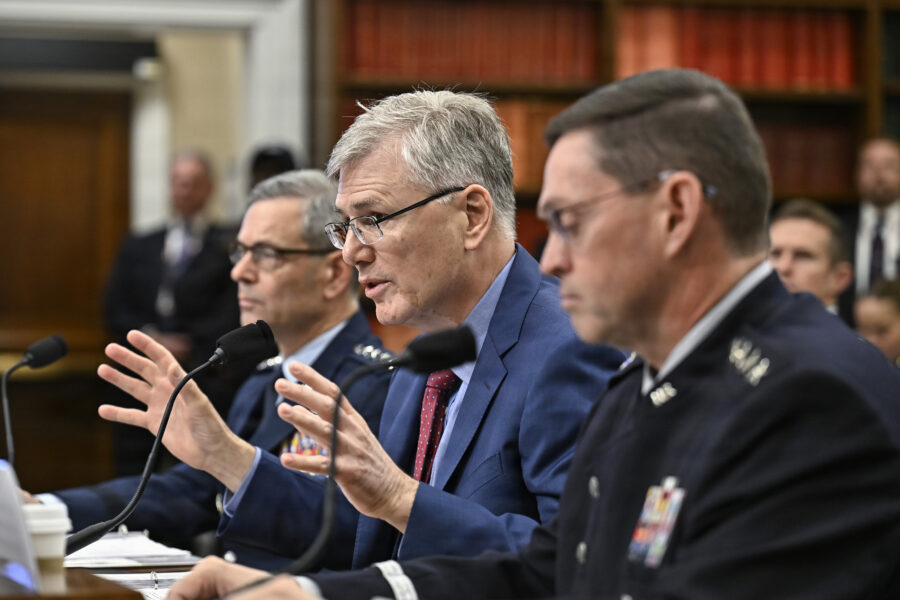
Moderated by Charles Galbreath, Director and Senior Resident Fellow for Space Studies at the Mitchell Institute’s Spacepower Advantage Center of Excellence. (Photo by Jud McCrehin, Air & Space Forces Association)
Space Force Linkage
Schriever’s work connects directly with the founding of the U.S. Space Force in 2019 and its growing mission today, multiple officials said at the ceremony.
“It’s no longer fiction, it’s at our doorstep, it’s happening now,” said Space Force Brig. Gen. Christopher Fernengel, director of plans and programs.
The Cold War space race and today’s expanding space mission parallel each other in many ways, Fernengel said.
Both have aspects of uncertainty; the U.S. doesn’t know how far its adversary, the Soviet Union then or China now, could go in contesting the domain, Fernengel said. Both eras have elements of urgency and require space professionals to accelerate technology development to meet those needs.
“If there’s one lesson we can take from Gen. Schriever, it’s this: the future does not belong to those who wait,” Deptula said. “It belongs to those who build.”
Schriever’s great-grandson, Air Force Reserve Master Sgt. Brett Schriever, shared the stark reality that his family’s patriarch envisioned: “Space is no longer a benign environment; it is a rapidly developing warfighting domain.”
The Schriever’s space lineage continues with Brett, who serves as a space systems operator with a unit at the National Reconnaissance Office. His own grandfather, Bernard Schriever’s son, served as a “Star Catcher,” one of the aviators that captured Corona spy film capsules reentering from orbit continues to this day with space systems operator who serves in a unit at the National Reconnaissance Office. The family’s space lineage runs deep. And his father, Bernard Schriever’s grandson, is a Space Force officer with more than three decades in service.
Bernard Schriever’s drive holds a lesson for the new service, said retired Gen. David D. Thompson, the first Vice Chief of Space Operations: it must continue moving forward.
“He was famous for maintaining momentum, especially by forcing decisions to keep moving forward,” Thompson said.

A Toast to History
The statue has a legacy in its own right. It was made by the famed sculptor Eugene Daub, who was previously commissioned to sculpt a 9-foot statue of Schriever that now stands outside Space Systems Command in Los Angeles, Calif.
That effort was spearheaded by the Air & Space Forces Association’s Schriever Chapter 147, said retired Air Force Maj. Gen. Thomas Taverney.
Taverney said that Daub studied dozens of photographs of Schriever and listened to speeches to best capture the general’s character.
“He saw Schriever as a visionary, a man with great imagination,” Taverney said.
Following the statue unveiling, attendees continued a recent tradition that traces to Space Force’s founding—a champagne toast with plastic cups.
The humble ritual’s origins date back to Dec. 20, 2019, when the new service was established.
That day, in a hangar on Andrews Air Force Base, Md., the first Chief of Space Operations Gen. John A. Raymond flew in for the ceremony. He flew out the same day and, on that flight, told his staff they needed to celebrate the event, Thompson said.
The crew delivered an $11 bottle of champagne and found some plastic cups to make it a reality.
“And that was the first toast of the Space Force the night it was created,” Thompson said.
And during the Salute to Space event, the tradition continued while also marking the inaugural “Schriever Charge,” which Fernengel led: “To honor the past, challenge assumptions, and build the future.”
The post AFA, Space Force Leaders Honor Bernard Schriever with New Statue, Toast appeared first on Air & Space Forces Magazine.
Air & Space Forces Association, History, Bernard Schriever, Brig. Gen. Christopher Fernengel, Gen. Bernard A. Schriever, Gen. Bernard Schriever, Gen. David D. Thompson, Lt. Gen. David A. Deptula, Thomas D. Taverney
Air & Space Forces Magazine
[crypto-donation-box type=”tabular” show-coin=”all”]