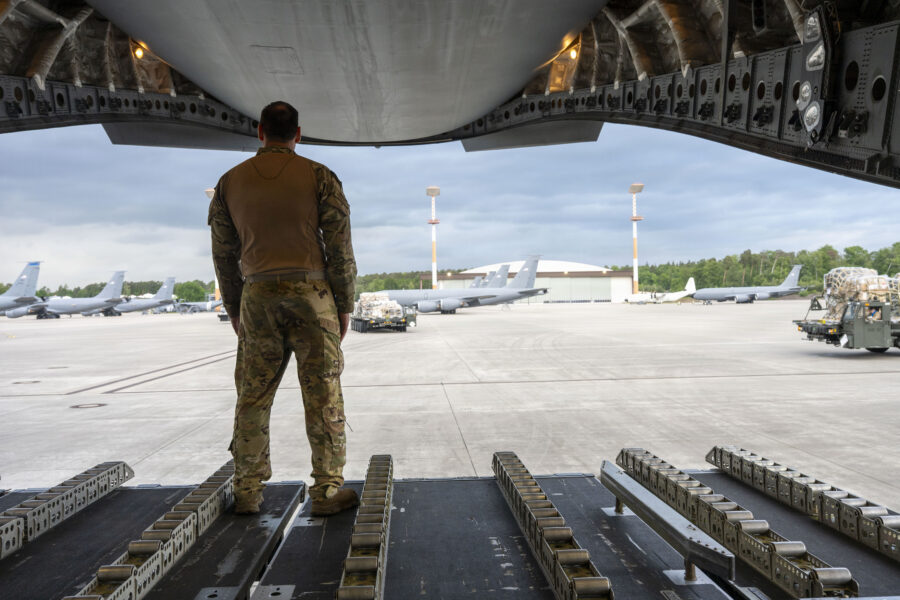
The U.S. military’s ability to access air bases in Europe will be a central consideration as the Trump administration makes decisions on the future American military posture on the continent, the top Pentagon policy official said.
Undersecretary of Defense Elbridge Colby, who addressed NATO allies in Brussels on Aug. 27, is leading the Pentagon review of the U.S. role in Europe with military input from Air Force Gen. Alexus G. Grynkewich, who serves as the head of U.S. European Command and NATO’s top military commander.
The question of access, basing and overflight, or “ABO” is one of the major points in the review as well as a source of potential tension between the U.S. and its NATO partners.
The Trump administration has complained that some European nations did not provide immediate access for U.S. aircraft when the U.S. joined Israel in the war against Iran. But some European officials said it was not realistic to expect them to quickly agree to access for U.S. warplanes for a war on which they were not consulted in advance and which did not involve the NATO alliance. And they are worried that a failure to come to terms could lead to additional U.S. force cuts on the continent.
The Pentagon has already removed two Army combat brigades as it pursues its policy of putting the Europeans in the lead for conventional defense so it can put more focus on the Western Hemisphere and the Pacific.
“We’re not looking in every context for a complete carte blanche, but we’re saying we need to be able to have the ability to operate effectively. We need predictability,” Colby told reporters at NATO’s headquarters. “That wasn’t always in evidence during Operation Epic Fury.”
Colby spoke to NATO ambassadors in Brussels following meetings at U.S. European Command in Stuttgart, Germany, where he met with Grynkewich, and at the alliance’s military staff at Supreme Headquarters Allied Powers Europe in Mons, Belgium. Colby met with Mark Rutte, NATO’s Secretary General, earlier in the day.
The Pentagon has provided allies with the so-called Terms of Reference document—the guidelines that govern the Pentagon’s review.
Among the criteria are what European nations are doing to meet higher defense spending targets, what steps they are taking to fill the gaps as the U.S. shifts military resources from the continent, and allies’ willingness and ability to support U.S. power projection outside of NATO with space, cyber, intelligence assets and base access, Reuters reported.
“This is not a narrow review about places and bases alone, although those are of course important. Rather, it is a look at our strategic posture here in the broader sense, designed to enable our Joint Force to meet the priorities laid out in the National Security Strategy and the National Defense Strategy,” Colby told NATO ambassadors.
The war with Iran has highlighted the importance of basing, as well as some of the political complications.
Britain initially did not immediately acquiesce to the Trump administration’s appeal to let B-52 and B-1 bombers use its RAF Fairford base. But after a legal assessment and consultations with American officials, Britain later relented with the stipulation that the bomber missions launched from there would be for “defensive purposes,” which was broadly defined and allowed attacks on Iranian missile and drone facilities for which the bombers were well suited.
But Spain, which opposed the war, did not allow the U.S. to use its bases at Rota and Moron.
U.S. cargo aircraft supporting the war have also used Europe as a hub and stopover point, particularly Ramstein Air Base in Germany, a major U.S. logistical hub. Ramstein sits near Landstuhl Regional Medical Center, the largest military hospital outside the U.S., which has received scores of U.S. service members wounded in the conflict.
American fighters permanently based in Europe, including F-35A and F-15E fighters from RAF Lakenheath, U.K., were also used in the war. So were F-16s from Spangdahlem Air Base, Germany, and Aviano Air Base, Italy. U.S.-based fighters also transited through European bases en route to the conflict, mostly via the U.K.
The Pentagon posture review and Colby’s talks with NATO officials are taking place against the backdrop of increased Russian aggression in eastern Europe and fears it might escalate even further.
CIA Director John Ratcliffe flew to Moscow earlier this week to consult with his Russian counterparts and reaffirm the U.S. commitment to defend NATO. according to reports by POLITICO and The Wall Street Journal. Russia has been engaging in a series of “hybrid attacks” against Europe, Western officials say, including sabotage operations. Flights by Russian drones prompted NATO to establish the Eastern Sentry mission to protect the alliance’s eastern flank.
The post Air Base, Overflight Access Key to Pentagon Review of US Military Forces in Europe appeared first on Air & Space Forces Magazine.
Air, National Security, Elbridge Colby, EUCOM, Gen. Alexus G. Grynkewich, Germany, Iran, Italy, Mark Rutte, Moron Air Base, NATO, NATO 3.0, Operation Epic Fury, RAF Fairford, RAF Lakenheath, Ramstein Air Base, Spain, Spangdahlem Air Base, Surpreme Headquaters Allied Powers Europe, U.S. European Commmand
Air & Space Forces Magazine
[crypto-donation-box type=”tabular” show-coin=”all”]