Tyler Durden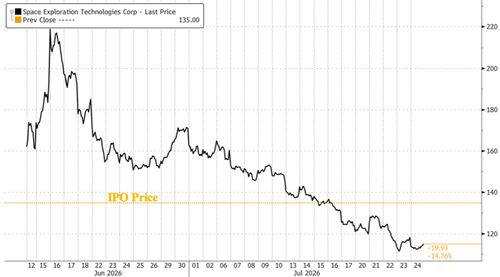
Deutsche Bank Says Starship Flight 13 Made “Solid Progress” Despite Booster Setback
Following last month’s record-setting IPO, SpaceX shares have plunged 50% from their peak and now trade about 15% below the $135 offering price. The post-IPO euphoria has faded, stripping Elon Musk of his trillionaire status – at least for now.
On Friday evening, SpaceX launched Starship on its 13th test flight and successfully deployed 20 next-generation Starlink V3 satellites, making solid progress toward full reusability. The upper-stage spacecraft completed all its primary objectives, despite another landing-burn failure involving the Super Heavy booster.
Deployment of 20 @Starlink V3 satellites complete. Today’s test will provide critical data as we prepare to expand our Starlink constellation pic.twitter.com/jWKLwXGlsk
— SpaceX (@SpaceX) July 24, 2026
Deutsche Bank analyst Edison Yu offered clients a post-mortem on Flight 13, noting that the latest Starship test.
Here is Yu’s take:
Starship Test Flight 13 illustrated solid progress for the program, in our view. For context, this was the second time the upgraded V3 iteration of Starship was flown. Interestingly, the rocket’s second stage (Ship) executed all primary objectives whereas the first-stage booster (Super Heavy) performed well for most of the mission until an incomplete engine relight led to a harder splashdown than planned which was also an issue observed on Flight 12. As such, it does appear SpaceX may attempt a catch recovery of the second stage on the next test flight; if successful, this would represent a key milestone given the very high technical difficulty. Additionally, Flight 13 saw the successful deployment of 20 functional Starlink next-gen V3 satellites. Overall, while the initial abort was optically not ideal, we think Starship continues to progress in line with our base-case expectations
What caused the initial abort?
During the first launch attempt on July 16th , Starship reached T-0 and began the engine start sequence. However, 4 of Super Heavy’s 33 Raptor engines failed to ignite. Therefore, the flight computer automatically aborted because the launch commit criteria permits a maximum of 2 engines out at liftoff. The company identified the cause to be off-nominal spin response in the liquid oxygen (LOX) turbopumps of 6 engines (4 failed to light plus 2 that displayed off-nominal behavior). The most likely cause of this dynamic was residual moisture that had collected inside the turbopumps from earlier operations. When the extremely cold cryogenic propellant was loaded, that moisture appeared to have frozen. As a result, the ice either slowed the turbopumps dramatically or stopped them from spinning up properly, so those engines never reached the required conditions to ignite. To address this, SpaceX removed and replaced 6 Raptor engines, performed verification testing including spin checks after chill. Then the attempt on July 23rd was postponed due to weather conditions in order to preserve visual coverage of the heat shield tiles during ascent. For background, the heat shield is still being iterated upon and considered one of the higher risk + less mature parts of Starship; therefore, gathering optical data is
What went well?
- Ascent & staging: All 33 booster engines and all 6 Ship engines performed well through their powered phases. Hot-staging was clean – rocket separation where the upper stage ignites its engines while still attached to the lower stage booster, which is also still firing.
- Boostback: First successful completion of the high-thrust portion of the boostback burn with all 33 engines running on V3 boosters. This is the maneuver that reverses first-stage booster’s horizontal forward momentum and steers it back toward the ocean.
- Starlink V3 deployment: First flight of functional (not simulator) next-gen V3 satellites. All 20 sats deployed, extended solar arrays and antennas, established RF and laser links, and returned telemetry before burning up on reentry after ~20 minutes.
- In-Space Raptor relight: Successful single-engine restart in space; the longest demonstrated to date. Important capability for future orbital missions and controlled de-orbit.
- Ship reentry & landing: Soft, controlled splashdown in the Indian Ocean. Ship 40 remained intact, continued transmitting telemetry and imagery, and provided the first high-quality views of an intact heat shield after a full reentry under higher dynamic pressure; should be ideal for heat-shield data collection.
What needs to improve?
- Booster landing burn: Only a subset of the Super Heavy engines (seemingly 8 out of 13) successfully relit for the landing burn. Hence, there was a hard splashdown rather than a soft, controlled impact. This remains the primary technical open item on the first-stage booster.
Next up: Flight 14
Following Flight 13, Elon Musk posted on X: “Unless we discover problems after mission data review, SpaceX will attempt to catch the ship with the tower on next flight.” This would be the first attempt to catch the upper stage using the Mechazilla tower arms and if successful, would represent a major milestone for the program given the much higher technical difficulty level compared with catching the first stage (energy, speed, flip maneuver, margin of error, etc…). We estimate a target window in late August or September. Separately, we note that Starlink V3 satellites can be deployed on Starship even with partial reusability.t a catch recovery of the second stage on the next test flight;
SPCX shares dipped 1.5% in Monday premarket trading, falling to the $113 handle as the stock searches for a floor following its dismal post-IPO performance.
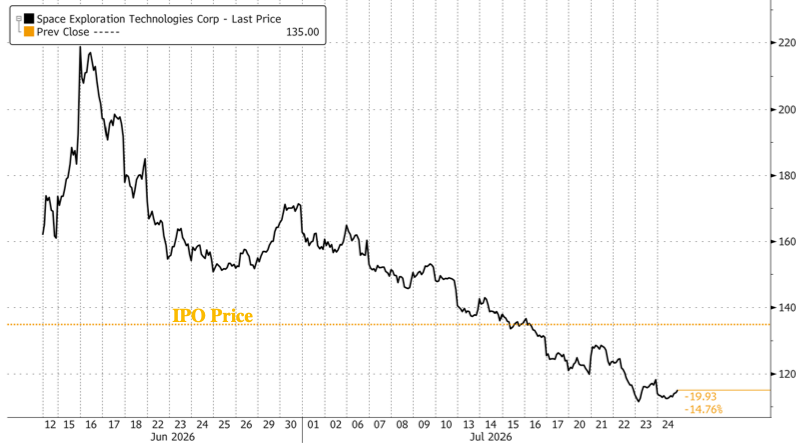
Looking ahead, SpaceX faces its first major post-IPO lockup expiration on Aug. 6, just two days after its scheduled quarterly earnings report. About 911.5 million shares will become eligible for sale, creating a potentially significant supply overhang.
Tyler Durden
Mon, 07/27/2026 – 10:00
ZeroHedge News
[crypto-donation-box type=”tabular” show-coin=”all”]