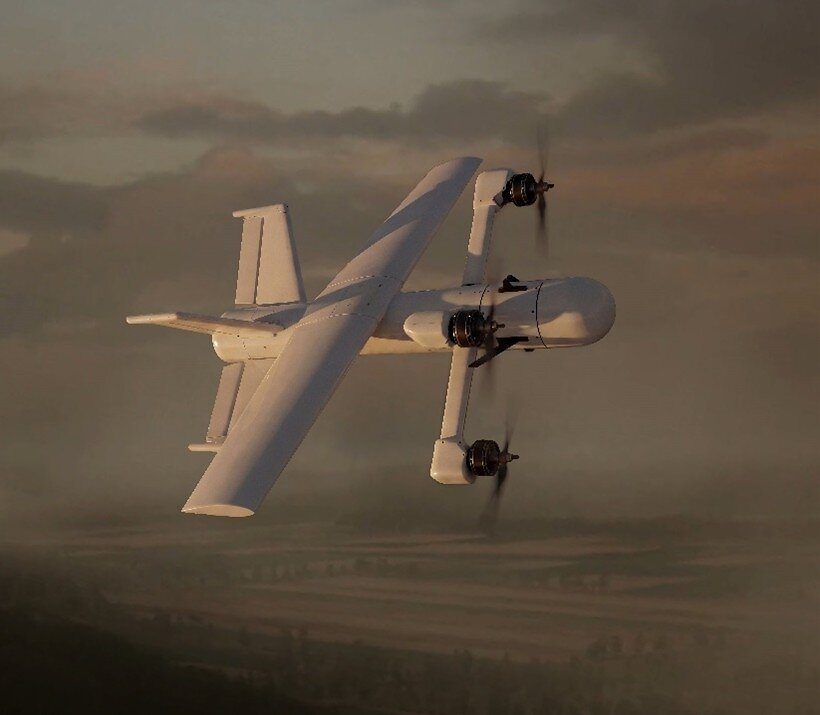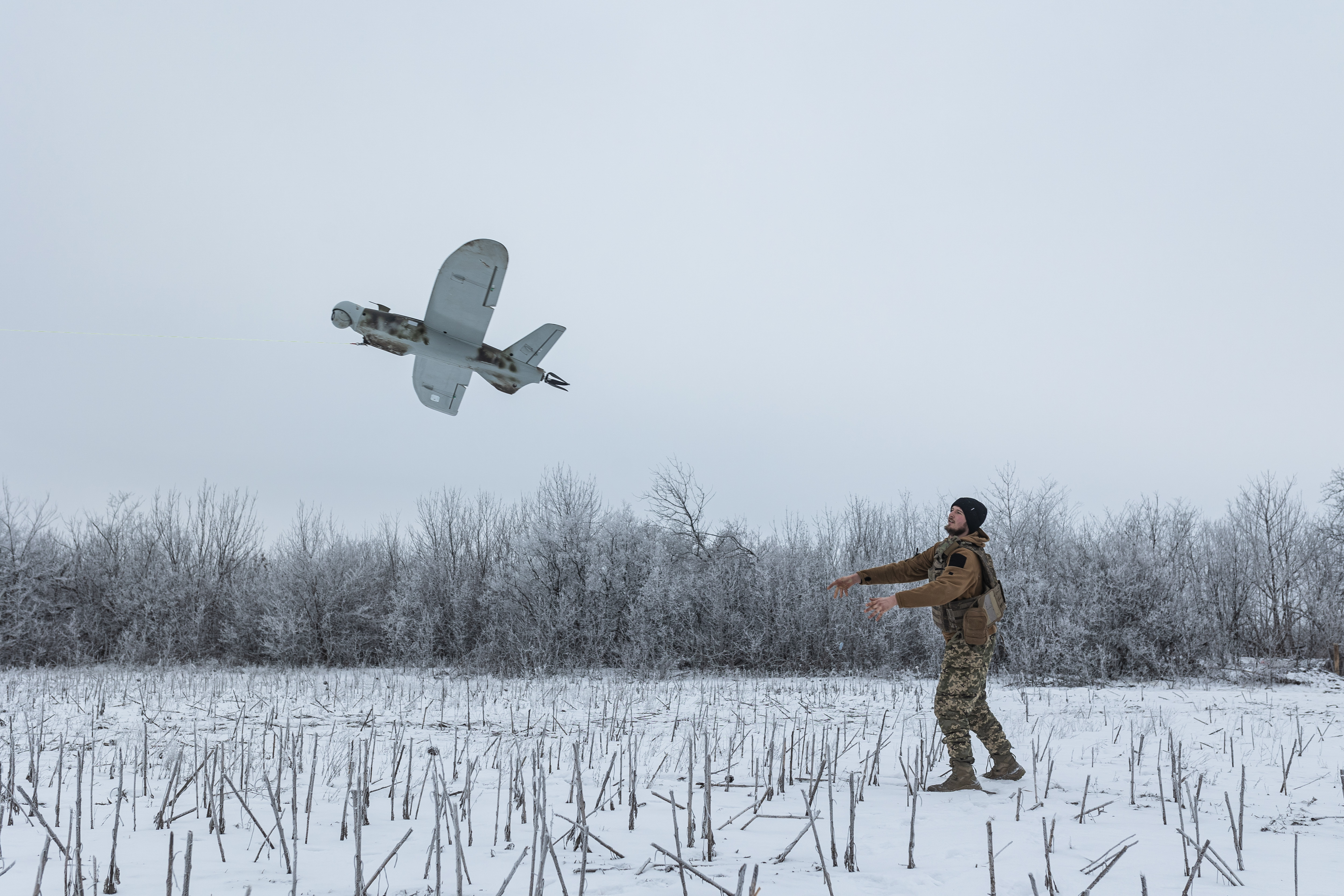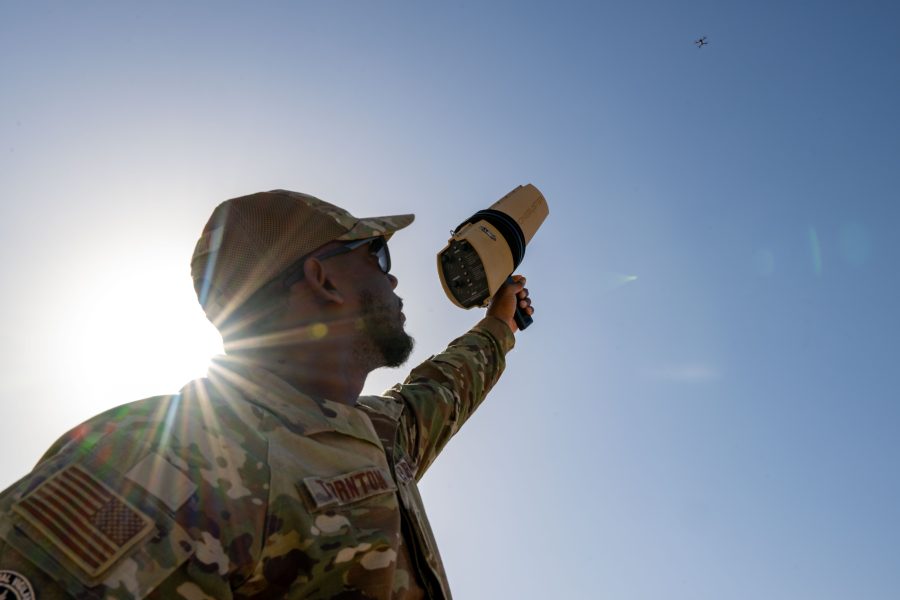
The Air Force has established the first rapidly deployable units designed to protect air bases in the Pacific or other potential hotspots from aerial attack.
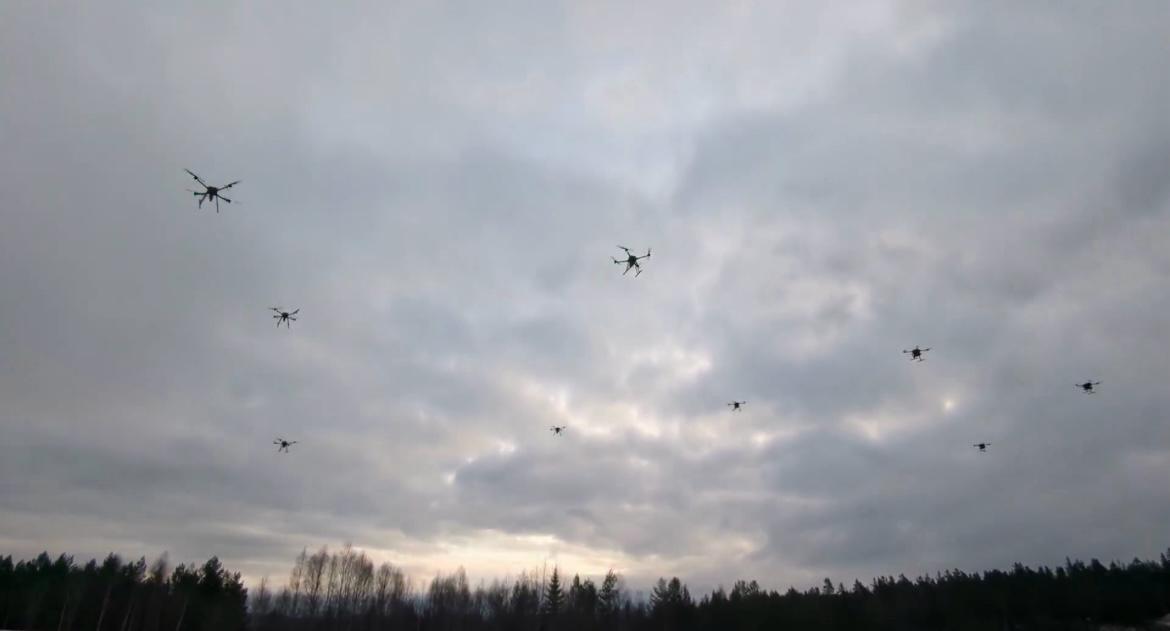
These point defense flights, made up of roughly 20 enlisted Airmen with aviation and battle management backgrounds, could protect permanent installations in the United States, but are specifically trained to defend remote airfields, such as might be used in agile combat employment, from drone attack.
“It’s an expeditionary capability, so we want it to be light and lean,” Michael Sheehy, director of future operations under the Air Force deputy chief of staff for operations, told Air & Space Forces Magazine.
The Air Force is in the early stages of refining these counter-drone units of action, will eventually be manned by Airmen trained for a base defense job specialty the service announced about a month ago to protect against evolving drone threatss. The proliferation of low-cost quadcopter and jet-powered drones like Iran’s Shahed have increased the threat of attacks on air bases and other military installations.
At least nine of the 16 U.S. service members killed during the conflict with Iran died as a result of Iranian drone and missile attacks on air bases in the Middle East. Sheehy acknowledged the Iranian drone threat in the U.S. Central Command region but said the Pentagon’s Joint Interagency Task Force 401, established last year, is providing counter-drone support for U.S. forces deployed in the region.
For now, new air base defense flights are being prepared for future deployments to hot spots from the homeland to the Pacific, Sheehy said. Until recently, Security Forces Airmen at high-security installations, such as nuclear bases and airfields, have made up the majority of personnel trained to counter drones. But Sheehy said the service is placing a heavy focus on identifying Airmen with command-and-control experience to serve in these new units.
“We’re looking at enlisted aviator and enlisted air battle manager sort of folks that are on the operational side and have that kind of airmindedness about them,” he said, using a term for an Airman’s constant awareness of their role in sustaining combat airpower.
Airmen go through a roughly three-week training course at Joint Counter Unmanned Aircraft Systems University, located at Fort Sill, Okla., to lean how to use U.S. military counter-drone technology and how to defend against enemy drone attacks.
Currently, the Air Force is working with JIATF-401 to procure commercially available counter-drone systems, but the service’s program of record for such threats remains the Small Unmanned Air Defense Systems, or SUADS, Sheehy said, describing SUADS as largely a detection system capable of identifying and tracking enemy drones of all sizes.
Congress funded SUADS with $51.8 million in procurement funds in fiscal 2026, according to Air Force budget documents. It’s available in two variants, one for fixed air bases and one that can be rapidly deployed on an aircraft pallet. For example, a point defense flight would deploy with the mobile SUADS variant “downrange as a force package to support ACE operations,” Sheehy said.
“So as teams are performing agile combat employment, they can have a rapidly deployable SUAD system that has a sensor, effector, and C2, kind of all-in-one box,” Sheehy said. “We could have those Airmen go downrange with that kit tomorrow, or in a very short amount of time.”
Future Base Defense Specialty Code
Air base defense is technically an Army mission but has long been an Air Force concern. The recent rise of drone warfare has pushed senior leaders to acknowledge the need for specially trained personnel and units to combat the threat.
Air Force Secretary Troy E. Meink, said in May 20 congressional testimony that Airmen “have a responsibility to defend our air bases and defend our forces, regardless of where they are.”
Air Force leaders settled on the need for a dedicated Air Force specialty code, or AFSC, that focuses on base defense at a semiannual “Corona” meeting at Wright-Patterson Air Force Base, Ohio, in June.
The service is “in the very nascent stages of exploring the development of an AFSC,” Sheehy said, so details remain scant.
“How are we going to do accessions … and [initial qualification training] for these folks? And then, what is their career path; we have to make sure that we offer somebody a career path,” Sheehy said, adding that the service can’t have an “AFSC that you top out at E-4.”
Currently, the service is working with Fort Sill’s C-UAS university to develop the technical training base defense Airmen would go through. “That syllabus is being is being worked on for what this initial qualification training will be for these for these new Airmen that are going into this career field,” Sheehy said.
The post An Early Look at the Air Force’s New Counter-Drone Units appeared first on Air & Space Forces Magazine.
Missile Warning & Defense, Warfighter Training, air base defense, air defense, Air Force Specialty Code, counter-drone, counter-drone strategy, counter-drone technology, JIATF-401, Joint Interagency Task Force 401
Air & Space Forces Magazine
[crypto-donation-box type=”tabular” show-coin=”all”]