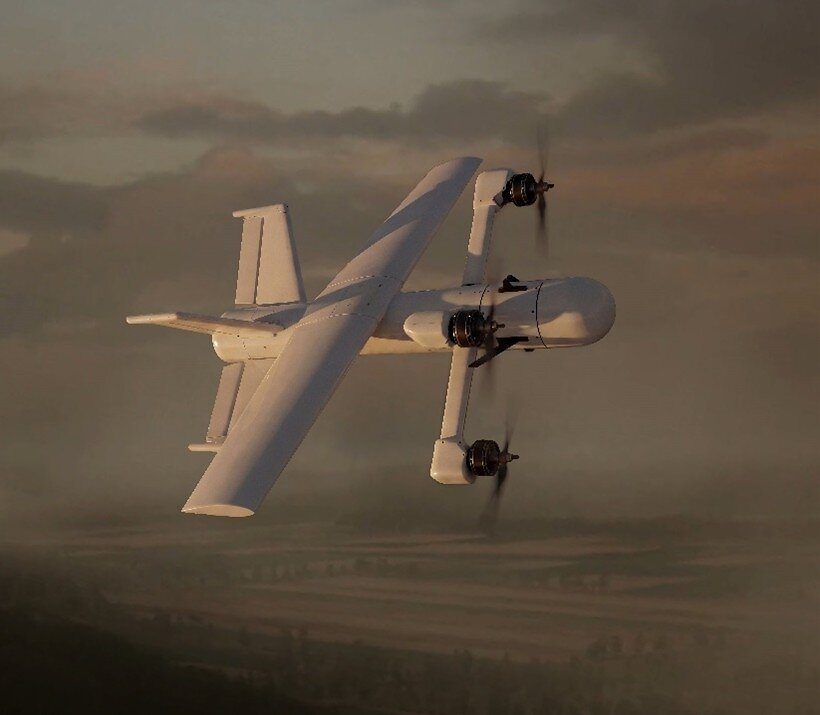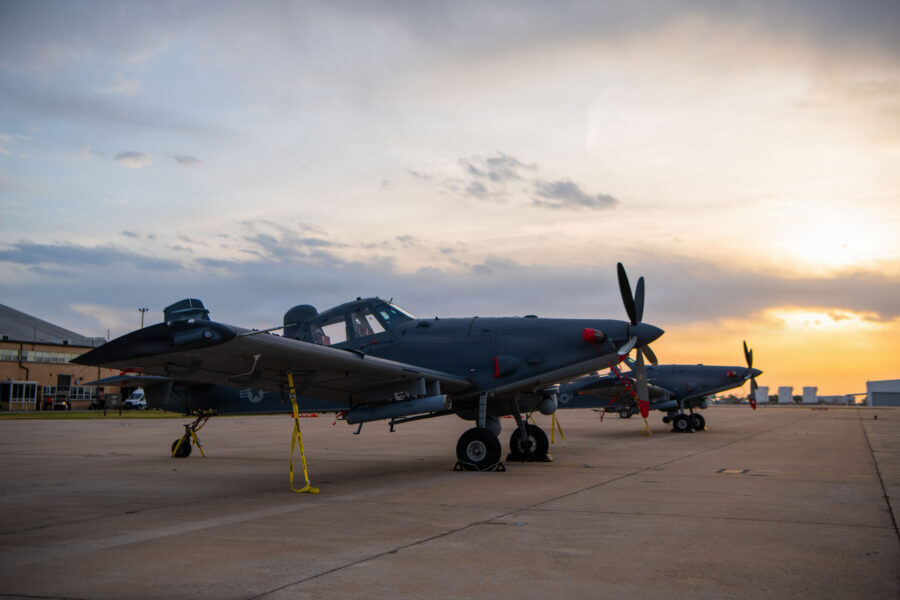
As L3Harris proves its OA-1K Skyraider II special operations aircraft can carry a signals intelligence sensor and electronic attack weapon, a key congressional committee is poised to boost production of the converted Air Tractor prop plane.
Along with the congressional endorsement, the demonstrations, described by a company executive to Air & Space Forces Magazine, signal positive momentum for the Skyraider program.
U.S. Special Operations Command selected the heavily modified cropduster for its Armed Overwatch program in 2022, but the plan to field 75 of the aircraft has faced headwinds ever since, with the total trimmed to just 53 due to budget constraints and increased interest in unmanned aircraft.
Officials at Air Force Special Operations Command, which will operate the plane, still say they want 75 airframes, however, and L3Harris executive Sean Ling expressed confidence in that plan.
“[It’s a] hot production line, we are executing on the program right now, delivering aircraft, and our anticipation is that that they will need and they will order the full quantity of aircraft,” said Ling, vice president and general manager for modernization and modifications for L3Harris.
The House Armed Services Committee’s version of the 2027 National Defense Authorization bill released last week recommends a four-fold increase in Skyraider funding, from $59.9 million to $279.9 million. The bill, which sets policy but does not appropriate funds, is typically indicative of congressional priorities. It’s unclear how many aircraft the Pentagon could acquire with nearly $280 million.
Envisioned as a scout aircraft for counterinsurgency operations in uncontested airspace, the OA-1K is not designed for high-end conflict. But Air Force officials say they are exploring how to expand its mission set. Last month, AFSOC Commander Lt. Gen. Michael Conley hinted that intelligence is one potential use. “It could do exquisite [signals intelligence], collect intel, and also be armed with up to 6,000 pounds of payload,” he told lawmakers, “whether that’s Hellfires, rockets, maybe some small cruise missiles that we’re working on.”
Ling confirmed signals intelligence is one capability L3Harris is working on. “We’ve already demonstrated for them the capability to integrate additional signals intelligence capabilities,” he said. “It was the pod that’s actually on that aircraft that we essentially modified to incorporate signal capability.”
The OA-1K comes with two electro-optical infrared sensors.
Ling said L3 has also made progress pairing its “pack” of air-launched vehicles with the Skyraider, including Red Wolf, a low-cost cruise missile, and Green Wolf, an electronic attack weapon.
“We’ve demonstrated that those can be installed and applied on this airframe,” Ling said.
The firm had announced the Red Wolf integration in February but had not previously disclosed that Green Wolf had been integrated.
Ling said neither weapon has yet flown on Skyraider, but added “that would not be a difficult challenge.”
L3Harris has more in mind than outfitting the OA-1K for AFSOC: it’s also on the hunt for international customers. While Ling declined to specify potentially interested countries, he said the company is “very aggressively involved in discussions with more than three potential customers.”
Foreign customers could help keep the OA-1K production line humming in Waco, Texas, and a larger U.S. investment would encourage international customers to sign on.
“We scaled from, frankly, zero at Waco to standing that production line up,” Ling said. “It is running. It is efficient. But there is further scaling that can be done to increase orders and throughput.”
The post AFSOC’s Skyraider Demos New Sensors, Gains Favor in Congress appeared first on Air & Space Forces Magazine.
Air, Budget, Congress, HASC, House Armed Services Committee, L3Harris, OA-1K Skyraider II, SOCOM, U.S. Special Operations Command
Air & Space Forces Magazine
[crypto-donation-box type=”tabular” show-coin=”all”]