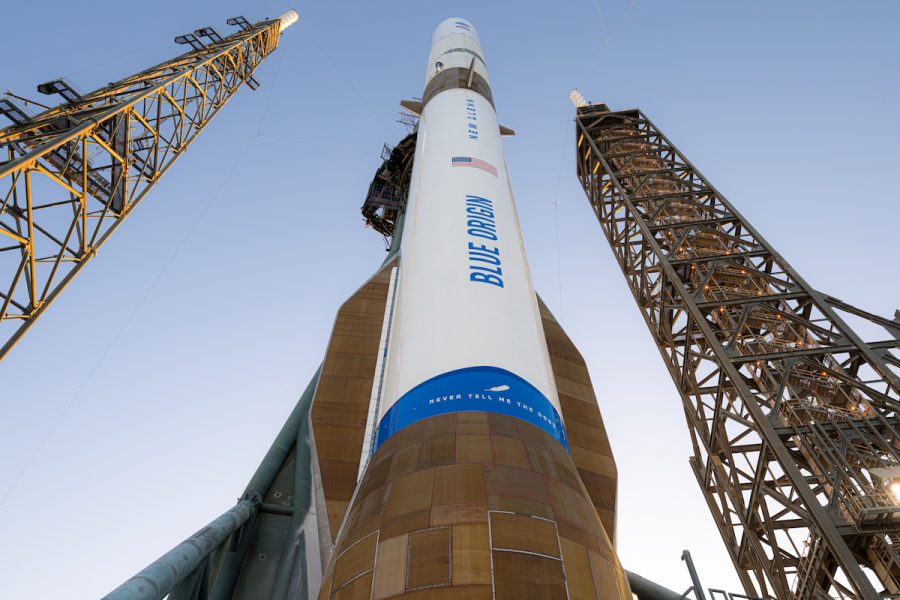
The Space Force on May 28 awarded a task order to Blue Origin for its first National Security Space Launch mission—the same day the company’s New Glenn rocket exploded on the launch pad at Cape Canaveral Space Force Base, Fla.
The contract is for a National Reconnaissance Office launch slated to fly in late 2027 or early 2028. In a May 29 press release announcing the task order—which it awarded the day before—the service said that despite the New Glenn mishap, it remains “committed partners with Blue Origin.”
“This anomaly is a solemn reminder that the critical capability this community provides is rocket science and inherently challenging,” Col. Eric Zarybnisky, acting portfolio acquisition executive for space access, said in the statement. “The National Security Space Launch program will continue working closely with our Blue Origin partners to help identify the root cause and implement corrective actions.”
The New Glenn mishap occurred during a routine prelaunch test around 9 p.m. May 28. The explosion caused a fireball that appeared to consume a large portion of Space Launch Complex 36-A, the company’s sole New Glenn launch pad. The company hasn’t issued details on the extent of the damage, but said in a May 30 update it is “actively investigating the hotfire anomaly” and will soon start clearing the pad and crafting a plan to rebuild its facility.
Blue Origin is one of three companies approved to compete for launch contracts under Phase 3 of the Space Force’s dual-lane National Security Space Launch program. Its recent award is for “Lane 1,” which covers the U.S. military’s more risk-tolerant, commercial-like missions.
The company is also in the midst of qualifying New Glenn to fly more risk-averse “Lane 2” launches that involve the Pentagon’s most exquisite, sensitive satellites. While Lane 1 companies can receive launch contracts after their vehicles have flown at least once, firms must complete a rigorous, individualized certification process to compete for Lane 2 awards.
New Glenn has flown three of the four flights required under its certification plan and was gearing up for the last of those launches—an Amazon mission slated to launch June 4. Now, the company is poised for what will likely be a monthslong investigation and, on top of that, a pad recovery process that experts say could take 18 months, depending on the extent of the damage.
The company is in the process of building a second New Glenn pad at Cape Canaveral, though it’s not clear how long it will take to complete. It also recently won a lease agreement to build a pad at Vandenberg Space Force Base, Calif., but the Space Force has said it could take at least two years to finish that facility.
The post Space Force Announces Launch Deal with Blue Origin After Rocket Mishap appeared first on Air & Space Forces Magazine.
Space, Blue Origin, Cape Canaveral Space Force Station, launch, National Reconnaissance Office, National Security Space Launch, New Glenn, NRO, NSSL, Space Force
Air & Space Forces Magazine
[crypto-donation-box type=”tabular” show-coin=”all”]