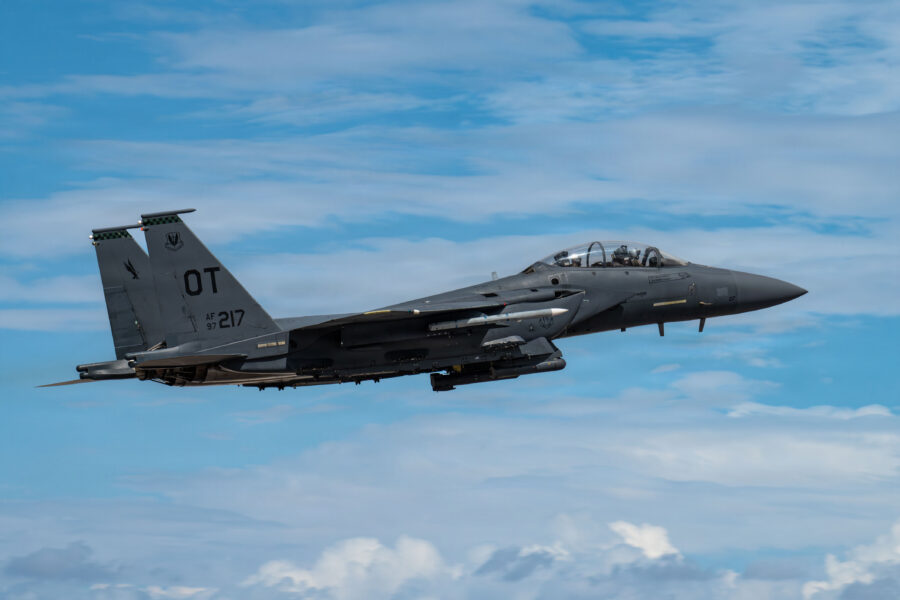
The Air Force Life Cycle Management Center has opened a “speedline” to accelerate installations of a new electronic warfare suite on board F-15E fighters, as the service looks to upgrade and expand its EW toolkit.
The new installation line will allow the center to add the Eagle Passive Active Warning Survivability System to the fourth-generation aircraft more rapidly than the previous plan of waiting to do so during regular depot maintenance, which occurs every 5-7 years, according to a May 26 release.
Established at the Warner Robins Air Logistics Complex in Georgia, “this independent line will significantly accelerate the installation and fielding of next-generation Electronic Warfare (EW) capabilities on F-15E aircraft,” according to the release.
The first F-15E will arrive on the line in June. The Air Force fielded its first two EPAWSS-enabled F-15Es in January 2025 at RAF Lakenheath, England. The 48th Fighter Wing said at the time that its 494th and 492nd Fighter Squadrons would get one apiece for training.
The new system extends the operational life of the already three-decade-old F-15E. The service’s plans call for adding EPAWSS to 99 F-15Es.
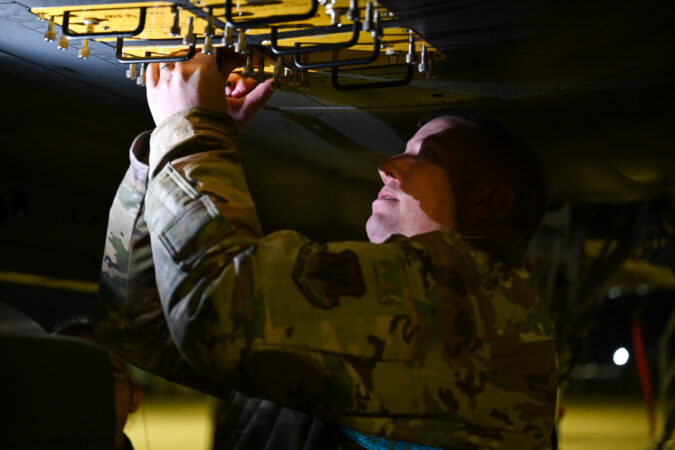
The USAF has made a concerted effort to upgrade the electronic warfare capabilities on older fighters like the F-15E and F-16 in recent years; the fourth-gen fighters will remain a critical portion of the fleet for years to come, and more advanced adversaries boast electronic attack and defense measures. Officials have described the EW upgrades as giving the older jets fifth-gen capabilities.
“We are not merely extending the life of this platform; we are aggressively expanding its lethality and survivability to ensure it dominates the modern battlespace,” Lt. Col. Matthew Heil, EPAWSS materiel leader for the F-15 program office, said in the release.
An AFLMC spokesman declined to say how many aircraft would get EPAWSS through the new “speedline” and how many have already had it installed, citing operational security concerns.
Original plans called for fielding EPAWSS on both the F-15E and F-15C, but in 2019 the Air Force decided to forego the F-15C installs, as the aircraft is being replaced by the F-15EX.
The Boeing-built F-15EX is delivered with EPAWSS already built in. Budget documents show that the USAF plans to double its fleet of the new jet to 267 fighters.
EPAWSS Development
While EPAWSS does not make the F-15E stealthy, it and other advanced EW technology do help fighters evade enemy radar systems, among other capabilities.
“The integration of advanced electronic warfare suites, such as the [EPAWSS] ensures the F-15E will not just survive, but actively disrupt and dismantle adversary kill chains in the most highly contested, electromagnetically dense environments,” Heil said in the May 26 release.
Built by BAE Systems, EPAWSS gives air crews an integrated radar warning, geolocation, situational awareness, and self-protection, according to the company’s website. The new system replaces an analog EW tool called Tactical Electronic Warfare System, which dates back to the Cold War.
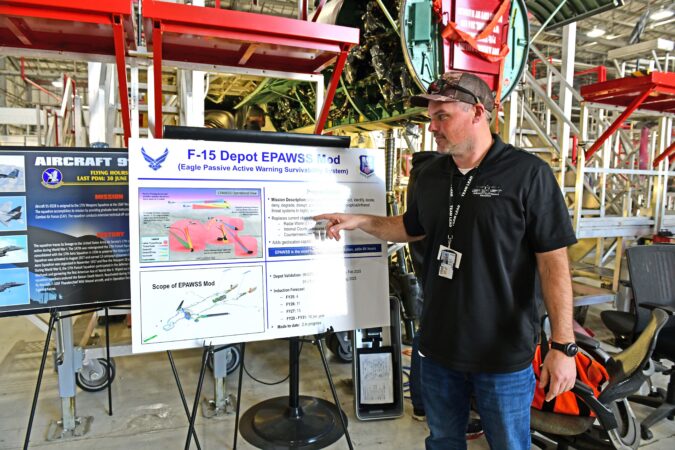
TEWS consists of the AN/ALR-56C Radar Warning Receiver, AN/ALQ-135 Internal Countermeasures Set, and the AN/ALE-45 Countermeasures Dispenser Set, according to a fiscal 2020 Director of Operational Test and Evaluation report.
Development on EPAWSS dates back to the mid 2010s.
Other EW Systems
In addition to the F-15, the Air Force is also working on upgrading EW tools for the F-16. Northrop Grumman told Air & Space Forces Magazine in October that the company would begin production on the ALQ-257 Integrated Viper Electronic Warfare Suite as early as 2026.
That install called for 72 Block F-16s to be outfitted with the IVEWS. The system is built with an ultra-wideband architecture to broaden the threat protection, which includes “agile and millimeter wave systems,” according to the company’s website.
Core components, or building blocks, of IVEWS have been in production since 2020, a Northrop Grumman spokesperson told Air & Space Forces Magazine on May 26 via email.
Shipsets of those components have been provided to the Air Force on two F-16s, the spokesperson wrote.
“We anticipate receiving a production contract award from the Air Force this year as we work toward full-rate production as outlined in the FY27 budget request,” the spokesperson wrote.
While EW for Air Force fighters give crews a critical capability for close-in work, the Air Force is also working on broader capabilities in the electromagnetic spectrum. The service wants to nearly double its EA-37 Electronic Attack fleet over the next five years to the tune of more than $3 billion.
The modified Gulfstream G550 business jet works as a theater-level EW asset for the USAF fleet. It provides a long-range electronic methods to break up enemy kill chains through suppressing air defenses and jamming enemy radar, navigation and communications.
The service has 12 jets either in its inventory or on order. Air Force Secretary Troy E. Meink told Congress earlier this year that a 10-aircraft plus-up would “expand our electronic attack capability.”
The post New F-15E Depot Line Will Speed Up Installs of EW System appeared first on Air & Space Forces Magazine.
Electronic Warfare, depot maintenance, Electronic warfare, EPAWSS, EW, Warner Robins Air Logistics Complex
Air & Space Forces Magazine
[crypto-donation-box type=”tabular” show-coin=”all”]