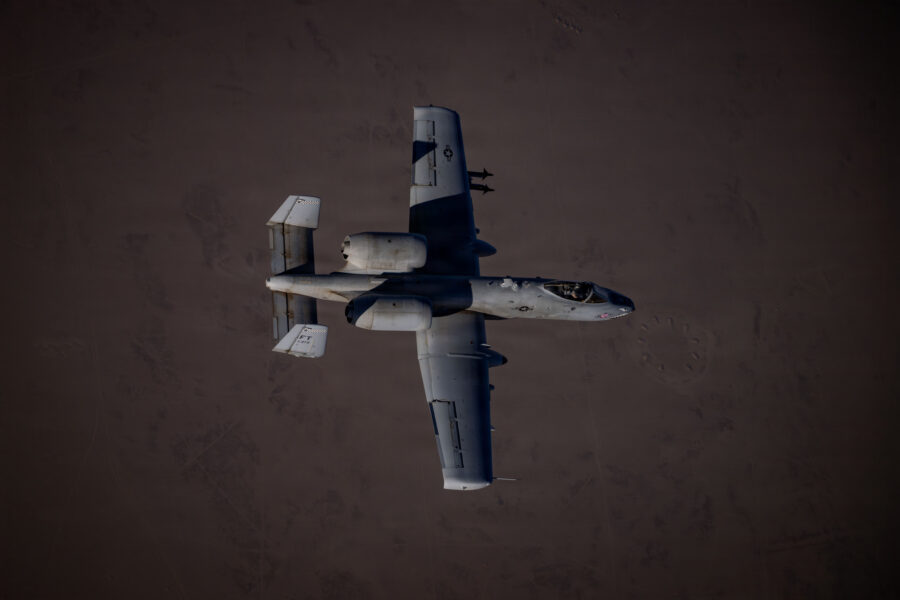
The U.S. military is poised to double its A-10 presence in the Middle East, as the venerable close air support plane plays a key role in combating Iranian boats and Iranian-backed militias in Iraq as part of Operation Epic Fury against Iran.
Twelve A-10s from the 107th Fighter Squadron at Selfridge Air National Guard Base, Mich., flew from Pease Air National Guard Base, N.H., to RAF Lakenheath, United Kingdom, on March 30, according to flight tracking data and local aircraft spotters.
Another six A-10s flew from Pease to Lakenheath on March 31, flight tracking data showed. Those half dozen aircraft arrived at Pease from the 190th Fighter Squadron out of Gowen Field Air National Guard Base, Idaho, on March 27.
The additional A-10s are likely to deploy to the Middle East in the coming days, and Lakenheath has been the primary stopover point for aircraft bound for the region.
#USAF United States Air Force – Coronet East
Boeing KC-135 Stratotanker 2x#AE038F 63-7996 – BORA 43#AE065D 60-0320 – BORA 44
Two KC-135s have departed RAF Mildenhall and Prestwick to collect what should be a further six A-10s – this time from the 190th Fighter Squadron… pic.twitter.com/3JRg9XoSO0
— Armchair Admiral
(@ArmchairAdml) March 31, 2026
The attack aircraft were refueled by KC-135 Stratotankers flying out of both Bangor Air National Guard Base, Maine, and RAF Mildenhall, England.
Lakenheath, Mildenhall, and RAF Fairford have been used to transfer U.S. aircraft and to stage tankers and bombers for Operation Epic Fury.
About a dozen A-10s are already in the Middle East participating in Operation Epic Fury. The A-10s have been patrolling the Strait of Hormuz and have been conducting attacks against Iraqi militia groups, people familiar with the matter told Air & Space Forces Magazine. Footage of A-10s conducting strafing runs in Iraq has circulated on social media, and Chairman of the Joint Chiefs of Staff Air Force Gen. Dan Caine has confirmed the A-10’s use in the Strait.
The U.S. military is leaning on the 1970s-era attack plane, purpose-built for close air support, despite Air Force plans to retire the fleet in the very near future. Even before operations against Iran began on Feb. 28, A-10s had been active attacking Islamic State group targets in Syria earlier this year, and they have been deployed to the Middle East continuously since 2023.
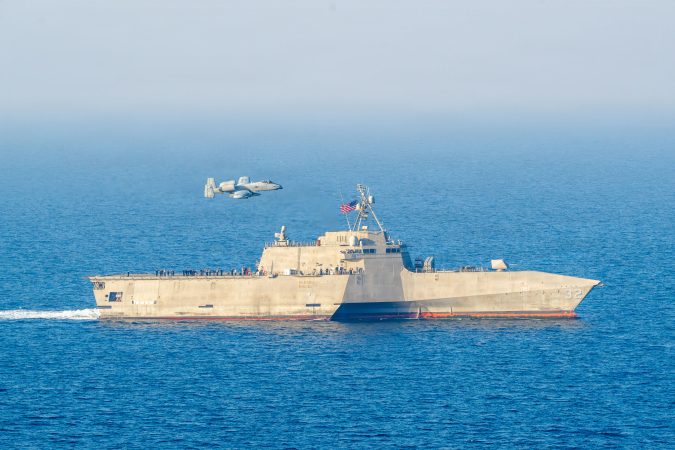
On March 19, Caine said that the “Warthog is now in the fight across the southern flank and is hunting and killing fast attack watercraft in the Strait of Hormuz.” Pentagon releases showed the plane being used in training for close air support with USS Santa Barbara in the Persian Gulf in early February. The A-10 flies at low altitudes and slow speeds, which allows for longer loiter times, a benefit when targeting watercraft.
The aircraft uses its 30mm GAU-8/A Gatling gun, which can fire 3,900 rounds per minute to strafe targets.
The A-10 is also capable of carrying a host of specialized munitions, including the WGU-59 Advanced Precision Kill Weapon System (APKWS) II, the GBU-31/32/38 Joint Direct Attack Munition (JDAM), and the AIM-9 Sidewinder.
The Air Force has cut a quarter of its A-10 inventory since 2024 and plans to shelve the remaining fleet over the next two years. But Congress has halted some cuts.
Air Force officials have long argued that the Warthog is too old and not survivable for missions against peer adversaries.
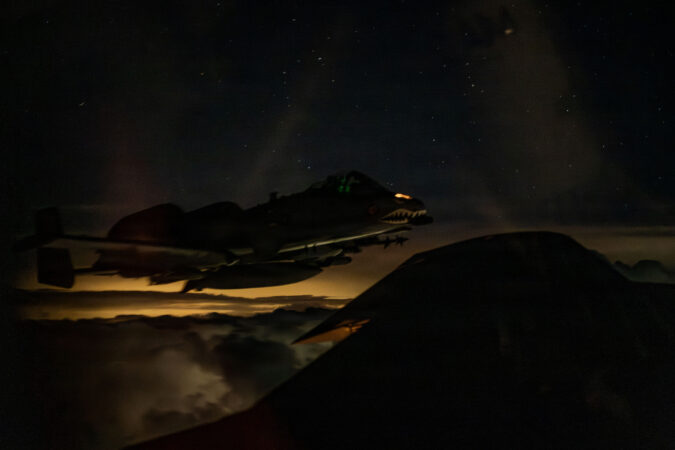
Service leaders first contemplated retiring the A-10 in 1984, after production had ended, according to a 2015 Congressional Research Service report. Leaders didn’t think the aircraft could survive the Soviet Union’s air defense systems projected for the 1990s.
With that adversary’s fall, less sophisticated defense systems gave the aircraft a second life. It was used for 8,084 sorties conducted by 132 aircraft during the first Gulf War, according to the CRS report.
The A-10 conducted 19 percent of close air support mission sorties for the Iraq and Afghanistan Wars between 2006 and 2013, second only to the F-16 with 33 percent, according to the CRS report.
An analysis in a 2021 Congressional Budget Office report found that operating a single A-10 squadron costs $370 million annually. Only the F-16, KC-46, and MQ-9 Reaper squadrons were cheaper, at $290 million, $280 million, and $240 million, respectively.
For comparison, an F-35 squadron ran $740 million a year, the most expensive fighter. And the B-2 Spirit cost $2.29 billion per squadron.
As of late 2024, the Air Force had 219 A-10s in its total inventory. The Active component held 141 aircraft, the Air National Guard housed 31, and the Air Force Reserve operated 47. The average age across the fleet at the time was 43.37 years, according to Air Force data.
The service shed 56 A-10s across the force in fiscal 2025 and had hoped to retired all of its remaining 162 aircraft in fiscal 2026, years ahead of its previous timeline.
However, Congress resisted the sped-up plan and, in December, paused plans to retire 102 of the remaining 162 aircraft.
In February, the service announced it would end depot maintenance for the A-10 at the 75th Air Base Wing at Hill Air Force Base, Utah.
The 124th Air Wing, which commands the 190th Fighter Squadron, began retiring A-10s from Gowen Field to the boneyard at Davis-Monthan AFB, Ariz., in May 2025. The squadron will transition to F-16s, which are slated to arrive in spring 2027. President Donald Trump announced in April 2025 that the 107th Fighter Squadron’s A-10s would be replaced with the F-15EX Eagle II aircraft, which should begin arriving in fiscal 2028. The 74th and 75th Fighter Squadrons at Moody Air Force Base, Georgia, are replacing their A-10s with F-35s. The 163rd Fighter Squadron at Fort Wayne Air National Guard Base, Indiana, began swapping its A-10s for F-16s in 2023. The Ohio Guard’s 179th Airlift Wing and Maryland Guard’s 175th Wing converted from A-10 to cyber units in 2023 and 2025, respectively.
The post A-10 Fleet in Middle East Poised to Double as Jets Cross the Atlantic appeared first on Air & Space Forces Magazine.
Air, 107th Fighter Squadron, 124th Fighter Wing, 175th Cyberspace Wing, 179th Airlift Wing, 190th FS, Bangor ANGB, Gen. Dan Caine, Gowen Field, Iran, Lakenheath, Moody AFB, Operation Epic Fury, Pease Air National Guard Base, RAF Mildenhall, Selfridge Air National Guard Base
Air & Space Forces Magazine
[crypto-donation-box type=”tabular” show-coin=”all”]