The tech industry’s pursuit of space-based AI data centers has potentially significant implications for military space operations, potentially enabling faster communication between satellites from multiple orbits and strengthening sensing and targeting for Golden Dome and related functions, industry and defense officials said March 24.
Over the past year, several companies have announced plans to someday put data centers on orbit. Google unveiled Project Suncatcher in November, projecting to start launching test satellites that would make up a data center in 2027. SpaceX announced last month it would seek Federal Communications Commission approval to launch a constellation of 1 million satellites that would function as an orbital data center.
Other high-flying tech firms, including NVIDIA, Blue Origin, OpenAI, and start-up StarCloud have also pitched the concept as an alternative to the sprawling conventional data centers proliferating around the country, housing racks of computing and network hardware and gobbling up electric power and water, for cooling, to power the cloud-computing and AI boom. These data centers range in size, but can span hundreds of acres, and disrupt local supplies of electricity and water.
On-orbit data centers, while potentially evading energy and water consumption concerns, would shift the space industry’s compute requirements from the ground to space, putting that power closer to spacecraft and thereby reducing latency lost in transmission. With data moving faster, military users could speed up tactical decisionmaking.
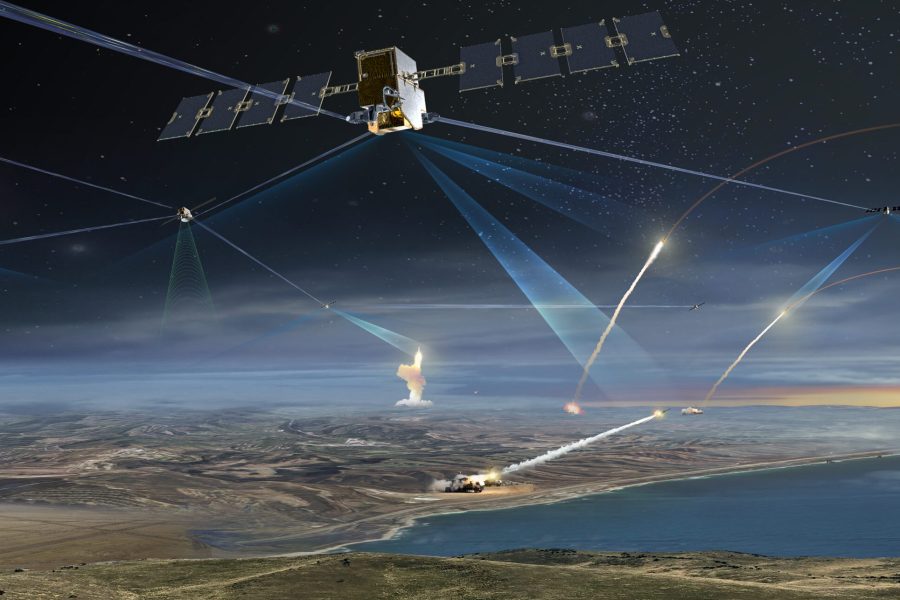
As the Pentagon looks to expand its network of sensors, satellites, and interceptors to enable Golden Dome‘s missile defense shield, data latency is a significant limiting factor. The longer it takes to move data between sensors and decision makers and back to shooters, the less time a decisionmaker has to identify, verify, and respond to potential missile threats.
James O’Brien, chief of U.S. Space Command’s global satellite communications and spectrum division, said on-orbit compute power is crucial to making Golden Dome work—and to fielding multi-orbit constellations for other missions, as well. Speaking on a panel at the Satellite Conference in Washington, D.C., March 26, O’Brien said that while some missions have shifted to low Earth orbit to gain faster data transmission speeds, space-based processing could reduce latency for satellites further from Earth, in medium Earth orbit or geosynchronous orbit.
“It’s hard to beat that lower latency and high throughput,” he said. “If they can drive down latency at geosynchronous orbit, we may see a greater boom in that orbitology versus just a proliferated LEO architecture.”
Asked whether space-based compute will be required for Golden Dome, O’Brien said: “I can’t see it without it.”
“You’re talking about a mission set that specifically needs critical information movement,” he said. “Anything that reduces that latency is critical to that mission set.”
Matt Sieber, strategic sales director for DOD programs and requirements at Kymeta said that as threats evolve and China and Russia develop maneuverable hypersonic missiles, compute power will have to move closer to the edge—that is, to where the sensing is, in space.
“The threat that we’re trying to counter has evolved as well,” he said. “As you start talking about maneuvering threats or hypersonic threats that need very rapid updates, the whole architecture flips on its head and it becomes space-based by necessity.”
The post Data Centers in Space Could Enable Golden Dome: Experts appeared first on Air & Space Forces Magazine.
Space, artificial intelligence, golden dome, missile defense, missile warning and tracking
Air & Space Forces Magazine
[crypto-donation-box type=”tabular” show-coin=”all”]