Defense Secretary Pete Hegseth’s recent decision to have chaplains remove their rank insigna in an effort to make them more approachable to lower ranks has some chaplains concerned that removing the rank could diminish their position and influence within commands.
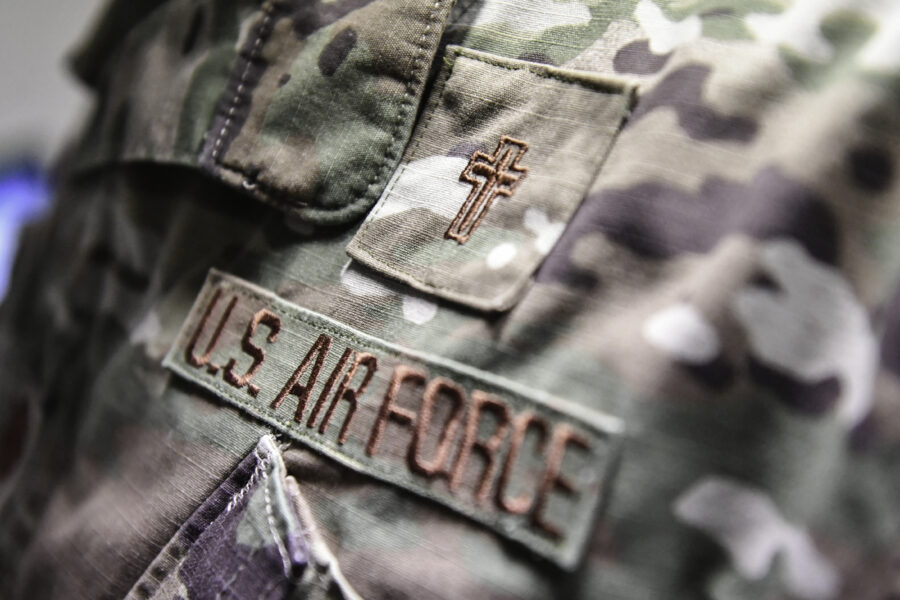
Under the directive, military chaplains in the Air Force, Army and Navy—the Space Force and Marine Corps don’t have their own chaplains—are still commissioned officers, but no longer wear their rank on their uniforms. Instead, they will wear only their appropriate religious affiliation insignia, Hegseth said in a March 24 video posted on X, the social media site formerly known as Twitter.
In addition to the insignia change, Hegseth also said the Pentagon is reducing from some 200 potential religion codes to 31. He described the reforms as “making the chaplains corps great again.”
Referring to the insignia change, Hegseth explained his reasoning.
“This reform is intended to uplift and celebrate the chaplain’s role as a chaplain,” Hegseth said. “It also removes any unease or anxiety junior officers or enlisted personnel may have in approaching an officer, potentially a senior officer, for guidance on sensitive matters such as addiction, relationships, or struggles with faith.”
Former Air Force Chief of Chaplains and retired Maj. Gen. Steven Schaick questioned the premise for the change. He said he never experinced a shortage of young Airmen seeking his counsel.
“I only had 35 years as a chaplain—I started out as a lieutenant, and I ended up as a major general—and I did not ever notice that my rank was prohibiting people from approaching me,” Schaick told Air & Space Forces Magazine. “I found young Airmen intrigued to be able to talk to a major general.”
Chaplains traditionally wear their religious insignia on one side and their rank on the other. Schaick suggested that for some Airmen and Guardians, the more daunting insignia might have been the cross he wore on Active duty: It can be “as much of a hindrance as the rank, because non-religious people just don’t have a lot of reason to talk to a chaplain and that’s kind of been my experience.”
Social media discussions lit up on the issue. On the unofficial Air Force amn/nco/snco Facebook page, some commenters said they never had a problem approaching chaplains, while others said they saw merit in making their rank invisible.
“Lower ranks have a hard time truly opening up to a higher rank,” wrote Raminah Harbor, a former Airman and Defense Department civilian, in a post on one discussion thread. “It’s hard to see past it or put aside when rank and hierarchy is stressed so in the military.”
Former Chief Master Sergeant of the Air Force Gerald Murray applauded Hegseth’s focus spirituality, saying it is important to the well-being of service members. But he disagreed with ordering chaplains to hide their rank.
“The identity of rank among the chaplains and the officership of chaplains gives credibility to a chaplain within the military organization,” Murray said.
The U.S. military’s chaplaincy dates back to July 29, 1775, when the Continental Congress authorized one chaplain for each regiment in the Continental Army, and pay equal to that that of a captain, according to the U.S. Army Historical Foundation. Since then, chaplains have served on the front lines of every war and are often a key resource for troops coping with loss and personal problems, including deaths caused by accidents, suicide, and combat losses.
Chaplains also advise commanders and are part of a command’s leadership team. For Murray, removing the rank could prove to be a step backwards in terms of the input chaplains have on individual commands.
“The bottom line to me is that it could very well affect the access to command authority for chaplains,” he said. “If the general officers are meeting, I want a general officer chaplain there with them. … Over time [this change] could dilute that.”
Hegseth emphasized that a chaplain is “first and foremost, a chaplain, and an officer, second.”
Chaplains, he said, “are first and foremost, called and ordained by God. And while they will retain rank as an officer to those they serve, their rank will not be visible. Instead, they will be seen among the highest ranks because of their divine calling.”
Schaick acknowledged that some chaplains he’s worked with believed similarly that their role as chaplains was primary over their role as officers.
“I don’t subscribe to that,” Schaick counters. “You’re both all the time. You’re both an officer and the chaplain at the same time, and one gives credibility to the other.”
Removing the rank effectively downgrades the chaplain’s position in the command, he suggested. “If we’re not officers, then why do we go through officer training? Why do we spend so much time teaching customs and courtesies and making sure that chaplains adhere to them?”
Murray expressed confidence that “good order and discipline” will be maintained. “Even though you don’t see captain’s bars or major’s clusters,” he said, Airmen will still “you “know they are officers.”
Fewer Religious Affiliation Codes
Hegseth’s March 24 announcement also redesignated the military’s faith and belief codes as “religious affiliation codes,” and reducd them from more than 200 to 31.
“The previous system had ballooned to well over 200 faith codes,” he said. “It was impractical and unusable, and many codes were never used at all. An overwhelming majority of the military population used only six of the codes. Our internal review committee recommended that going forward, the department use 31 religious affiliation codes.”
Schaick expressed no surprise at reducing what he agreed had become an unwieldy list of religions.
Over the years, religious groups that might have only represented a small number of people “threw in their packages” and won official status from the military, yet may “not have ever submitted a chaplain for consideration,” Schaick said. “But the list kept growing.”
The Pentagon has not published the list of the 31 approved religious affiliations, and a spokesperson did not respond to a request by Air & Space Forces Magazine to provide the list.
“My hope is that they came up with some new nomenclature to kind of encapsulate … the ‘churches of Steve Schaick’ and all the other little, maybe lesser groupings,” Schaick said. “Maybe this just streamlines things a little bit more.”
Schaick did not reject outright the removal of chaplains’ rank insignia, saying he will retain an open mind if doing so does in fact make them more approachable.
“If that’s the case, then I’m all open to that,” Schaick said. “Chaplains almost always serve people junior to them, and the rank certainly should never be a barrier.”
The post Hegseth’s Push for Chaplains to Remove Rank Sparks Debate appeared first on Air & Space Forces Magazine.
Personnel, Air Force, Chaplain Corps, Pete Hegseth, Space Force
Air & Space Forces Magazine
[crypto-donation-box type=”tabular” show-coin=”all”]