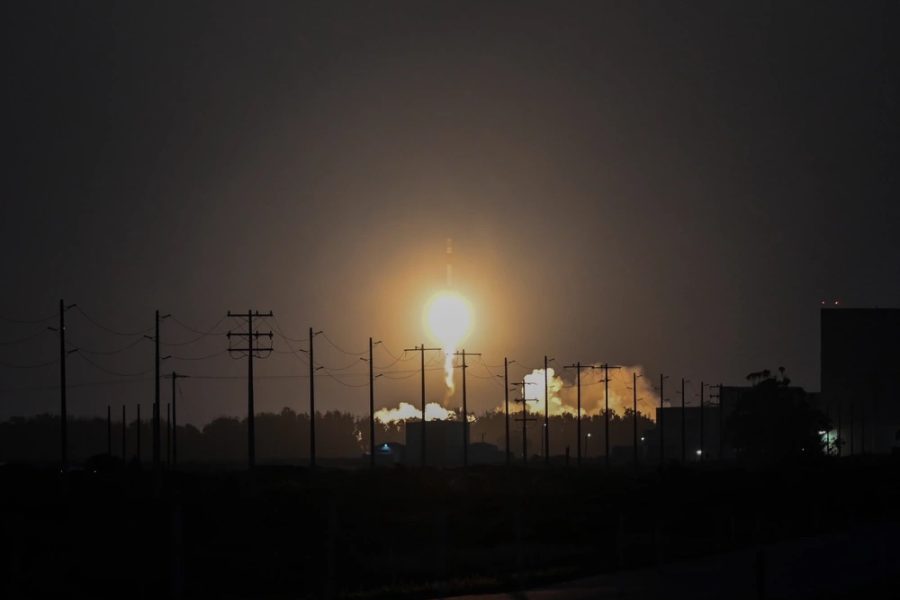
Space Systems Command just conducted its second Tactically Responsive Space mission, Victus Diem—but this time, instead of preparing and launching a live rocket and satellite on rapid timelines, the exercise was a simulation designed to refine its processes for repeatable rapid launch missions.
The two-part exercise, which the Space Force announced in a March 20 press release, included a tabletop excursion held last July and a field training exercise in January. System Delta 89’s Space Safari Office led the effort, which brought together representatives from Space Launch Delta 30 at Vandenberg Space Force Base, Calif., the Rocket Systems Launch Program, and two companies: Lockheed Martin and Firefly Aerospace.
The Space Force defines TacRS as the ability to quickly respond to on-orbit threats in any number of ways—from launching a rocket on demand to maneuvering an at-the-ready satellite to replace or augment another to buying commercial space capabilities during a conflict.
The service set records in 2023 with its first TacRS mission, Victus Nox, demonstrating that it could work with satellite and launch companies to deliver a spacecraft in a matter of months and deploy it to low Earth orbit just 27 hours after receiving launch orders. Millennium Space Systems built the satellite and firefly launched it. SSC has scheduled at least four more TacRS missions aimed at further pushing schedule boundaries as well as demonstrating concepts and fielding new capability.
At the front of the line is Victus Haze, which will feature two launch providers and two payloads: Rocket Lab flying its own satellite; and Firefly launching a satellite built by True Anomaly, a Denver-based space startup. The Space Force initially planned for Victus Haze to launch in 2025, but Firefly’s Alpha rocket had multiple mishaps that delayed the mission to this year. The rocket returned to flight in March, carrying an experimental payload for Lockheed Martin.
Other Victus flights slated to launch this year or next include:
- Victus Surgo, a mission cosponsored by the Defense Innovation Unit that will feature a SpaceX Falcon 9 launching a highly maneuverable spacecraft built by Impulse Space
- Victus Salo, another Falcon 9-supported mission that will carry a payload built by the Massachusetts Institute of Technology
- Victus Sol, launched by Firefly’s Alpha, which will carry an operational payload
While the other missions in the Victus series have live and even operational components, Victus Diem focused solely on codifying processes for TacRS. During the tabletop phase, SSC focused on rapid payload processing by working closely with the launch delta, which runs the service’s West Coast launch range. The exercise demonstrated the ability to complete payload arrival, checkout, mating, and encapsulation operations in under 12 hours.
The field training exercise, or FTX, focused on rapid launch activities. During this phase, the team conducted a 36-hour simulation, practicing how to execute responsive launch protocols during an active conflict. An SSC spokesperson confirmed to Air & Space Forces Magazine that the exercise did not involve any live launch elements.
“The FTX involved simulated launch preparations with government and contractor personnel in the field, and on console, as they would be for a real TacRS mission, but it did not include execution of a live launch,” the spokesperson said. “No hardware such as launch vehicles or space vehicles were moved, and a launch vehicle was not utilized to go through the motions such as transitioning from horizontal to vertical or refueling.”
Col. James Horne, commander of SLD 30, said one goal of the exercise was to strengthen “command relationships” between the various entities involved in the mission. Notably, the exercise included U.S. Space Command, but it also included SPACECOM’s component field command, U.S. Space Forces-Space.
“You are starting to see those two pieces come closer together and work more collaboratively to get the capability on orbit,” Horne said in the press release. “We are increasing the pace at which we can field capabilities and execute them for urgent combat needs.”
The Space Force’s fiscal 2026 budget includes $168 million for TacRS—$33 million in base funding, plus $135 million in reconciliation funds—a significant increase from the $30 million to $40 million Congress has appropriated over the last few years. Beyond planning for a busy run of missions, USSF plans to use that money to fund ground infrastructure, launch range improvements, and software that could support future TacRS missions.
The post Space Force Exercise Aims to Solidify Responsive Space Processes appeared first on Air & Space Forces Magazine.
Space, FIrefly Aerospace, launch, Lockheed Martin, TacRS, tactically responsive space, Victus Nox mission
Air & Space Forces Magazine
[crypto-donation-box type=”tabular” show-coin=”all”]