A photo of a B-52 Stratofortress flying with an apparent pair of Long-Range Stand-Off missiles suggests the Air Force’s effort to test its future air-launched nuclear missile is proceeding well, an aviation expert said.
Jarod Hamilton, the Los Angeles-based director of photograph for CALLSIGN Magazine, snapped the images of the B-52 and posted them to social media on March 21. The Air Force declined to comment on the photograph to Air & Space Forces Magazine.
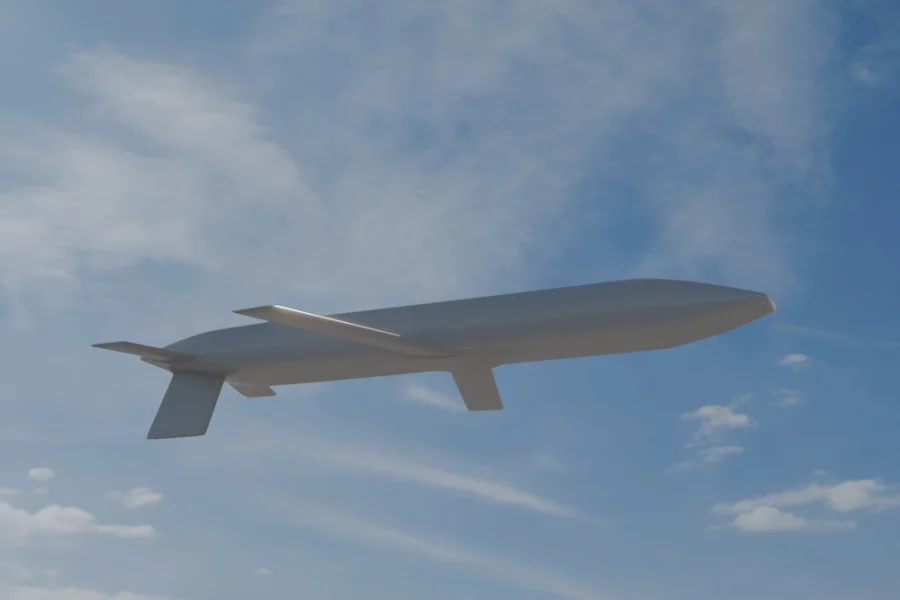
Mark Gunzinger, the director of future concepts and capability assessments for the Mitchell Institute for Aerospace Studies, said the weapons carried on a pylon under the B-52’s wing “appear to conform with the artist rendering of the LRSO released by the Pentagon last year.”
The AGM-181 LRSO is being developed by Raytheon to succeed the Cold War-era AGM-86B Air-Launched Cruise Missile, also a nuclear-armed missile, which is aging and well past its expected service life. LRSO is meant to be launched from the B-52J, a revamped version of the existing Stratofortress, or the upcoming B-21 Raider stealth bomber.
Gunzinger, who is also a retired B-52 pilot, said March 24 that it’s been known for some time now that B-52s have been conducting captive carry tests of inert, unarmed LRSOs. But, he said, the photograph provides hints as to where the LRSO testing process now stands.
“It’s great to see multiple weapons on a single pylon,” Gunzinger said. “That tells you that they have tested these weapons in flight singly, then they go to multiple, then they go to actual live fire where it separates and the engine will torch off [with] inert warheads.”
Such tests, which often take place at Edwards Air Force Base in California, typically are conducted to assess whether a new weapon will safely launch from the carrying aircraft, Gunzinger said, and make sure it is safe to carry or employ several weapons at once.
They are meant to “ensure that the aerodynamics of new weapons are such that they’ll effectively separate [from] the aircraft without striking the weapons bay, or other weapons, if you’re volleying more than a single weapon at a time,” Gunzinger said. “It’s an incremental process, it takes a bit of time. But it’s absolutely critical to safety of flight and effectiveness of the weapons themselves.”
However, Gunzinger cautioned it would be unlikely a B-52 would volley fire multiple LRSOs at once in an actual nuclear war scenario, since the weapons are so devastating and would likely only be used for a single, specific target.
Weapons like the LRSO are not ejected by a charge, Gunzinger said, but instead released from a pylon or internal weapons bay and use gravity to drop for a short period. After it reaches a certain distance away from the bomber, he said, the missile’s wings extend and its rocket ignites.
Gunzinger said the testing progress suggested by this photo is a good sign, especially since the ALCM needs to be replaced. ALCM was designed in the 1970s and first delivered for operations in the 1980s, and Gunzinger said they have become increasingly difficult to sustain in recent decades.
The air defenses operated by potential adversaries such as China or Russia have significantly progressed over the last four decades, he added.
“The ALCM was never designed for the kinds of [integrated air defense systems] that exist today,” Gunzinger said. “In highly contested environments, the B-52 is a stand-off bomber. And if it doesn’t have a stand-off weapon it can employ, then that impacts the effectiveness of our nuclear deterrent in a major, major way.”
The post Image of B-52 with Test Versions of New Nuclear Missile Shows Progress: Expert appeared first on Air & Space Forces Magazine.
Air, B-52, B-52J, Col. Mark Gunzinger, flight test, Long-Range Stand-Off weapon, LRSO, Mitchell Institute, nuclear missile
Air & Space Forces Magazine
[crypto-donation-box type=”tabular” show-coin=”all”]