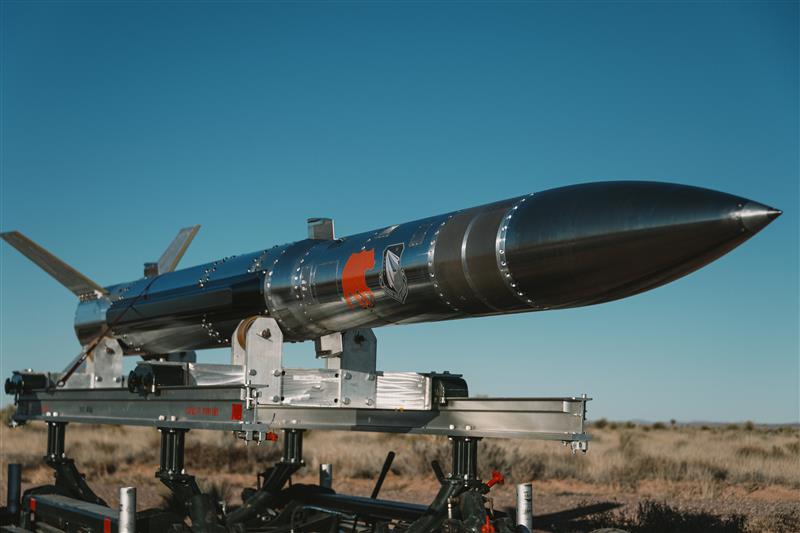
A recent supersonic test flight conducted at Wright-Patterson Air Force Base in Ohio could pave the way for affordable, maneuverable hypersonic missiles by leveraging advances in a decades-old technology.
The Air Force Research Laboratory and aerospace startup Ursa Major achieved supersonic flight using the Draper, a liquid rocket engine developed by the firm, according to a release.
The test was part of a program dubbed Affordable Rapid Missile Demonstrator and is an early step in the larger effort to create the company’s HAVOC missile system, which will use the Draper to produce medium-range, affordable hypersonic missiles.
“This project proves that we can transform and leverage our acquisition models to rapidly deliver critical technology advancements to deter and win in a future conflict,” said AFRL Commander Brig. Gen. Jason Bartolomei. “We are not just building a single missile; we are forging a new path toward a cost-effective, mass-producible deterrent for the nation.”
“This flight proves that you can get a vehicle with a safe, storable, and throttleable liquid engine in the air quickly and affordably,” said Ursa Major CEO Chris Spagnoletti. “We went from contract to flight-ready of an all-up round and propulsion system in just eight months.”
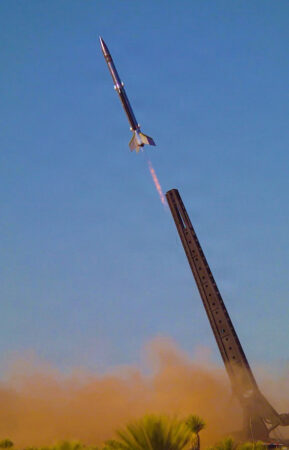
Ursa Major’s ARMD Program Director Kat Hornstein said the timeline is unprecedented compared to the 3-5 years a propulsion project can often take.
The Draper is a 4,000-pound-thrust closed catalyst-cycle engine that uses storable hydrogen-peroxide/kerosene propellant, according to the company’s website.
There are key advantages to liquid rocket propulsion over standard solid rocket motor technology, and the technology is now more accessible due to advances in additive manufacturing and miniaturization, said retired Col. Charles Galbreath, senior resident fellow for space studies at AFA’s Mitchell Institute for Aerospace Studies
“Liquid engines allow for you to start, stop, restart, and throttle the engine,” Galbreath said. “That isn’t possible with solid rocket motors.”
That flexibility, Spagnoletti told Air & Space Forces Magazine, allows for the engine to change mission profiles and launch on demand. Solid rocket motors are more common, but they can’t change thrust on demand to respond in flight.
Spagnoletti explained that the Draper engine is self-contained, carrying both its own oxidizer and fuel, which makes it environment agnostic.
“It can operate from sea level to space, if necessary,” Galbreath said.
Without the need for cryogenics, the technology also helps sustainment and operations become more affordable by eliminating the need for specialized ground equipment, Galbreath said.
By using peroxide instead of liquid oxygen, as some liquid propulsion systems require, the Draper is also storable over a range of temperatures and for five to 10 years, Spagnoletti said. It can also be shipped inert and have fuel added on site.
While the ARMD project focuses on hypersonics for the Air Force, Spagnoletti said the company is seeing interest from all military branches and that Draper’s engine technology is applicable to various platforms and missions.
The HAVOC Missile is a modular system that uses a vehicle encapsulating the Draper engine as its upper stage. Modifications to the upper stage and the booster system can allow for longer range, vertical launch, or mounting on an aircraft such as an F-15, he said.
The CEO said the engine would be well-suited for areas of space where users need high maneuverability and higher-thrust capabilities. One example is when vehicles operate as taxis, traveling from Low Earth Orbit to higher orbits.
Following the recent supersonic test flight, the Draper engine is undergoing a flight upgrade and further testing through this year, followed by a booster-assisted flight, Hornstein said.
Spagnoletti expects a full-up hypersonic booster demonstrator to fly by early 2027.
AFRL announced its partnership with Ursa Major in mid-2023, citing the Draper engine for hypersonic work.
The Draper drew technology development lessons from the company’s Hadley engine. The Hadley is also a liquid rocket engine that runs on liquid oxygen and kerosene, which requires cryogenics. The Hadley has flown multiple hypersonic flights and reached sustained Mach 5+ speeds and return, flying with the Stratolaunch-built Talon-A vehicle, according to a release.
The post New Liquid Rocket Engine Flight Test Shows Promise for Affordable Hypersonic Missiles appeared first on Air & Space Forces Magazine.
Air, Space, Technology, AFRL, Air Force Research Laboratory, Liquid rocket engine, rocket, Ursa Major
Air & Space Forces Magazine
[crypto-donation-box type=”tabular” show-coin=”all”]