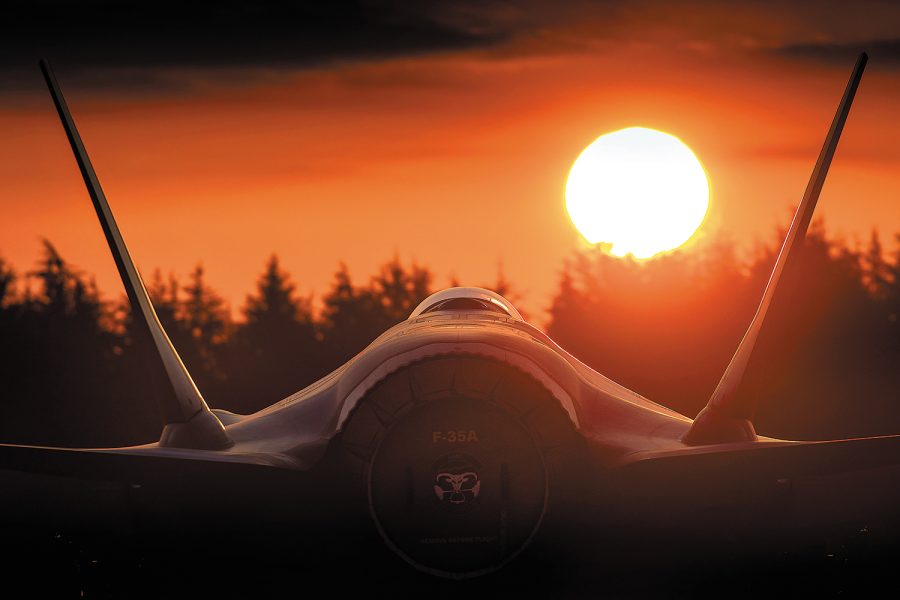
The first F-35 Joint Strike Fighter with ballast, rather than an advanced radar in its nose, flew an acceptance flight the last week of February, Air & Space Forces Magazine has learned.
The F-35B successfully completed the test flight at Lockheed Martin’s Fort Worth, Texas, facility, a required step before the U.S. military could accept delivery of jets without their advanced radar. The still-delayed APG-85 radars are considered government-furnished equipment, and distinct from the airplane, under the government’s contract with Lockheed.
F-35s will arrive without radars at Air Force, Navy and Marine Corps bases for next several months and possibly into next year, until radar maker Northrop Grumman completes work on the next-generation AN/APG-85, an active electronically scanned array, or AESA, radar, which replaces the AN/APG-81 radar in future F-35s. That system was also built by Northrop Grumman.
Lockheed Martin and Northrop Grumman each declined to comment and referred queries to the F-35 Joint Program Office. The JPO did not respond to queries.
Fighter jets can fly without radars and conduct sone flight training, but are limited for combat or combat training.
Breaking Defense was the first outlet to report on the issue, writing March 19 that the U.S. Marine Corps will start accepting radar-less F-35s in the next few months, and that the Navy and Air Force will accept similar deliveries later this year. A source familiar with the matter confirmed that schedule to Air & Space Forces Magazine.
The source also confirmed that several more F-35Bs without radars have flown in recent weeks, although none have been delivered yet. It may be several weeks or more before the Marine Corps accepts delivery, the person said.
The Air Force issued a statement Feb. 12 noting that Lot 17 aircraft now being delivered come with the older APG-81 radar, and that USAF was working with the F-35 Joint Program Office on future deliveries. The JPO said in a separate statement that same day that F-35s “are being built to accommodate the F-35 advanced radar (APG-85) for the U.S. Air Force, Navy and Marine Corps.”
The APG-85 was intended to debut in the midst of Lot 17, the JPO said: “Initial fielding [with the APG-85 radar] for some F-35 aircraft is planned for Lot 17, which began delivery in 2025 and continues through September 2026.”
In a statement to Air & Space Forces Magazine, the Marine Corps acknowledged that the F-35 program’s approach to F-35 Block 4 upgrades, including the APG-85, depended on concurrent development of multiple components. Delays to some components disrupted the planned schedule. This was a calculated risk the JPO needed to take, the Marine Corps spokesman said.
“The Department of War deliberately undertook a highly concurrent development and production program for Block 4 capabilities [including the APG-85] and the largest fighter aircraft production line in the world,” Marine Corps spokesman Capt. Jacob Sugg said in a statement, using the secondary title for the Defense Department. “DOW officials made this decision with full understanding of the risk of having production aircraft ahead of the Block 4 capabilities. The services’ decision ensured that production aircraft could accept Block 4 capabilities, rather than continuing to build Block 3 F-35s that would require extensive retrofit for Block 4 capabilities, thereby saving multiple years of retrofit hardware installation.”
Keeping the Line Going
Heather Penney, a former F-16 pilot who is now director of studies and research at AFA’s Mitchell Institute for Aerospace Studies, said the decision to deliver F-35s without radars is “the least bad option” for the program. Pausing production to wait for the radar would cause even more serious challenges, including quality risks and workforce shortages, she said.
“You can’t turn off an aircraft production line and then turn it on and surge it when all the parts and pieces come together,” Penney said. “If we were to turn off production on the F-35, not only would that then go dark, and we would lose all those skilled workers, you’d lose the running of the production line and how smooth all of that is. … You’re not going to be able to make up for the jets that you didn’t build.”
The Air Force faced a similar problem in the 1970s, Penney said, when many of the first F-15 Eagles were delivered without engines because engine-maker Pratt & Whitney was struggling with production delays. Aircraft flew from McDonnell Douglas to air bases, where the engines were removed, and then trucked back to St. Louis for reinstallation in the next new airframe. Eventually, Pratt caught up and the problem faded away.
The F-35 radar problem is exacerbated by a change in design to support the new radar. The bulkhead on which the radar is mounted was redesigned for the new radar, Penney said, and was not made backwards compatible to fit the older radar.
“The bulkhead is a structural piece of the aircraft,” Penney said. “That would be very difficult to retrofit later.”
The radars are not a simple plug-and-play component that can be swapped out one for the other. Each requires its own processing software, and in a highly integrated airplane like the F-35, that’s not a simple matter.
With the benefit of hindsight, Penney said, it may have been better to mitigate some risk by engineering newer F-35s to operate with either radar. But not doing so was a reasonable choice, she argued.
“For a program that is this complex, I think they were smartly leaning into the future,” Penney said. “They [just] didn’t anticipate the delays with the radar delivery.”
Without a radar, Penney said, the newest F-35s can fly training missions and help those squadrons transitioning to the F-35 from the A-10 Thunderbolt II or F-16 Fighting Falcon. But in combat or combat training, the new jets are still far from blind without their radars. The Lightning II has an electro-optical distributed aperture system providing 360-degree awareness to detect threats, weather conditions and more, and it has extensive data sharing capabilities enabling it to take advantage of the radar in a wingman F-35, or that of a nearby airborne battle management plane, such as the E-3 Sentry.
“It’s still a very viable combat asset,” Penney said. “Is it ideal? Is it as fully capable? It’s not. But if you are able to mix the formation, then you can make up for the lack of radar in many ways.”
The post Military Prepares to Accept F-35s Without Radars appeared first on Air & Space Forces Magazine.
Air, Technology, Air Force, APG-85, F-35 Joint Program Office, F-35 Joint Strike Fighter, Lockheed Martin, Northrop Grumman
Air & Space Forces Magazine
[crypto-donation-box type=”tabular” show-coin=”all”]