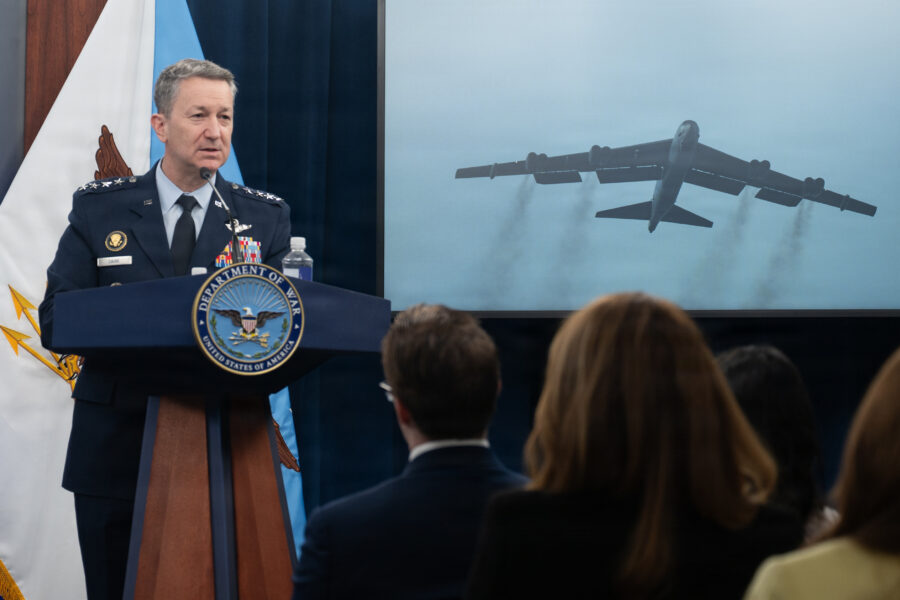
“Their contributions to Epic Fury have been decisive.” That’s how Air Force Gen. Dan Caine, Chairman of the Joint Chiefs of Staff, summed up the contributions of U.S. Air Force bomber crews and maintainers against Iran during a March 19 press conference.
For nearly five minutes, Caine described in detail the key role the bomber force is playing in the conflict and how the Airmen who operate that fleet do their jobs.
Caine noted that all three types of USAF bombers have been used in the operation—B-1B Lancers, B-2A Spirits, and B-52H Stratofortresses—and that the jets are crewed by Active, Guard and Reserve Airmen.
He also mentioned that he recently visited B-1 and B-52 bomber crews and maintainers at a deployed location—without divulging where that visit was. RAF Fairford in the United Kingdom has been the principal operating location for bombers during this operation. According to flight tracking data and aviation spotters, 18 bombers are known to be at Fairford, including 12 B-1s and six B-52s. Together, they represent nearly one tenth of the entire U.S. bomber fleet.
Early in the conflict, B-2 stealth bombers conducted penetrating strikes against Iran, leveraging its stealthy to evade Iranian air defenses. B-1 and B-52 crews initially focused on “stand-off” strikes, firing missiles from beyond Iranian airspace, but once the U.S. established air superiority in the operation, enabling U.S. forces to operate at will over portions of Iran, B-1 and B-52 attacks shifted to “stand-in” strikes using less costly guided bombs, instead.
Bomber jets are unique to the U.S. Air Force, their larger airframes designed to carry far more weapons than multi-role fighter aircraft. The B-1 payload capacity tops out at 75,000 pounds internally and 50,000 externally, far in excess of an F-15’s capacity, which is less than 30,000 pounds.
U.S. bombers have dropped both 2,000- and 5,000-pound “bunker-buster” bombs during Epic Fury, according to U.S. Central Command, destroying Iranian targets including deeply buried ballistic missile facilities.
Caine has made a point in his briefings so far to single out and highlight the contributions of different parts of the joint force.
Gen. Dan Caine’s Verbatim Remarks on Bombers in Epic Fury
“Today I want to talk about some exceptional Airmen who are engaged in the fight daily: United States Air Force, Air Force Reserve, and Air National Guard crews within our bomber force, the B-1s, B-2s and B-52s, and the Airmen on the ground who maintain and load these weapon systems.
“They are the backbone of America’s long-range strike capability, and their contributions to Epic Fury have been decisive. Assigned to STRATCOM under Adm. Rich Carell and supported by TRANSCOM [aerial refuelers], … under the command of Gen. Randall Reed, every mission is designed to achieve overwhelming outcomes on behalf of the United States and our allies.
“Last weekend, I had the chance to go out and see some of our deployed bomber forces, the B-1 and B-52 crews. And I had a chance to sit down with some young aviators and maintainers and ask them, ‘How do you feel? Tell me about your typical day.’
“And these are crews comprised of between two and five Airmen, two on the B-2s, five on the B-52s and four on the B-1s out there. Some of these Americans are in their early- or mid-20s, and we give them the gift of this incredible responsibility, hundreds of thousands of pounds of aircraft, and they take off and go do our work as required.
“Their mission actually begins the day prior, when they’re given a target, or a bunch of targets, and they begin to study those targets [and] look at: ‘What are the effects required? What are the weapons required to get there? How will we program these weapons? What is the weather? What is the tanker flow?’
“It’s an incredibly complex problem that we give each and every one of these crews, and they work it over the period of 24 hours prior, get some rest, and then step out the door to go fly. The last thing they do is they check all of their equipment, their oxygen mask, survival gear, load pistols, and get ready to go. They crank the jets about an hour prior to take off and then launch into the daylight … and, as the kids say, lock in and prepare to go to war, sometimes on a long and stressful journey.
“During the flight, they’re surrounded by technology and capabilities, and they’ll do multiple aerial refueling efforts across tankers on the way to the area of responsibility, either coming from the States or coming from a forward deployed base.
“And I will tell you, as a fighter pilot, getting gas is a lot easier in an F-16 than it is in a B-1, B-2, or B-52 where you are handling this airplane—it is a physical thing—unlike a fighter, that’s a lot easier. And they stay on that boom for sometimes up to 30 minutes, taking hundreds of thousands of pounds of gas. It is a physical, demanding thing to take gas. And they do it multiple times on the way there, and they do it multiple times on the way home.
“As they enter the operating area, they bring the entirety of America’s joint force together to go do the things that we’ve tasked them to do, to put bombs on time, on target, with the proper effects. And I know they’re feeling a range of emotions, but the thing the American people should take away from this is they’re filled with a focus that is incredibly impressive. And they have fear, of course, but their bigger fear is, ‘Dear God, please don’t let me screw this up,’ the warrior’s prayer that we all have in our souls.
“In the [early] days of Epic Fury, they were shooting … a lot of stand-off weapons. Now we’ve switched and rolled, as I mentioned last week, to stand-in weapons, and behind each and every one of them are incredible maintainers and weapons-builders who go out there and make sure these aircraft and their weapon systems are ready to go. These airplanes are so big that they’re not in hangars. They’re out in the cold, out in the snow, out in the rain, [and] the bombs are being built outside for protection and to make sure that it’s safe.
“And they do it 24/7. It’s not comfortable work. But when you go spend just a minute with these incredible, young Americans who are so motivated, you cannot come away from that exchange not being hopeful for America’s future. It is simply awesome. And we hand these Americans incredible and weighty responsibility, and they deliver every single time, quietly, with professionalism and humility, doing the things that we ask them to do.”
The post WATCH: Chairman of the Joint Chiefs Praises Bombers’ Role in Epic Fury appeared first on Air & Space Forces Magazine.
Air, Air Force bombers, Chairman of the Joint Chiefs of Staff, Gen. Dan Caine, Iran, Operation Epic Fury, RAF Fairford
Air & Space Forces Magazine
[crypto-donation-box type=”tabular” show-coin=”all”]