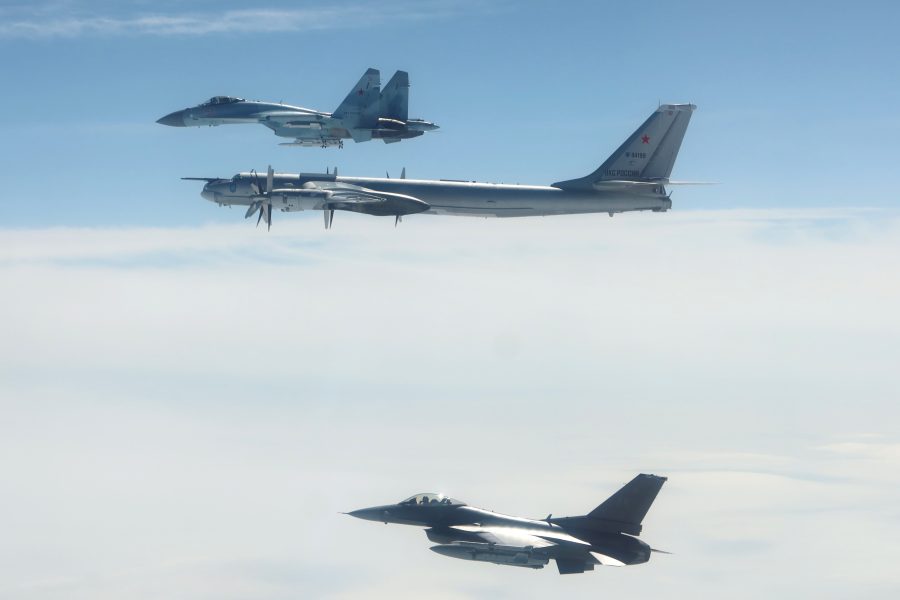
Russian warplanes are flying near the U.S. and Canada at a rate “above historical norms,” the head of U.S. Northern Command and NORAD said this week in written and verbal testimony to Congress.
Air Force Gen. Gregory Guillot also said that China is upping the number of “routine out-of-area deployments” for both its naval and air forces.
NORAD often announces instances when it detects and tracks Russian aircraft entering its Air Defense Identification Zones—buffer zones of international airspace just outside U.S. and Canadian sovereign airspace—and the command’s press releases invariably note that such activity “occurs regularly and is not seen as a threat.”
But in a March 17 hearing of the House Armed Services Committee, Rep. Gil Cisneros (D-Calif.) argued while questioning Guillot that such incursions are increasing and testing how NORAD will respond.
“They’re continuing, trying to push us to see what we can do and how far they’ll go,” Cisneros said.
Guillot did not say whether he agreed that such incursions are meant to push NORAD, but he did confirm that their frequency has picked up.
“Congressman, you’re right, the number of incursions by Russian aircraft into the ADIZ has increased over the last year,” Guillot said, before he was cut off to move on to the next lawmaker’s questions.
In written testimony, Guillot provided more detail.
“In 2025, U.S. and Canadian NORAD aircraft conducted 16 disciplined and professional intercepts of long-range Russian aircraft inside the U.S. and Canadian Air Defense Identification Zones (ADIZ) and have already conducted four this year,” he wrote.
Prior to Guillot’s testimony, NORAD had publicly announced two incursions this year and 10 in 2025. The command did not immediately respond to a query, but a spokesperson told Stars and Stripes last year that NORAD had tracked anywhere between zero and 15 ADIZ incursions per year since Russia resumed long-range aviation activities in 2007.
The latest publicly known incursion occurred March 4, when two Russian Tu-142s, used for maritime reconnaissance and anti-submarine warfare, entered the Alaskan and Canadian ADIZ. That incident was particularly notable given NORAD’s response: A half-dozen American and Canadian fighters, along with six support aircraft, scrambled to intercept. The last time NORAD sent six fighters for an intercept was in response to the first ever combined Russian-Chinese bomber patrol off the coast of Alaska in July 2024.
The March incident was also the first ADIZ incursion since the U.S. launched Operation Epic Fury against Iran, sending a massive amount of airpower to the Middle East.
Guillot has warned about Russian incursions before—in 2024, he revealed that Russian warplanes had entered NORAD’s ADIZ from the northeast, as opposed to near Alaska where most incursions occur. At the time, he said his team was working with NATO and U.S. European Command to keep an eye on that different approach.
In another hearing before the House Armed Services Committee on March 18, Supreme Allied Commander Europe Gen. Alexus G. Grynkewich said he continues to closely monitor the region, often referred to as the GIUKN Gap, for Greenland, Iceland, the United Kingdom, and Norway.
In written testimony, Grynkewich referred to the area as a “strategic chokepoint” and noted that in February, NATO launched Arctic Sentry, an “enhanced vigilance activity” to watch Russian activity there.
That activity is showing no signs of slowing—NATO Allied Air Command announced March 13 that Norwegian F-35s had scrambled on back-to-back days to intercept a Russian aircraft flying north of Norway. The command also said in January that it executed “over 500 scrambles … across NATO airspace” in 2025.
11:30 today,
Eurofighter Typhoons deployed at Ämari,
, were scrambled to intercept a
BE-200 aircraft approaching the Baltic Sea
In 2025, over 500 scrambles have been executed across NATO airspace.
Air Policing and enhanced Vigilance Activities ensure Allied security 24/7 pic.twitter.com/SgyeaRVnNN— NATO Air Command (@NATO_AIRCOM) January 16, 2026
The post Russian Warplanes Flying Near US and Canada More Frequently: NORAD Boss appeared first on Air & Space Forces Magazine.
Air, ADIZ, Air Defense Identification Zone, Alaska Air Defense Identification Zone, Canadian Air Defense Identification Zone, Gen. Gregory M. Guillot, NORAD, Russia, U.S. Northern Command
Air & Space Forces Magazine
[crypto-donation-box type=”tabular” show-coin=”all”]