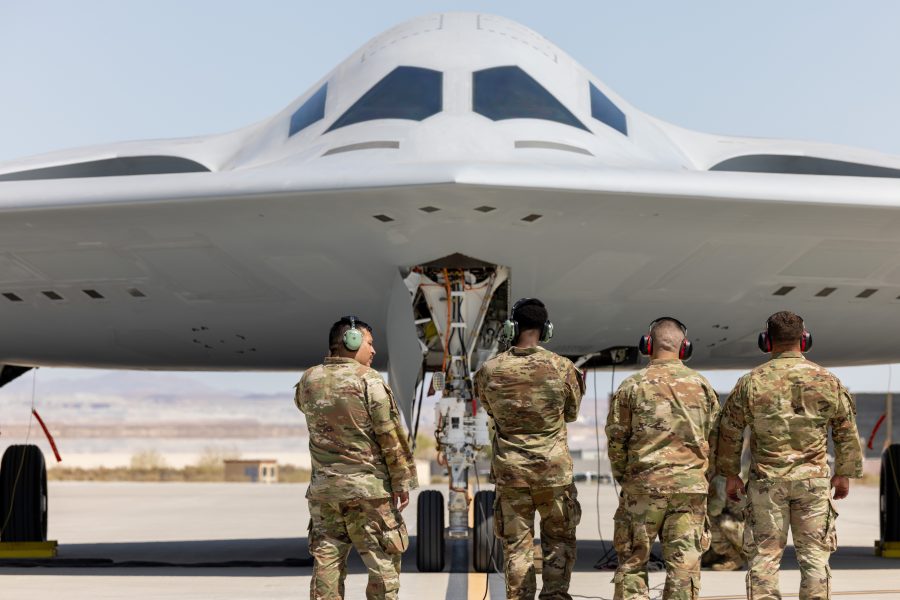
The U.S. military struck a $4.5 billion deal last month to increase the rate of production on its new B-21 bomber. Now officials are considering whether they will open up an entire second production line to go even faster in constructing the sixth-generation stealth Raider.
Adm. Richard Correll, head of U.S. Strategic Command, told lawmakers March 17 that his command still believes the Air Force needs to increase its planned B-21 fleet to 145 airplanes—a figure his predecessor Air Force Gen. Anthony J. Cotton endorsed last March. A second production line could be a way to reach that goal.
“There are, of course, investments that have been made to increase the production rate and to potentially open a second production line,” Correll told the House Armed Services Committee’s subcommittee on strategic forces. “That decision has yet to be made, but clearly the B-21 represents a really significant capability both from a conventional and a nuclear perspective.”
The current Air Force program of record specifies a minimum of 100 B-21s, to be built by Northrop Grumman at its Air Force Plant 42 in Palmdale, Calif. The planes are needed to replace aging B-1 Lancer and B-2 Spirit bombers in the 2030s. The first two B-21s are now in flight test at Edwards Air Force Base, Calif., and the first Raider is scheduled for delivery at Ellsworth Air Force Base, S.D., in 2027.
The Air Force announced on Feb. 23 that it had reached agreement with Northrop Grumman to increase B-21 production capacity by 25 percent, using funds from last summer’s One Big Beautiful Bill Act. The announcement did not say, however, when that capacity increase might translate into actual production.
Gen. Dale White, the Air Force’s Direct Reporting Portfolio Manager for Critical Major Weapon Systems, which includes the B-21, said March 17 that the service is sticking to its goal of at least 100 Raiders. Speaking at the McAleese Defense Programs Conference in Arlington, Va., White explained htat increased production capacity will “allow us that decision space that we didn’t have before,” to increase production when and if desired.
The $4.5 billion is “a very sound investment [that] keeps the program moving in the right direction,” White said. He made no mention off a second production line.
While the Air Force is holding off on increasing the projected B-21 fleet size, STRATCOM’s call for more bombers has support in Congress. Reps. Don Bacon (R-Neb.) and George Whitesides (D-Calif.) both agreed on the need for 145 B-21s.
The B-21’s advanced stealth are designed to enable it strike deep into enemy territory without detection, to carry deliver either conventional or nuclear weapons. Northrop Grumman officials have claimed the mantle of “sixth-generation aircraft” for the the B-21, due to its advanced stealth, open systems architecture, and data sharing technology.
Correll also said acquiring more B-21s will strengthen the nation’s ability to execute complex military operations. “For the joint force, it’s a sixth-generation stealth capability with … stand-off precision distance strike, or stand-in precision strike, and the ability to maneuver within a contested electromagnetic spectrum,” Correll said. “The sooner we field that capability and the sooner we ramp up in delivery of that capability, the stronger position that puts the joint force in, to address the strategic environment, from deterrence to any spectrum of conflict that we would contemplate.”
The post STRATCOM Boss: Pentagon Eyes Second B-21 Production Line appeared first on Air & Space Forces Magazine.
Air, Rapid Acquisition & Sustainment, Adm. Richard Correll, Air Force Plant 42, B-21 production, Northrop Grumman, Palmdale, STRATCOM, U.S. Strategic Command
Air & Space Forces Magazine
[crypto-donation-box type=”tabular” show-coin=”all”]