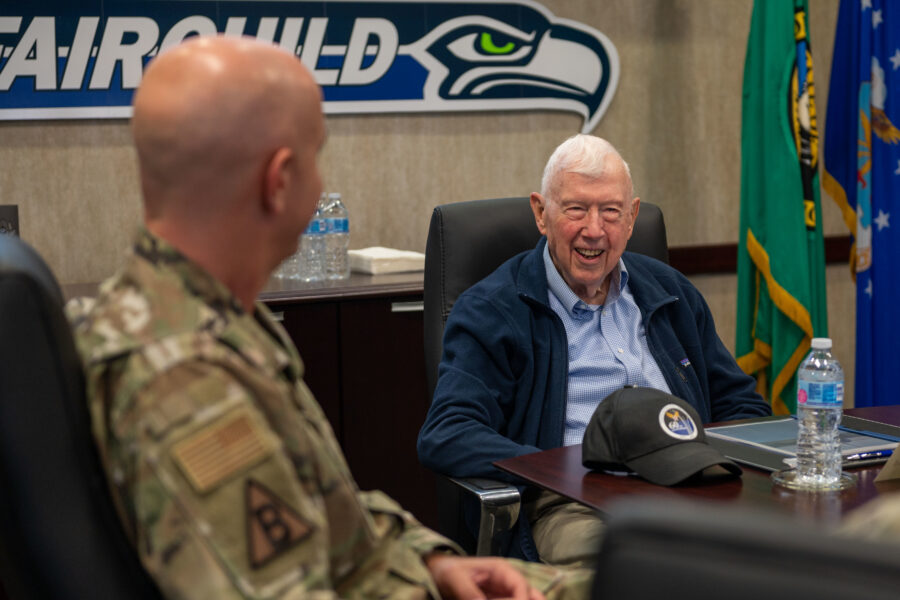
Gen. John Shaud, who led AFA as Executive Director for seven years at the dawn of the 21st century, died at his home in McLean, Va., on March 13 of complications following a stroke. He was 92.
Born in Cleveland to schoolteacher parents in 1933, Shaud grew up as a child of the Great Depression and World War II and spent a year as a pre-med student at Lafayette College in Easton, Pa. But when an Ohio lawmaker offered him a vacant spot at the U.S. Military Academy at West Point, N.Y., he changed his trajectory completely.
“You had to be qualified for pilot training to go to the Air Force out of West Point,” he recalled in a 2014 interview. Setting his heart on that course as a cadet, he earned his pilot wings along with a commission in the Air Force upon graduating in 1956—three years before the first Air Force Academy class would graduate and earn their commissions.
Shaud headed off to pilot training at Reese Air Force Base, Texas, and from there to the 358th Bombardment Squadron at Davis-Monthan Air Force Base, Ariz., where he flew B-47s.
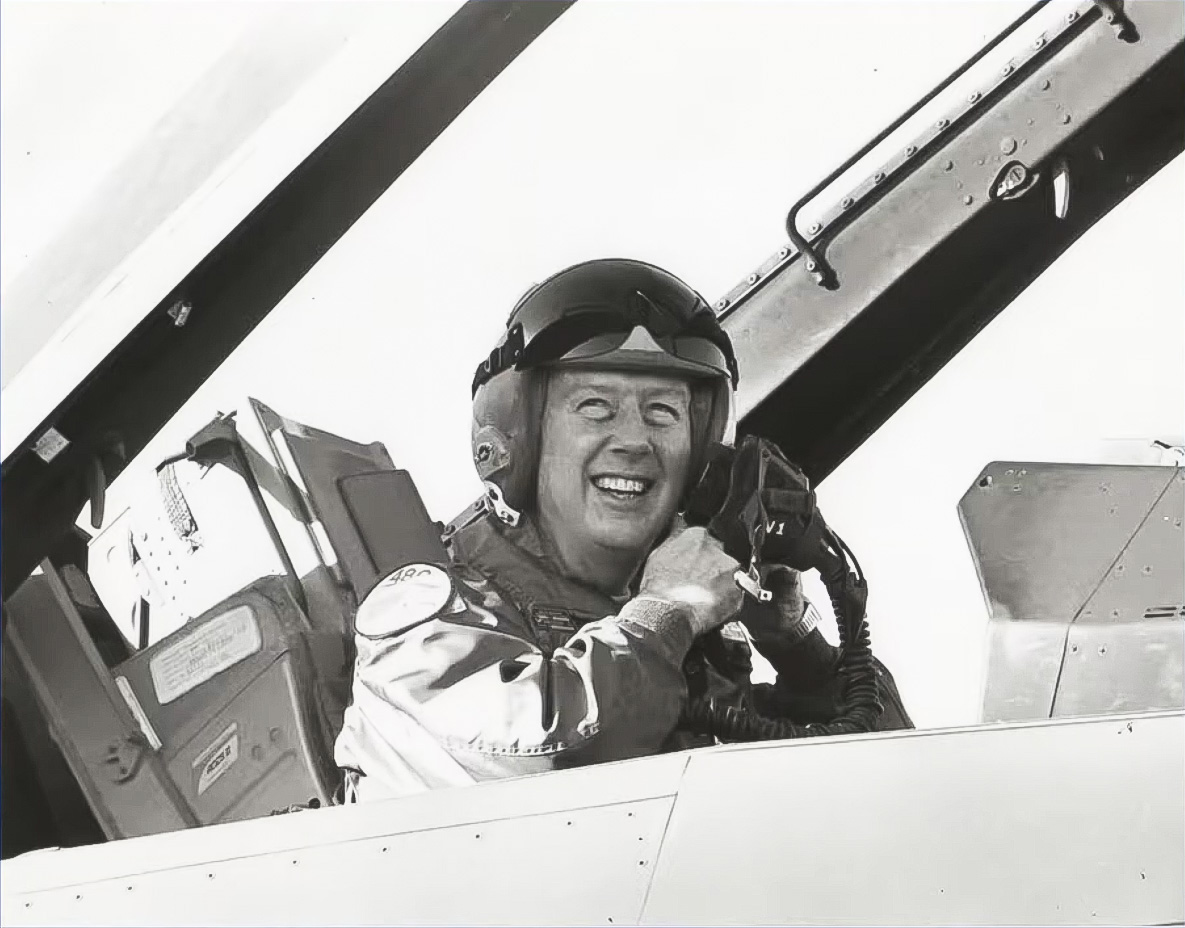
Over the next 31 years he would fly 35 aircraft types, carrying his signature smile and good humor through combat in Vietnam and to command tours at every level. He flew
B-52s with the 17th Bombardment Wing at Wright-Patterson Air Force Base, Ohio, then qualified in the RF-4C before departing for Southeast Asia, serving on the operations staff at the 388th Tactical Fighter Wing at Korat Royal Thai Air Force Base, Thailand, and later flying RF-4Cs at Tan Son Nhut Air Base, South Vietnam, with the 12th Tactical Reconnaissance Squadron.
In between flying tours, Shaud pursued his academic goals, earning a Master of Science degree from The George Washington University in 1967, a doctorate from Ohio State University in 1971, and graduating from the National War College in 1974.
Following staff duty at the Pentagon in Plans and Operations, he took command of the 92nd Bombardment Wing (Heavy) and, later, of the 47th Air Division, both at Fairchild Air Force Base, Wash. He was there when Mount St. Helens erupted in 1980, recalling later that “I knew we could fly from Spokane to Mount St. Helens. What I didn’t know was Mount St. Helens could fly to us.” As volcanic ash approached the base, he had to cancel an air show and send people home as the sky “became like dusk.”
Following a brief tour as commander of the 57th Air Division, Shaud returned to Air Force headquarters, serving in a series of jobs as deputy director of plans, director of plans in the Office of the Deputy Chief of Staff, Plans and Operations, and as the three-star Deputy Chief of Staff for Personnel from September 1985 to August 1986.
He commanded Air Training Command at Randolph Air Force Base, Texas, from 1986 to 1988, and completed his career as Chief of Staff, Supreme Headquarters Allied Powers Europe in Mons, Belgium, serving there from 1988 to 1991.
Shaud had 5,600 flying hours over his career in the B-47, B-52, RF-4C, T-38 and C-21A, among others, including 251 combat hours in the RF-4C. His military decorations include the Distinguished Service Medal, Legion of Merit with oak leaf cluster, Distinguished Flying Cross, Meritorious Service Medal with oak leaf cluster, Air Medal with five oak leaf clusters, and Air Force Commendation.
John Albert Shaud is survived by his wife Beverly Brockus Shaud, his children, Patricia Francis (Tom), James Shaud (Lola) and Katherine Tofigh (Navid). His first wife, Janelle Ohlenbusch Shaud, the mother of his three children, died in 2006 and he remarried in 2010. He leaves behind nine grandchildren and a great granddaughter, and is also survived by a stepson, Jason Heinberg and his stepdaughter, Susan Heinberg, her husband, Andrei Oleinik, and their two children, Nikita and Alex Oleinik, whom he considered grandchildren.
Following his retirement from the Air Force, Shaud continued to serve in significant ways. He was Director of the Air Force Aid Society (now the Air & Space Forces Aid Society); was a senior mentor for the Pentagon’s Capstone Program, advising senior officers from all services newly promoted to flag rank; and in 1995 was named Executive Director of the Air Force Association, where he led the staff from 1995 to 2002.
During his AFA tenure, AFA worked with other associations in the Military Coalition to help pass legislation ensuring states could not impose income taxes on military retirees not living within their boundaries, but who served in those states during their careers, and helped secure an act of Congress ensuring an honor guard detail would be made available on request for any veteran’s funeral. He also led AFA’s efforts to celebrate the Air Force’s historic 50th birthday and set in motion efforts that would ultimately lead to the creation of the Air Force Memorial.
Even after retiring from AFA, Shaud continued to work. He was the first director of the Air Force Research Institute, leading it from 2008 to 2013, and for a decade was president of the SHAPE Officers Association.
In 2011, while leading the Air Force Research Institute, Shaud co-authored a prescient report with Adam B. Lowther analyzing “An Air Force Strategic Vision for 2020-2030.” The study described a future focus “likely to continue shifting from Europe to Asia, which will require a greater emphasis on long-range power projection by the Air Force … that will double, in most cases, the distances the Air Force must fly to reach its primary operating areas.”
The report emphasized the necessity to integrate cyber and space as “particularly important in an Asia-centered world” and advocated for increasing “global situational awareness” by means of affordable space and cyber capabilities as the “only means of conducting surveillance and reconnaissance of peer competitors.”
AFA staff recalled Shaud fondly. “General Shaud was a true American hero, a combat veteran of Vietnam, a thoughtful operational planner and visionary leader, and a great friend and partner in AFA,” said AFA President and CEO Lt. Gen. Burt Field, who holds the post Shaud held a quarter century ago. “He was a man of service, always an advocate for Airmen and airpower, and devoted to our Association. He will be deeply missed.”
Kenneth Goss, who worked under Shaud as Executive Director and was friends with him both before and after that tenure, recalled asking him which aircraft he liked best. Without hesitation, Shaud answered, “The B-47,” adding, as many an Air Force pilot has done, his eyes brightening above his wide grin, “You know, I am the Air Force’s greatest B-47 pilot.”
Another long-time AFA employee, John Tirpak, who recently retired after three decades at Air & Space Forces Magazine, captured Shaud’s memory in just three brief sentences: “He was always smiling; I never saw him angry. He loved AFA.”
In a 2018 awards ceremony, when he was presented with AFA’s Lifetime Achievement Award, Shaud demonstrated his own dedication and humility with two points. The first was recalling former Chief of Staff Gen. John Jumper describing the kind of young person attracted to Air Force service: “The Airmen, with a capital A, coming on board, were interested in becoming part of something greater than themselves, and wanted to be part of a team,” he said. “This reflected what I was thinking about when I joined the Air Force.”
The second point Shaud made was about what one does after hanging up the uniform. “The idea was to give back to this institution that meant so much to us,” he recalled, and he chose to do that through AFA. “Our mission,” he said, “is service.”
The post Gen. John Shaud, Former AFA Boss and SHAPE Commander, Dies at 92 appeared first on Air & Space Forces Magazine.
Air & Space Forces Association, History, AFA, Gen. John Shaud
Air & Space Forces Magazine
[crypto-donation-box type=”tabular” show-coin=”all”]