The Pentagon’s top financial officer said March 17 the department’s fiscal 2027 budget request may be released in just a few weeks— but seemed to acknowledged that the projected $1.5 trillion topline of that request will face heavy political pushback.
Jules Hurst III, who is performing the duties of Pentagon comptroller/chief financial officer, would not give a specific timeline for the budget release but told an audience at the McAleese Annual Defense Programs Conference that “I think we’re very close” and later added that the justification books, or J-books, that provide more granular detail on programs will “probably” be released in April.
President Donald Trump announced in January that he planned to increase defense budget to $1.5 trillion—about $500 billion over 2026 spending levels.
That massive projected increase comes as the Air Force and Navy are expending billions of dollars in precision munitions on Operation Epic Fury, an extended air campaign to degrade Iran’s military capabilities. It has also led to intense speculation as to how the increase will be divided among the Air Force and its sister services and how each plans to spend its extra dollars, whether it be modernization, readiness accounts, or something else.
Typically the Air Force garners about 20 percent of the military’s budget. If that portion remains consistent, Trump’s proposed increase would be about $100 billion in 2027.
But as the budget release draws near, it’s still unclear if Congress will agree to such a large increase.
“The president has said very clearly—he’s going to come over with a $1.5 trillion defense budget; we will mark to $1.5 trillion,” Rep, Rob Wittman (R-Va.), vice chair of the House Armed Services Committee, said during the conference, before couching his statement: “Now it’s another issue about what the appropriators are going to do and where they find those dollars, but the bottom line is we will mark to that [amount] and we will look across the spectrum of the things that we need to do to build this nation’s capacity.”
Rep. Adam Smith, the top Democrat of the HASC, sought to pour cold water on the idea of a $500 billion budget increase, citing the national debt of some $38 trillion and the argument some analysts have made that the Pentagon needs a slow, steady increase, not one massive jump.
“I don’t see a $1.5 trillion budget coming through this Congress,” Smith said. “If it did, it would set us up for pretty big failure down the road.”
Hurst said he remains confident in the $1.5 trillion topline but acknowledged the possibility that the Pentagon could walk away with less when the final appropriations bill passes Congress.
“If we don’t get the $1.5 trillion, I’m confident we’re going to get close to about that,” Hurst said, adding that Pentagon officials would have to “figure out where we would take risks” on defense spending.
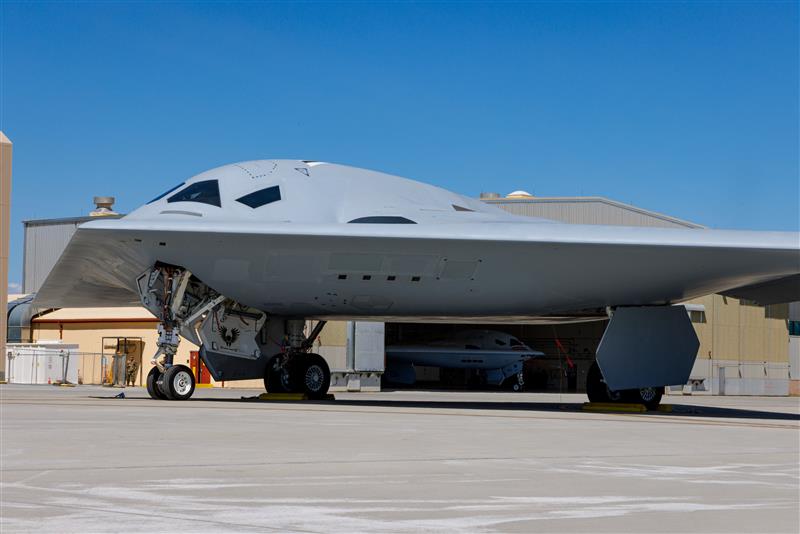
For the Air Force, any reduction in its budget request could mean less money for over-cost programs like Sentinel, the long-delayed replacement to the Minuteman III intercontinental ballistic missile, as well as high priorities like the F-47 Next-Generation Air Dominance fighter or B-21 bomber.
It’s also unclear how the upcoming budget will deal with the mounting costs of Operation Epic Fury. Pentagon officials said the first six days of the operation, which began Feb. 28, cost roughly $11.3 billion, and the White House has been crafting a supplemental funding package to help pay for the operation’s mounting costs.
Hurst would not provide details but said the Pentagon is “providing options” so the White House can decide whether a supplemental package should be part of Trump’s proposed topline increase or a separate funding line.
For the future fight, the Air Force is prioritizing the development of the B-21 and the F-47, but Secretary Troy E. Meink said he is also pushing the service to “dramatically increase production” of weapons systems of all types.
Meink said the service has to change the way it plans to produce its defensive systems as well as its arsenal of offensive capabilities to adapt to the evolving threats it faces.
In the past, the Air Force did not anticipate “the numbers and the scale” of systems it would need.
In many cases, “we haven’t designed them for production, or we haven’t facilitated that production,” Meink said. “But that to change; that has to change rapidly.”
The post Defense Budget Release Weeks Away, but $1.5 Trillion Topline Faces Pushback appeared first on Air & Space Forces Magazine.
Budget, 2027, 2027 budget request, fiscal 2027 budget, Jules W. Hurst III, McAleese conference, McAleese Defense Conference, President Donald Trump
Air & Space Forces Magazine
[crypto-donation-box type=”tabular” show-coin=”all”]