Component Commands Must Grow to Support Surge Ops, New Missions: Official
As Space Force leaders call for the service to double in size in the coming years, the commander in charge of presenting forces to U.S. Space Command said part of that growth will need to go toward increasing the footprint of forward-operating units.
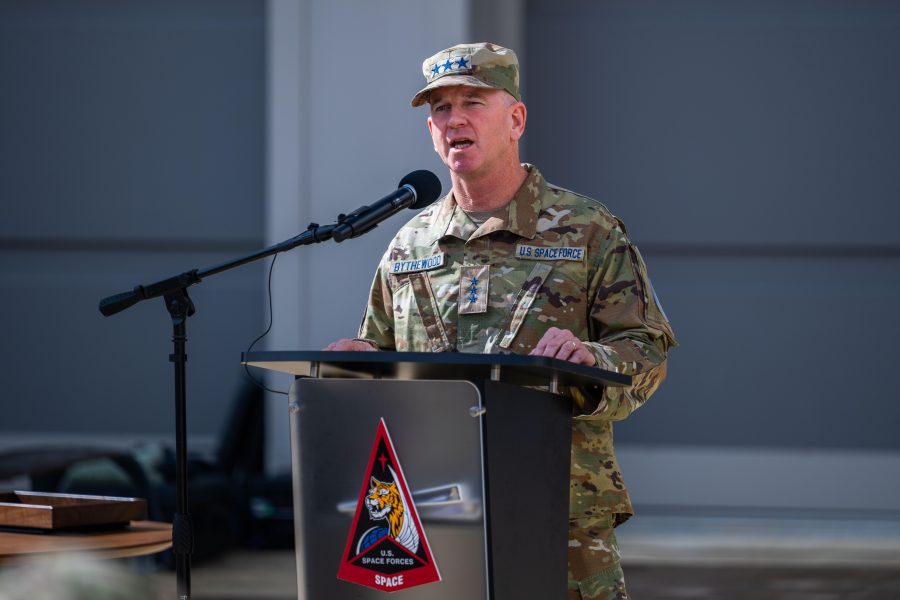
Lt. Gen. Dennis O. Bythewood, commander of U.S. Space Forces-Space, said during a March 13 event with AFA’s Mitchell Institute for Aerospace Studies that the service’s components under each of the combatant commands are building out Space Support Teams comprised of Guardians who will “surge” to forward operating locations during conflict.
“As we walked forward and stood up U.S. Space Force components—now with almost every combatant command around the planet—each one of those was sized to get off the ground and start doing the integrated work that we’ve seen,” Bythewood said. “But we already see that in stressing times, we’re having to surge people forward.”
The Space Force today has eight components; Along with Space Forces-Space, it has established components within U.S. Northern Command, U.S. Southern Command, U.S. Indo-Pacific Command, and U.S. Central Command. It also has a combined component for U.S. European Command and U.S. Africa Command, and sub-unified combatant commands in Japan and Korea.
To support future surge requirements, Bythewood said, Space Forces-Space and other component commands will need to grow so that when Guardians are deployed, regular operations aren’t disrupted.
“Those teams also need to grow just to do their day-to-day mission of integrating space capabilities into the joint force,” he said, adding that his command has “growth that’s already laid in over the next couple of years to get after that.”
Space Force leaders have been making their case for more personnel and funding on Capitol Hill and in public appearances, arguing that while the service was created six years ago as a lean and agile force, it needs to grow in order to meet new demand for space capabilities.
“To effectively fulfill our national mandate, we must increase our infrastructure and double our size,” Chief Master Sergeant of the Space Force John Bentevigna said during a recent Senate Armed Services personnel subcommittee hearing. “This critical expansion is not only necessary, but entirely achievable.”
While additional capacity is needed to meet today’s missions, Bythewood said component commands will also need to grow to support future mission sets. For example, as the Space Force brings on new capabilities like space-based moving target indication, its Combat Forces Command will need to create squadrons to perform that mission and, in turn, Space Forces-Space and the other component commands would generate new “presented elements.” That increase in presented forces would then require more support from the teams that manage and direct operations.
“I tend to think of it as, the growth happens at the tactical level and then you’re growing the planning teams and the management teams above,” Bythewood said.
The Space Force’s forthcoming “objective force” planning document—which will lay out the capabilities, personnel, and support structures the service expects to need over the next 15 years—will include component commands requirements in its assumptions. Bythewood said his command is providing inputs, though much of its focus is on near-term needs.
“From my command standpoint, just like the combatant commanders, I tend to be focused on, ‘What can you do for me now? What do we have for the capabilities in the next one to two years?’” he said.
The post Space Force Components Building Up Units to ‘Surge’ Forward appeared first on Air & Space Forces Magazine.
Space, component commands, Lt. Gen. Dennis O. Bythewood, Space Force components, Space Forces-Space, U.S. Space Forces Space
Air & Space Forces Magazine
[crypto-donation-box type=”tabular” show-coin=”all”]