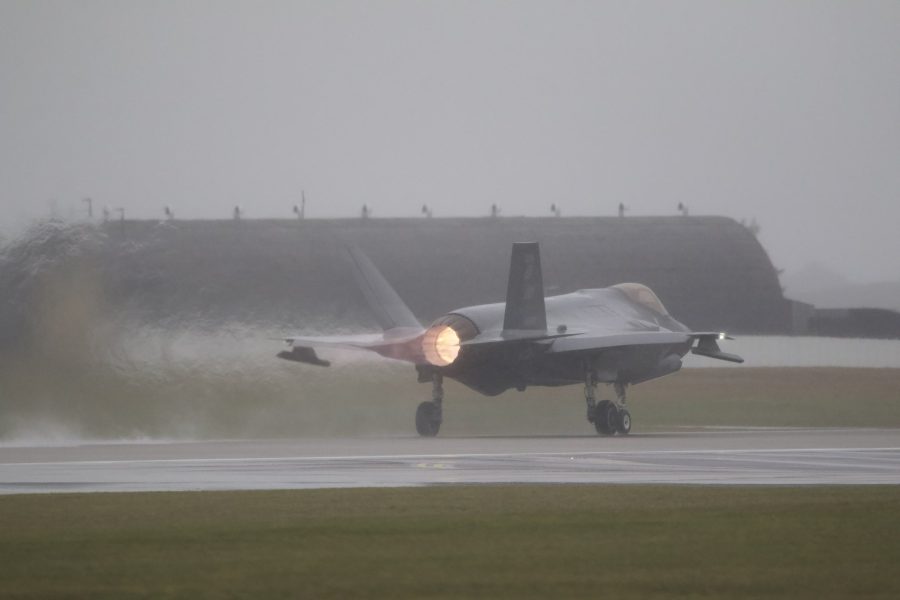
U.S. Air Force F-35A Lightning II stealth fighter jets were observed flying toward the Middle East on Feb. 11, the latest step in the U.S. military buildup in the region as the Trump administration weighs possible strikes on Iran.
The administration has threatened to strike Iran if the two sides do not strike a deal constraining the Iranian nuclear program.
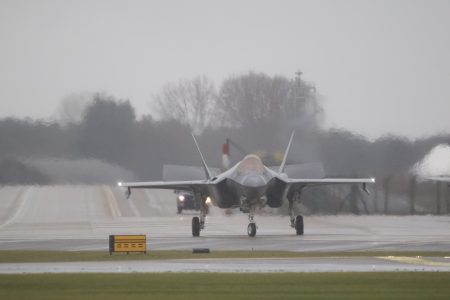
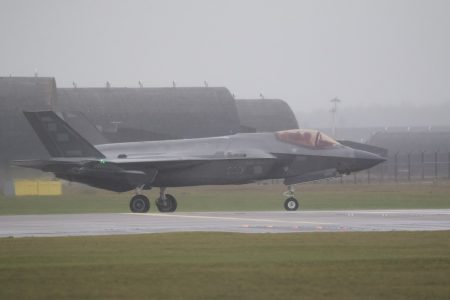
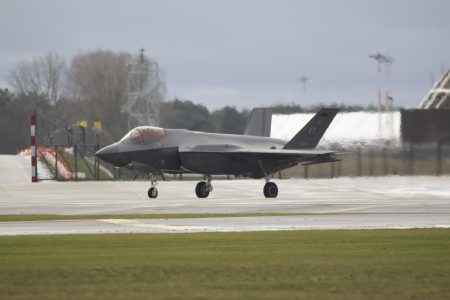
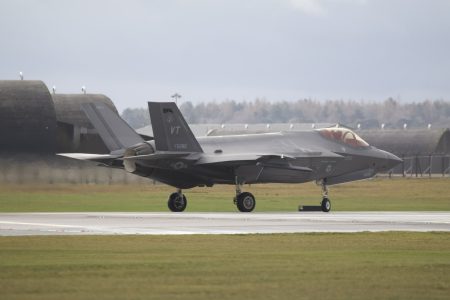
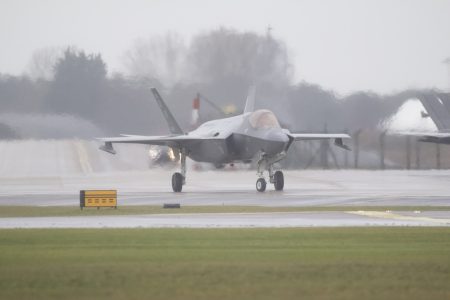
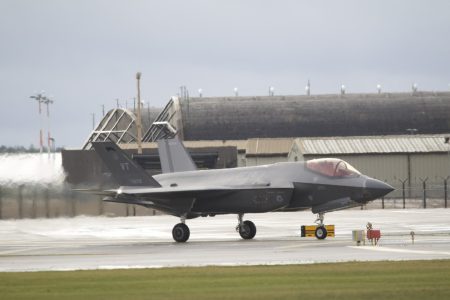
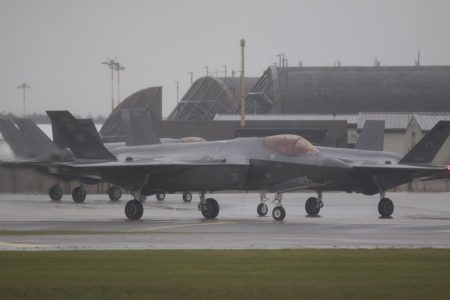
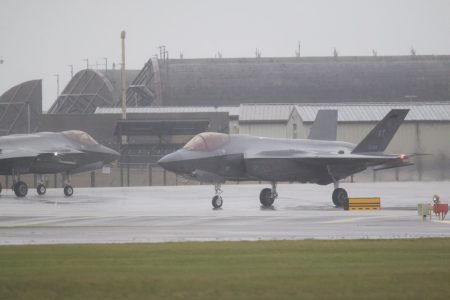
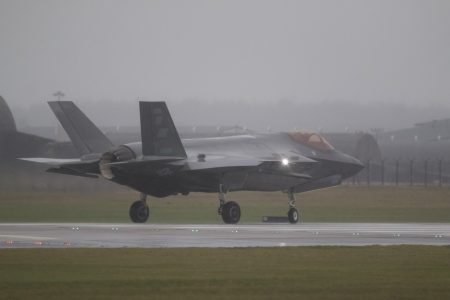
The F-35s headed toward the Middle East are the same ones that deployed to RAF Lakenheath in the United Kingdom on Feb. 9, which is often used as a stopover point for fighters bound for the Middle East from the United States. On Feb. 11, the six fighters departed Lakenheath, according to local aircraft spotters and air traffic control communications.
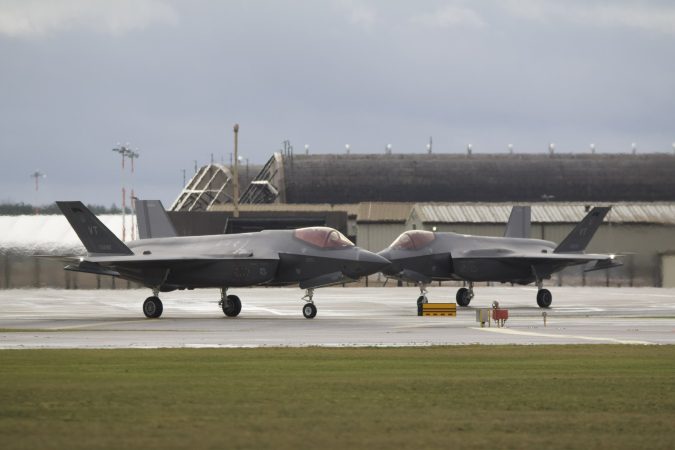
Local aviation photographer Glenn Lockett observed the F-35s leaving Lakenheath at roughly noon local time and shared photos of their departure with Air & Space Forces Magazine.
The F-35s used “Tabor 41” through “Tabor 46”—the same callsign used when they crossed the Atlantic from Vermont on Feb. 9. The F-35s are from the Vermont Air National Guard’s 158th Fighter Wing, noted by the “VT” tailflash and serial numbers painted on aircraft, though at least one of the jets that took off from England on Feb. 11 had its identifying information painted over, photos show.
The fighters were accompanied by three KC-135 Stratotankers that took off from RAF Mildenhall, U.K., and headed over the Mediterranean towards the Middle East, according to flight tracking data.
U.S. Central Command, which oversees forces in the Middle East, declined to comment.
Lakenheath has its own unit of F-35As belonging to the base’s 48th Fighter Wing, though there is no indication that those jets are deploying.
On Feb. 6, the U.S. and Iran held indirect talks regarding Iran’s nuclear program. In an interview with Axios on Feb. 10, Trump said he expects talks to continue next week, covering Iran’s nuclear program and possibly its ballistic missile program.
“We have an armada that is heading there, and another one might be going,” Trump said, referring to the deployment of another aircraft carrier strike group that would join the USS Abraham Lincoln aircraft carrier, which is in the region.
The Lincoln carries F-35Cs, the naval variant of the aircraft, and F/A-18 Super Hornet fighters, as well as EA-18 electronic attack aircraft that can take out air defenses. On Feb. 3, an F-35C from the ship shot down an unarmed Iranian Shahed-139 drone that appeared more than 25 miles away from the carrier. U.S. officials have said the Iranian drone was maneuvering toward the carrier.
Air Force F–35As, along with other aircraft, were also used to suppress Iranian air defenses and escort the seven B–2 Spirit bombers that participated in Operation Midnight Hammer, the operation to bomb Iranian nuclear sites last June.
At that time, Trump said the U.S. had “obliterated” those facilities, but Pentagon spokesman Sean Parnell provided a more qualified assessment in July, telling reporters that the U.S. strikes had “degraded their program by one to two years.”
“Either we will make a deal, or we will have to do something very tough like last time,” Trump told Axios, referring to Operation Midnight Hammer.
Trump is meeting with Israeli Prime Minister Benjamin Netanyahu at the White House on Feb. 11 to discuss the Iran talks. The Israeli government is pushing the Trump administration to get Iran to agree to a deal that includes inhibiting Iran’s ballistic missile program and curtails Tehran’s support for its proxy groups in the region, rather than one solely forced on Iran’s nuclear program.
There could be more F-35s headed to the Middle East. Six F-35s from the same unit that left Lakenheath on Feb. 11, the 158th Fighter Wing, are currently deployed to Morón Air Base, Spain. Those jets first arrived in Europe last month from Puerto Rico.
Early this year, the unit, which specializes in the suppression of enemy air defenses, participated in Operation Absolute Resolve, the U.S. mission to capture Venezuela’s former president Nicolás Maduro.
The U.S. has dispatched other forms of additional airpower to the Middle East in recent weeks as well. Lakenheath deployed 12 of its own jets, F-15E Strike Eagles from the 494th Fighter Squadron, to the Middle East last month. As of Feb. 11, before the arrival of the F-35s, the Air Force had boosted its fighter footprint in the Middle East to three squadrons of F-15Es, one squadron of F-16 Fighting Falcons, and one squadron of A-10 Thunderbolt II attack planes. One of those F-15E squadrons, from Mountain Home Air Force Base, Idaho, has been in the region for roughly 10 months, an unusually long deployment.
The U.S. has also deployed Patriot and THAAD missile defense systems to the region, officials said. More than 80 C-17 Globemaster III and C-5 Galaxy flights have flown to the Middle East from locations known to host air defense equipment and personnel, noted an analyst who monitors assets entering the region using flight-tracking data and other open-source information. The Air Force’s newest search-and-rescue helicopters, HH-60W Jolly Green IIs, deployed to the Middle East late last month.
Iranian president Masoud Pezeshkian said Feb. 11 that his country would “not yield to their excessive demands,” referring to talks with the U.S.
The post F-35s Flying Toward Middle East as Trump Presses Iran for Nuclear Deal appeared first on Air & Space Forces Magazine.
Air, National Security, CENTCOM, Donald Trump, F-35, Iran, Israel, Middle East, Operation Midnight Hammer, U.S. Central Command
Air & Space Forces Magazine
[crypto-donation-box type=”tabular” show-coin=”all”]