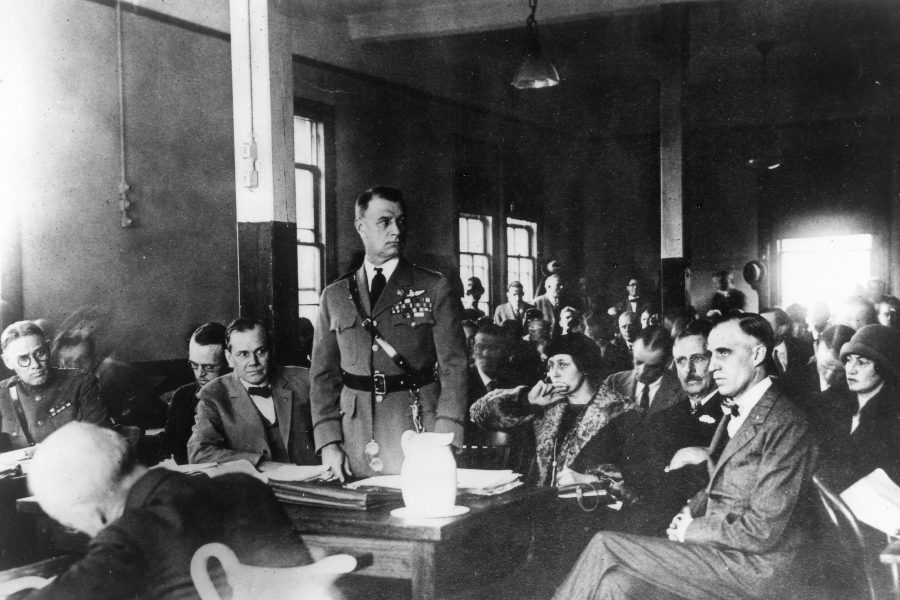
Exactly 100 years ago, on Dec. 17, 1925, Brig. Gen. Billy Mitchell was convicted by court-martial for violating an order that required approval before he could engage with the media. Ironically, his conviction grounded him on the 22nd anniversary of the Wright Brothers first flight.
Mitchell’s provocative thoughts and unorthodox methods sought attention for a cause that he saw as uniquely American. In his mind, airpower would be “the determining factor in international competitions, both military and civilian.” Thus, he knew that its promotion was vital to national security.
In preparing to publish “Mitchell’s Winged Defense: The Development and Possibilities of Modern Air Power, Economic and Military,” his publishers recommended that he back off from his more flamboyant claims and radical concepts. They feared it would hurt his book sales. Mitchell didn’t care, saying he wanted his writings to be read and relevant “a hundred years hence.” They are!
Mitchell was the “dominant figure in American aviation” following World War I. His advocacy for airpower, though far beyond the capabilities of the time, would be a natural fit for the headlines of our current day a century later. His concepts on the decisiveness of airpower were directly relevant to the 12-Day War between Iran and Israel; his ideas on the potency of strategic bombardment were brilliantly demonstrated by Operation Midnight Hammer’s B-2 strikes on Iranian nuclear sites; his belief in the necessity of air superiority to break the stranglehold of attrition is playing out daily in Ukraine; and Mitchell’s concerns about shattered American isolationism are relevant to prompting major investments in Golden Dome. His foresight remains legendary, whatever one thinks of his methods.
Yet, there are aspects of Mitchell’s methodology that are also relevant to today’s focus on military agility, readiness, and lethality. Mitchell successfully engaged in a campaign of culture design that utilized performative leadership and employed concepts of provocative language, nontraditional images, and relentless socialization.
Intentional global messaging has played a significant role in recent conflicts. We have seen it in Ukraine, Russia, Israel, Iran, and the Caribbean. Deliberate strategic communications campaigns designed to sway world opinion and shape strategic perception regularly flash onto our screens and populate our feeds. Yet, the performative nature of warfare must not be limited to its outward facing strategic impacts. It must also be intentionally cultivated to prompt rapid culture change from the inside out. It would be a strategy familiar to Billy Mitchell.
Mitchell understood that carefully orchestrated events could capture the attention of decision-makers and captivate the focus of the public. Transcontinental air races, air mail deliveries, and flights to Alaska were all intentional stunts, publicized and sensationalized to prove a point and captivate the public. Yet, none of those activities were as powerful as the sinking of a hardened German battleship seized in the wake of World War I. The sinking of the Ostfriesland in 1921 was the singular event that transformed the future of air warfare. It was the original manifestation of global strike.
The Ostfriesland was deemed impervious to attack from the air, yet in spite of U.S. Navy inputs to the test concept that drastically curtailed the probability of success, Mitchell’s team sent this ship to the seabed. Mitchell described the scene as follows: “It was a very serious and awesome sight. Some of the spectators on the observing vessels wept, so overwrought were their feelings.” The sinking hearkened the eventual end of the battleship as the dominant element of naval power. A joint board that followed Mitchell’s trials “called for the maximum development of aviation, the rapid addition of aircraft carriers to the Navy, and the improvement of antiaircraft armament.”
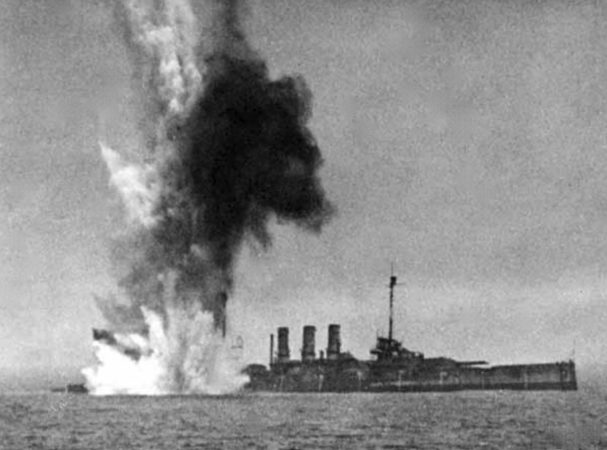
This extraordinary response was not derived from a binder of data on operational relevance or military effectiveness. Nor did Mitchell’s methods rely on mounds of study or the preponderance of data. Instead, he simply used an event to capture the minds of the public through carefully designed imagery and a discrete concept that lingers more than 100 years hence. Mitchell used the same concept a few years later at great personal risk to further his cause and captivate the nation.
By 1924, Mitchell’s strategy of showmanship was waning in its effectiveness. He yearned to break through the noise and shatter the sensibilities of a public intent on isolationism. Statements and articles that called the military leadership incompetent, negligent, and near-treasonous did the trick. He was court-martialed, creating a grand public stage on which to articulate his worldview.
Billy Mitchell viewed his trial as a “necessary cog in the wheel of progress, a requisite step in the modernization and rehabilitation of the national defense of the country.” Counter to the advice of counsel, he even gave his own closing statement, recognizing it as a prime opportunity to publicize his contentions about airpower. His conviction added to the spectacle and further fueled public opinion and decision-maker policies on the future of airpower.
At the cost of his career, Mitchell’s arguments propelled his cause. Prompted by the unmistakable spectacle of his trial, the Morrow Board established the nation’s first broad aeronautical policy and created a structural foundation for what would eventually become the separate service of the United States Air Force. It was a personally costly but broadly successful strategic communication campaign.
The conditions of the day required something that would break through the prevailing and alluring comforts of the status quo. Mitchell utilized unconventionality when more traditional means were falling flat. It was radically effective in kick-starting cultural change that dwarfed the plodding and tired methods of the management experts. The grit and gristle of the military’s bureaucratic machine required that catalyst and Mitchell helped reprogram the system to embrace transformation.
As in Mitchell’s day, transformation of today’s national security culture cannot be forced merely through edict, prescriptive policies, or mountains of well-intended rules and regulations. Instead, it is fundamentally about culture change, a complex science that Mitchell innately understood. Cultural change requires both sound concepts and performative methods. Despite the best traditional arguments, culture keeps its firm grip on a system designed to protect itself until shaken loose by something provocative, captivating, and relentlessly socialized.
Through his performative leadership, Billy Mitchell shook the system loose and paved the way for American airpower dominance. By utilizing his unique version of culture design, he changed both perception and reality to overcome a system effectively designed to sabotage progress. Employing similar methods, we can apply his tactics to overcome substantial challenges in our own context 100 years hence!
Jason Korman is the CEO of Gapingvoid Culture Design group and the creator of the Culture Science® methodology. Gapingvoid is the world’s only Culture Design® firm and serves fearless leaders in both the private and public sectors. His writing has been published on outlets such as London School of Economics, Businessweek, Forbes, MIT Sloan Review, The Wall Street Journal and The World Economic Forum, and Washington Times.
Retired United States Air Force Brig. Gen. John Teichert is a leading expert on foreign affairs and military strategy. He served as commander at Joint Base Andrews, Md., and Edwards Air Force Base, Calif., was the U.S. senior defense official to Iraq, and recently retired as the assistant deputy undersecretary of the Air Force for international affairs. A prolific author and speaker, he can be followed at johnteichert.com and on LinkedIn.
The post Billy Mitchell: Lessons a Hundred Years Hence appeared first on Air & Space Forces Magazine.
Air, History, 12-Day War, aircraft carriers, B-2, Billy Mitchell, Brig. Gen. John Teichert, Court martial, Gapingvoid, Jason Korman, Mitchell’s Winged Defense, Morrow Board, Navy ships, Osfriesland, transform culture
Air & Space Forces Magazine
[crypto-donation-box type=”tabular” show-coin=”all”]