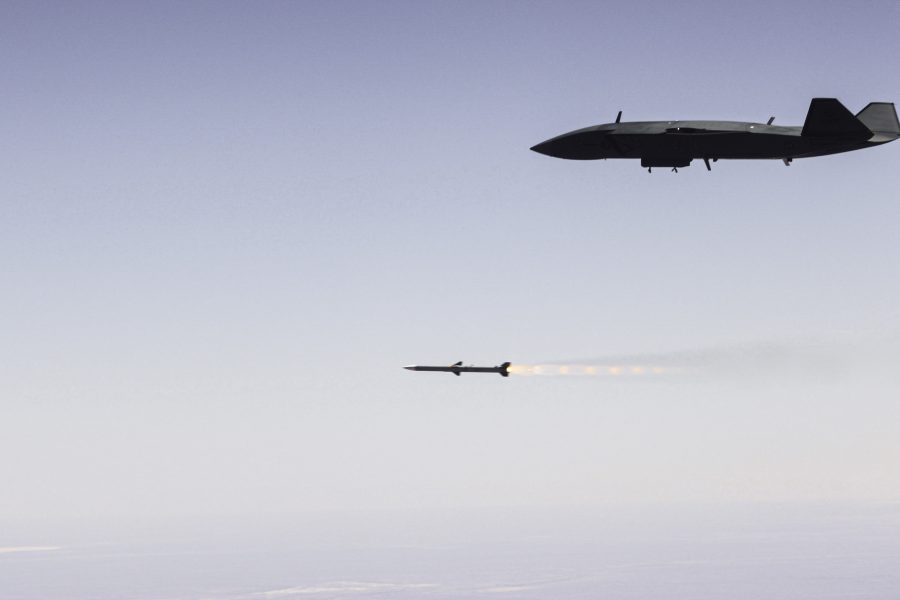
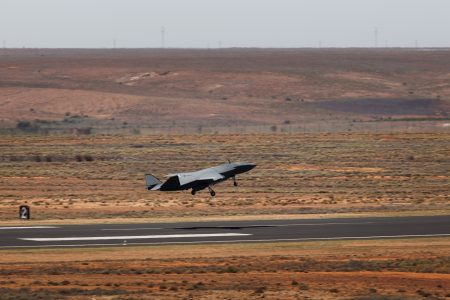
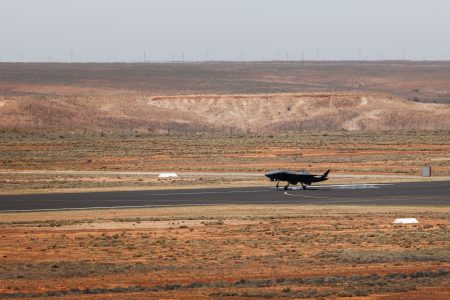
A semi-autonomous Collaborative Combat Aircraft drone shot down an air-to-air target in a Dec. 8 test supported by the U.S. Air Force, a notable milestone in the development of the loyal wingman-type drones that will join the fleets of the USAF, other American services, and allies and adversaries.
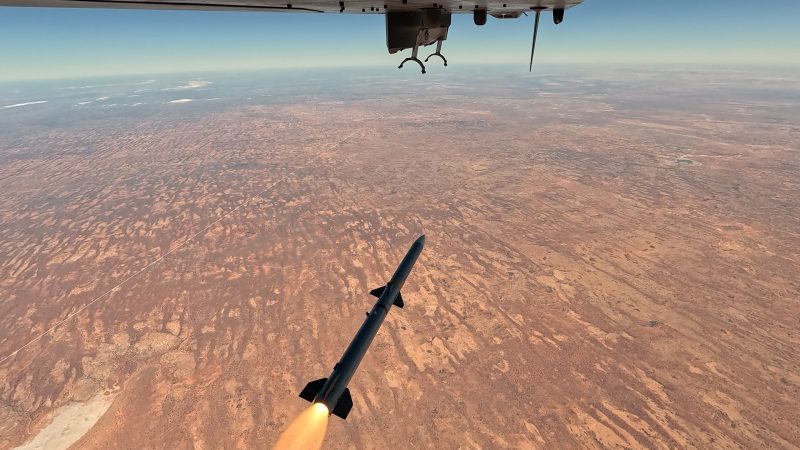
The Royal Australian Air Force led the test, using a Boeing MQ-28 Ghost Bat to down the target, according to the Australian Ministry of Defense and the aircraft’s manufacturer. The MQ-28 fired an AIM-120 AMRAAM, which destroyed a Phoenix jet-powered drone that Boeing described as a “fighter-class” object.
The test was a joint effort by Boeing, the RAAF, other defense firms, and the U.S. Air Force, Boeing said. It was part of the Trial Kareela 25-4 exercise, which occurred over the Woomera Range Complex in southern Australia.
“Trial Kareela 25-4 was a demonstration of a Collaborative Combat Aircraft (CCA) employing an air-to-air weapon against an aerial target in an operationally relevant scenario,” the Australian Department of Defense said in a release. “This landmark demonstration proves that the MQ-28A is a world-leading Collaborative Combat Aircraft (CCA) capability and underlines the MQ-28A’s growing potential to deliver an operational capability for the Royal Australian Air Force.”
The Australian military is working to bring the MQ-28, which first flew in 2021, into operational service and has agreed to further development and production by buying seven more MQ-28s for close to $1 billion, Australia’s Minister for Defense Industry Pat Conroy said Dec. 9. The aircraft was designed by Boeing’s Australian division.
“The Ghost Bat turns a single fighter into a combat team,” Conroy said during a press conference in Sydney. “It is our intention for the Ghost Bat to enter into service with the Royal Australian Air Force.”
“Our vision is for a ratio of a minimum of at least three uncrewed aerial platforms to every one crewed combat aircraft,” Conroy added.
The test came ahead of “AUSMIN” consultations in Washington between the two nations’ top diplomats and defense chiefs, a nearly annual meeting. American Secretary of State Marco Rubio and Secretary of Defense Pete Hegseth met Dec. 8 with Australian Minister for Foreign Affairs Penny Wong and Deputy Prime Minister and Minister for Defense Richard Marles. Hegseth and Marles are scheduled to meet again Dec. 10 at the Pentagon.
The MQ-28 flew with an RAAF F/A-18 Super Hornet fighter and an E-7 Wedgetail airborne battle management aircraft, which took off from three separate locations.
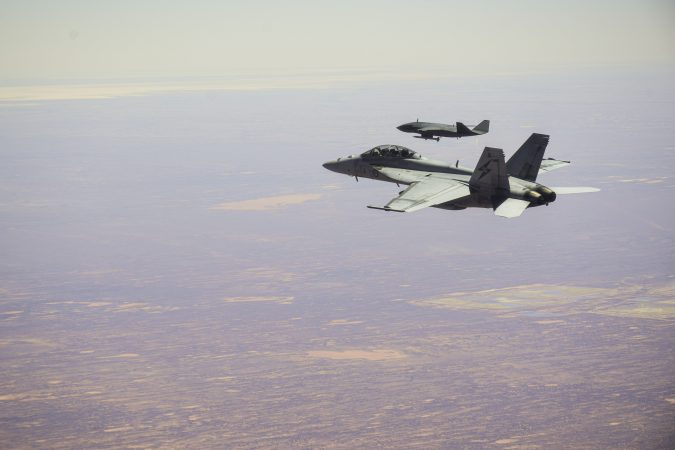
“This scenario was representative of a real-world mission,” Amy List, the managing director of Boeing Defense Australia, told reporters alongside Conroy and Chief of the Air Force Air Marshal Stephen Gareth Chappell.
The MQ-28 and F/A-18 flew in formation, identified, and tracked the airborne target drone. Neither the Australian military nor Boeing said whether the MQ-28 was able to do that on its own. The E-7 served as the in-flight quarterback for the MQ-28, according to the Australian military.
The concept of Collaborative Combat Aircraft, also known as a loyal wingman, is that they are primarily controlled by the fighters or bombers they will fly with. But in this test, the “MQ-28A teamed with an E-7A Wedgetail as a loyal wingman,” which was “supported by” the F/A-18, the Australian Department of Defense stated. Boeing promised earlier this year it would conduct an air-to-air test with an MQ-28.
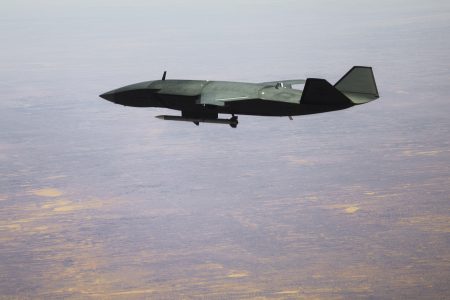
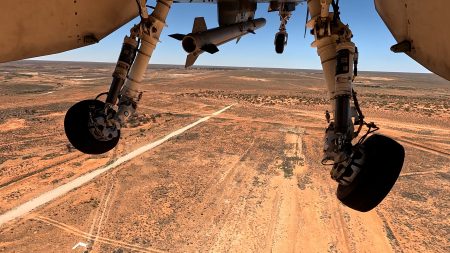
The AMRAAM was mounted on an underbody external hardpoint of the MQ-28 for the test.
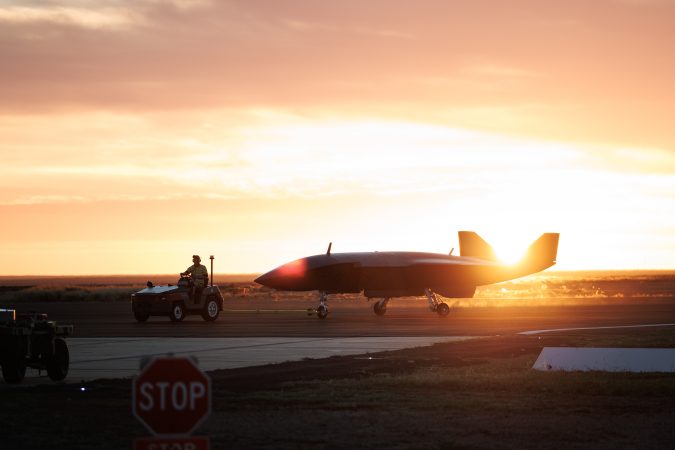
“We had an E-7 in custodianship of the MQ-28 alongside F/A-18F Super Hornets, a target designated handoff to E-7, the target, and then the custodian of the E-7 provided the command authorities for the MQ-28 to deploy, engage, and fire an air-to-air weapon and downed successfully the target aircraft,” Chappell said. “So a full combat replication test very successfully achieved and a world-leading demonstration of our MQ-28 and its combat capabilities in a repeat environment.”
The U.S. Navy has expressed interest in the MQ-28 as a possible future addition to its fleet.
During the AUSMIN discussions, Australia and the U.S. agreed to enhance their defense partnership. The ministers noted the “positive trajectory of both countries’ investments in defense capabilities and infrastructure as the alliance builds out our force posture and defense industrial cooperation to respond to the demands of the Indo-Pacific strategic environment,” according to a fact sheet of the meeting provided by the State Department.
Australia agreed to improve infrastructure at Royal Australian Air Force Bases Tindal and Darwin to support rotations of U.S. bombers, fighters, and intelligence surveillance and reconnaissance aircraft, as well as improve infrastructure works at Royal Australian Air Force Base Amberley, which has hosted U.S. bombers in the past.
The two countries also agreed to further co-production, co-sustainment, and development of the Hypersonic Attack Cruise Missile, as well as “furthering depot-level sustainment” of AIM-9X and AMRAAM missiles, among other defense agreements. The two countries also agreed to further the Biden administration-era AUKUS agreement—originally a plan to sell nuclear-powered submarines to Australia, but now a wide-reaching defense pact involving advanced technologies.
The post Australian MQ-28 CCA Downs Drone in Milestone Air-to-Air Test appeared first on Air & Space Forces Magazine.
Air, AUKUS, Australia, Boeing, CCA, Collaborative Combat Aircraft, MQ-28, RAAF, Royal Australian Air Force
Air & Space Forces Magazine
[crypto-donation-box type=”tabular” show-coin=”all”]