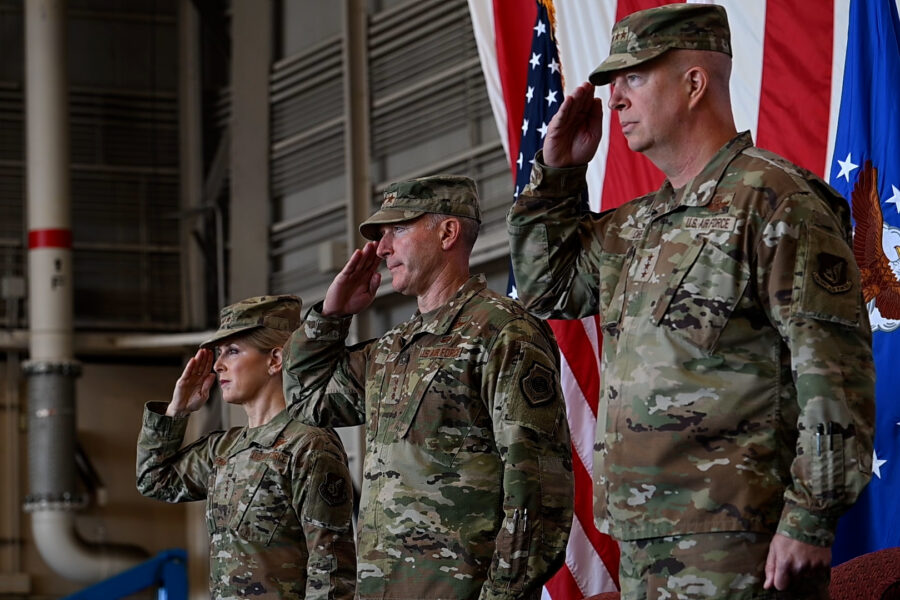
The Pentagon formally split the combined U.S. Forces Japan and the Fifth Air Force into separate commands, ending a dual-hatted arrangement that had been in place for more than 60 years.
Amidst growing tensions between Japan and China, the separation leaves Air Force Lt. Gen. Stephen Jost as head of U.S. Forces Japan, and the recently promoted Lt. Gen. Joel Carey in command of the Fifth Air Force.
The combined command role dates back to 1957, the Air Force said in a release.
USFJ now shifts from its traditional focus on bilateral security, joint and bilateral exercises, and Status of Forces Agreement issues to become a “warfighting headquarters.” Japan’s Self-Defense Forces, meanwhile, will expand and improve their military capabilities as a distinct response to Chinese military aggression.
“The transformation of USFJ into a warfighting headquarters enables a more agile and lethal joint force,” Jost said in the release. “Along with today’s change of command with dedicated leaders for both USFJ and 5th AF, we are bolstering our collective ability to protect security, prosperity, and freedom – ultimately embodying peace through strength in the Indo-Pacific.”
The White House nominated Jost in December to retain his role as USFJ commander and nominated Carey to head the Fifth Air Force. But preparations date back to mid-2025, when command-and-control augmentees arrived at USFJ headquarters to craft the transition. Notably, the change in structure means that in the future, USFJ could be commanded by leaders of other U.S. service branches, because without the Fifth Air Force, the role no longer requires Air Force credentials.
“The transformation into a warfighting headquarters will streamline decision-making and create more agile and lethal forces, embodying peace through strength through credible deterrence in the Indo-Pacific,” a spokesperson for U.S. Forces Japan told Air & Space Forces Magazine in December.
With the change, USFJ will take on more operational taskings, observed retired Lt. Gen. Burton Field, who headed USFJ and Fifth Air Force from 2010 to 2012. Field is now president and CEO of the Air & Space Forces Association.
“All of this will help INDOPACOM in their deter/defeat mission in the Area of Responsibility,” Field said. “It will give them more capability—if tensions rise, to deter, and more capability to employ combat power if required.”
In an op-ed published in The Asahi Shimbun, a Japanese newspaper, last year, Jost wrote that “these shifts in command and control are occurring against the backdrop of intensifying regional concerns, including a rise in coercive and unprofessional military maneuvers in all domains of operations.”
Since the aftermath of World War II, Japan’s military has been constitutionally limited to being a self-defense force, but in recent years the government has enabled its military to add more offensive capabilities. Political leaders have publicly stated the country would seek to intervene, along with the United States, if China were to attack Taiwan.
Retired Air Force Brig. Gen. Houston Cantwell, who served as director of operations at USFJ from March 2014 to July 2016 and is now a senior resident fellow for Airpower Studies at the Mitchell Institute for Aerospace Studies, said the shift was necessary given China’s growing threat posture.
“Until this split, U.S. Forces Japan was not focused on warfighting,” Cantwell said. “Look at U.S. Forces Korea: that command is focused on one thing, and that is to deter war against North Korea and, if required, defeat North Korea.”
Now USFJ will have a similar focus on China.
In December, Chinese aircraft locked their radars on Japanese planes during an exercise involving a Chinese aircraft carrier near southwestern Japan. Locking radars is a preparatory step for firing missiles. In June 2025, two Chinese carriers were spotted near the Japanese island of Iwo Jima, sparking concern about China reaching into Japanese territory.
This past December, the Japanese Cabinet approved a record defense budget: more than $58 billion for 2026, including funds to improve Japan’s counter-strike and coastal defense capabilities using cruise missiles and drones. The increased budget marked the fourth year of a five-year program in which Japan has sought to double annual weapons spending to a level equal to 2 percent of its gross domestic product.
As head of the Fifth Air Force, Carey will command 15,000 Airmen and civilian employees in the 374th Airlift Wing at Yokota Air Base, the 35th Fighter Wing at Misawa Air Base, and the 18th Wing at Kadena Air Base, Okinawa.
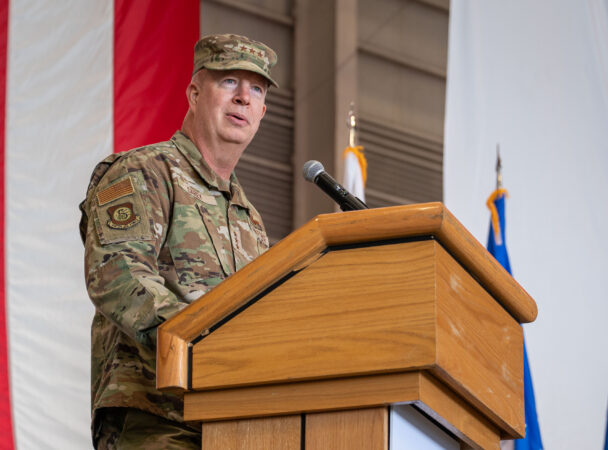
Cantwell called his elevation a “tremendous” opportunity for the three-star general. “Now he can focus on the [Japanese Self-Defense Force], focus on airpower, something that got diluted when it was a dual-hatted responsibility,” he said.
While serving as USFJ director of operations, Cantwell said he worked closely with his Japanese counterpart and focused on training, exercises, and access to ranges for U.S. troops.
Cantwell referred to Operation Epic Fury as an example of prioritizing airpower preparations ahead of conflict.
“As we’ve seen in Iran, that footprint of airpower, air bases that already exist, capabilities forward deployed, is absolutely critical,” Cantwell said. “Whoever is managing that footprint in East Asia is absolutely critical, and Okinawa is the epicenter of all U.S. activity in East Asia.”
Having a three-star general exclusively in charge of Fifth Air Force ensures that the strategic location gets what it needs and has the bilateral relationships it needs, he said, noting the value of Kadena Air Base and Misawa Air Base, which will soon receive F-35 fighters, as key strategic assets in the region.
The post Pentagon Splits Combined US Forces Japan Forces and 5th Air Force into Two Commands appeared first on Air & Space Forces Magazine.
Air, National Security, 18th Wing, 35th Fighter Wing, 374th Airift Wing, Fifth Air Force, Lt. Gen. Joel Carey, Lt. Gen. Stephen F. Jost, U.S. Forces Japan
Air & Space Forces Magazine
[crypto-donation-box type=”tabular” show-coin=”all”]