The Air Force is deferring parts of the B-52’s radar upgrade and plans to start outfitting two Stratofortresses with new engines for testing in fiscal 2027, according to a new Pentagon report, as the service strives to keep the bomber’s modernization on track.
Officials are counting on the combination of the B-52’s Radar Modernization Program and Commercial Engine Replacement Program to keep the venerable bomber flying into the 2050s. The planned changes are so extensive the Air Force has said they constitute a new designation, the B-52J.
But in its annual report released March 16, the office of the Director of Operational Test and Evaluation revealed that the radar program in particular is still struggling after rising costs triggered a law requiring the Air Force to notify Congress last spring.
At the time, officials said they were considering changing the scope of the program, and the DOT&E report indicates the Air Force has now committed to that strategy.
“The Air Force is revising the acquisition strategy to focus on delivering a [minimum viable product] to control costs,” the report states. “This MVP will include a subset of the capabilities originally documented … with other functionalities deferred to future increments, including the new wideband nose radome.”
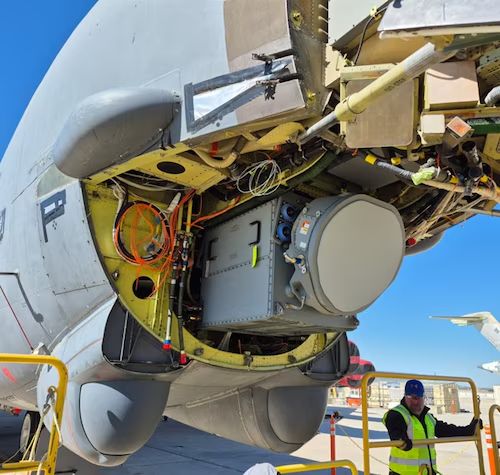
The radome is the physical structure that houses and protects the radar. It must be strong enough to protect the system, while still allowing for signals to pass through. On the B-52, the Air Force has decided to keep using the “legacy” radome with the new radar in the interim.
“The Air Force will need to characterize the capability of the new radar with the legacy radome,” the report states. Last year, when the service was still considering changes to the new radome, the DOT&E report noted that a radar’s performance can be impacted by its radome’s design.
The radar at the heart of the program isn’t changing: the Raytheon AN/APQ-188, a hybrid of the active electronically-scanned array radars used by the Boeing F-15 and F/A-18, configured mostly for the air-to-ground mission. Officials say it is urgently needed to replace the long-obsolete and problem-prone analog AN/APQ-166 radar.
And even as the Air Force drops the new radome for now, it has been moving forward with the AN/APQ-188. A B-52 configured with the new radar flew for the first time in December, heading to Edwards Air Force Base, Calif., for continued flight testing.
The DOT&E report states the Air Force plans to make a low-rate initial production decision on the new radar this summer in the fourth quarter of fiscal 2026, followed by initial operational test and evaluation and a final production decision in fiscal 2028. Those dates are in line with previously reported timelines.
The radar program is ahead of the re-engining effort, which was hit with a three-year delay back in 2024 and is now not expected to clear initial operational test and evaluation until 2032.
In January, the Air Force inked a $2 billion deal with Boeing to install new engines on two B-52 bombers and begin testing of the new eight-engine configuration. The service did not say at the time when the jets will be ready for testing.
The DOT&E report, however, states that a critical design review for the program will take place in fiscal 2026, “followed by the modification of the two … aircraft in FY ’27 for testing.”
That critical design review is a year later than the office projected in its previous report. The new Rolls-Royce F130 engines already passed their critical design review in December 2024, but the replacement program includes much more, including the engine struts, the electrical power generation system, and engine cockpit displays.
Flight testing of the new B-52 engines will largely take place alongside production of those engines, a phenomenon called “concurrence” that the DOT&E report notes is fraught with risk—any issues that pop up in testing will require costly retrofits.
“Previous aircraft development programs with highly concurrent flight test and production schedules of this kind have frequently incurred significant cost increases and schedule delays driven by deficiency discoveries,” the report states.
Despite this, the Air Force is planning to award contracts for 69 percent of the fleet before operational testing is complete, justifying the move by citing “a business case analysis that projected significant cost savings from procurement of a commercial engine replacement in fewer and larger lots with installation schedules aligned with existing B-52 periodic depot maintenance schedules,” per the DOT&E report. The report doesn’t call for the service to change its plans, but it does recommend that officials mitigate the risk “by establishing clear, data-driven exit criteria based on flight test results” before it awards each of the low-rate production contracts.
The test and evaluation of the B-52’s new radar and engines will be particularly tricky to manage because the BUFF fleet is so small but so valuable, Air Force Gen. Dale R. White noted last month at AFA’s Warfare Symposium.
White, the Direct Reporting Portfolio Manager for Critical Major Weapon Systems, told reporters during a roundtable that “the challenge with B-52 that I think everybody forgets, it’s such a small fleet that has such a tremendous requirement in terms of readiness. You’ve got to have a certain number on the ramp. That’s a requirement.”
There are 76 B-52s left, and the fleet’s mission capable rate has hovered in the mid-50 percent range in recent years, meaning around 40 or so are available at any given time. But the bombers are a critical component of the U.S. nuclear triad and are also highly prized for their conventional firepower—at least eight of the aircraft are known to be participating in Operation Epic Fury against Iran.
The post Air Force Scales Back B-52 Radar Upgrade Program, Plans New Engine Testing appeared first on Air & Space Forces Magazine.
Air, B-52 Commercial Engine Replacement Program, B-52 radar modernization program, B-52 reengining, B-52J
Air & Space Forces Magazine
[crypto-donation-box type=”tabular” show-coin=”all”]