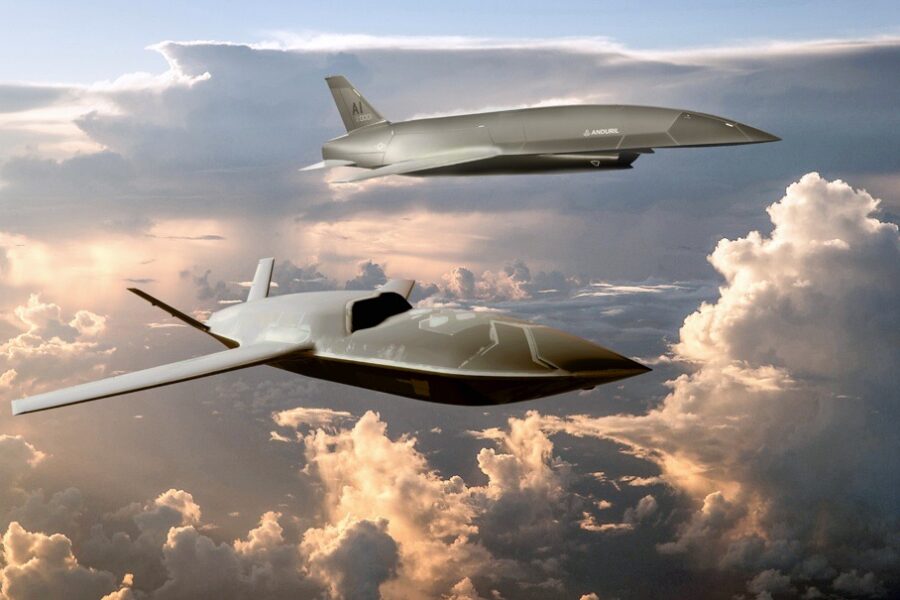
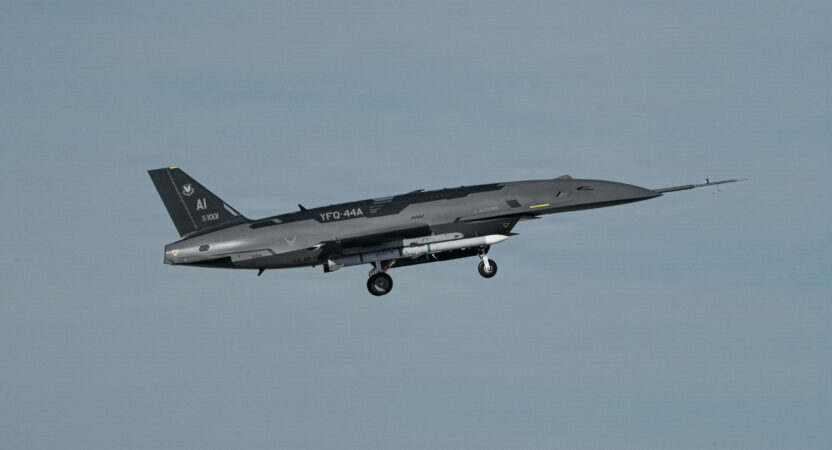
As the Air Force races to develop and field new semi-autonomous Collaborative Combat Aircraft, the service is also rethinking its production plan for CCAs—how many and how quickly—to replace the notional figures set several years ago.
Gen. Dale R. White, who is charged with overseeing the program, said March 17 at the McAleese Defense Programs Conference that officials will decide as early as this summer on the new plan, which could see production scale beyond the 100 CCAs initially envisioned by 2029. That possibility would seem to align with Air Force Secretary Troy E. Meink’s new focus on increased production, which he emphasized multiple times during his own session at the conference.
Back in April 2024, just after the Air Force narrowed the competition for Increment 1 of the CCA program to Anduril and General Atomics, then-Air Force Secretary Frank Kendall told Congress that the service expected to have “over 100 on order or delivered” as part of Increment 1. In the long term, he added, the Air Force could buy anywhere from 1,000 to 2,000 of the drones, which are envisioned as flying alongside and taking direction from manned fighters.
“It’s going to be a significant part of our force structure,” Kendall said at the time.
When Air & Space Forces Magazine asked White, the Direct Reporting Portfolio Manager for Critical Major Weapon Systems, whether Kendall’s production estimates still stand, he said the Air Force Futures directorate is in the process of revisiting them.
“The … requirements leads are really looking at, what is the right number?” White said. “We have a production number that we’re marching toward. How do you scale that, or do you start looking closer at Increment 2?”
Other questions to consider, White added, include:
- “How much you want to ramp and scale Increment 1 above the baseline, if we do at all?”
- What production will look like on Increment 2 of the program
- Given the gap in production between those two increments, “would you be better off scaling greater?”
The general said he expects answers to those questions this summer or fall—around the same time the Air Force is expected to make a production decision on Increment 1. At AFA’s Warfare Symposium in February, White also announced that the service would put CCAs into the hands of Airmen to experiment with this summer.
The discussion around expanded production is driven in no small part by money, and the Air Force is still figuring out what it wants the unit cost of a CCA to look like, White said.
“We’re finding a greater operational use of these platforms and capabilities,” he said. “So, as we continue to explore the design space with these platforms—how much they can do in lieu of a manned platform, etc., that really changes the landscape of how we view cost.”
White said they’re looking at affordability in relation to the aircraft’s payload, range, fuel requirements, and other factors. But, he added, program leaders set a cost amount early on in the process to ensure it didn’t grow too quickly, and they’ve stayed “well within that.”
Price estimates for the program have ranged anywhere between $5 million and $30 million per aircraft. At the high end, that places the CCA at about one-third the cost of an F-35.
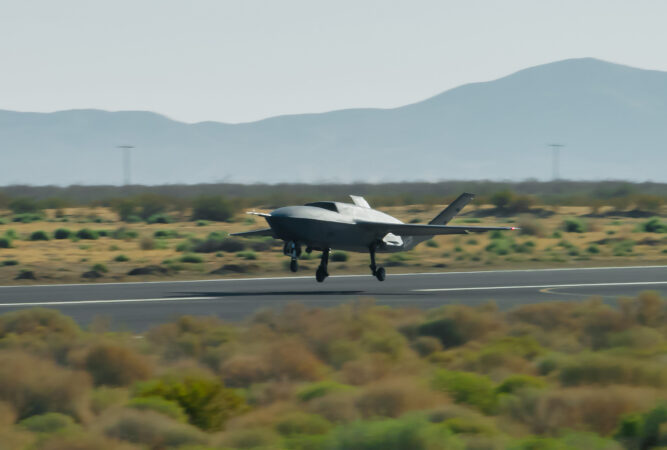
The cost will likely change for Increment 2 of the program, depending on the requirements the Air Force settles on. Initial plans called for the CCA to be an “exquisite,” high-end, stealthy platform. But following wargames showing that large numbers of low-end CCAs would be more valuable in a Pacific fight, the service revisited the concept.
Now industry has introduced a host of CCA concepts, many of them more attritable and low-cost, but the Air Force has not tipped its hand. In late 2025, the service awarded preliminary contracts to nine companies, but officials did not disclose which companies or the dollar amount of the contract award, Breaking Defense reported in December.
The Air Force has not established production plans for Increment 2, but Secretary Troy Meink is pushing for “dramatically increase production” of weapons systems across the board.
While operational considerations play a role, he said the real push is driven by a shift in the types of threats the military faces.
“When we started fielding some of these systems, we weren’t concerned about thousands of ballistic missiles, particularly from smaller countries,” Meink said.
Whether it’s air-based, ground-to-air, air defense, or offensive action systems, Meink said, “we just never predicted the numbers and scale of what we’re seeing.”
Though Meink said the numbers aren’t there yet, he said he is seeing “immense progress” in production improvements.
The post Air Force Revisiting Production Goals for CCA with Eye Toward ‘Scale’ appeared first on Air & Space Forces Magazine.
Air, Rapid Acquisition & Sustainment, CCA, CCAs, Collaborative Combat Aircraft, Gen. Dale R. White, Gen. Dale White, McAleese conference, McAleese Defense Conference, Troy Meink
Air & Space Forces Magazine
[crypto-donation-box type=”tabular” show-coin=”all”]