Tyler Durden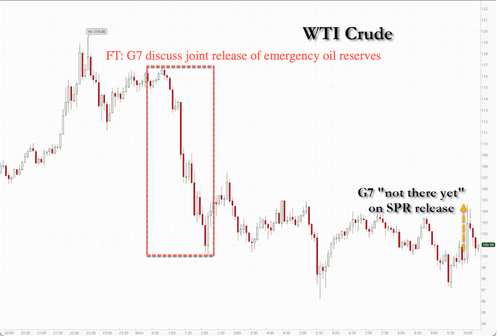
G-7 Leaders Reject SPR Release Plan, But ‘Stand Ready’ After Initial Jawbone Efforts Fade
Update (1055ET):
G-7 finance ministers used headlines in Asia, including calls for a meeting to discuss an SPR release, as a purely performative attempt to calm chaotic energy markets.
Now that the emergency meeting is over, the group of leaders failed to agree on releasing crude supplies. Those headlines briefly hit Brent down from around $119/bbl to near $100, but once again, it appears to have been little more than a circus act as world leaders stare directly into what could become an energy shock.
France said the G-7 is not yet prepared to move forward with a coordinated release of SPR in response to Operation Epic Fury, which has unleashed chaos across the Middle East.
French Finance Minister Roland Lescure told the other ministers that the group stands ready to take whatever steps are necessary to stabilize conditions and is closely monitoring developments, including the possible use of the SPR.
“We agreed on following the situation very closely, we are ready to take all necessary measures including using strategic reserves to stabilize the market,” Lescure said after the meeting, quoted by Bloomberg.
Bloomberg commodities analyst Javier Blas said on X that the G-7 stopped short of authorizing an SPR release and instead opted to continue monitoring energy markets. He added that Japan cited an IEA recommendation urging G-7 leaders to consider tapping reserves to contain the oil price spike.
BREAKING:
G-7 nations decide against releasing SPR for now
G-7 agreed to continue monitoring energy marketsJapan says IEA recommended G7 to release SPR
— Javier Blas (@JavierBlas) March 9, 2026
The Financial Times reports:
G-7 finance ministers are poised to release a joint statement saying the countries “stand ready to take necessary measures, including to support global energy supply, such as a stockpile release,” according to people familiar with the situation.
A virtual meeting on Monday included the heads of the IEA, IMF, World Bank, and OECD, according to those people.
“We discussed the current conflict in the Middle East, its impact on regional stability, global economic conditions, and financial markets, and the importance of secure trading routes,” the ministers are expected to say in the statement.
How G-7 leaders jawboned energy markets today:
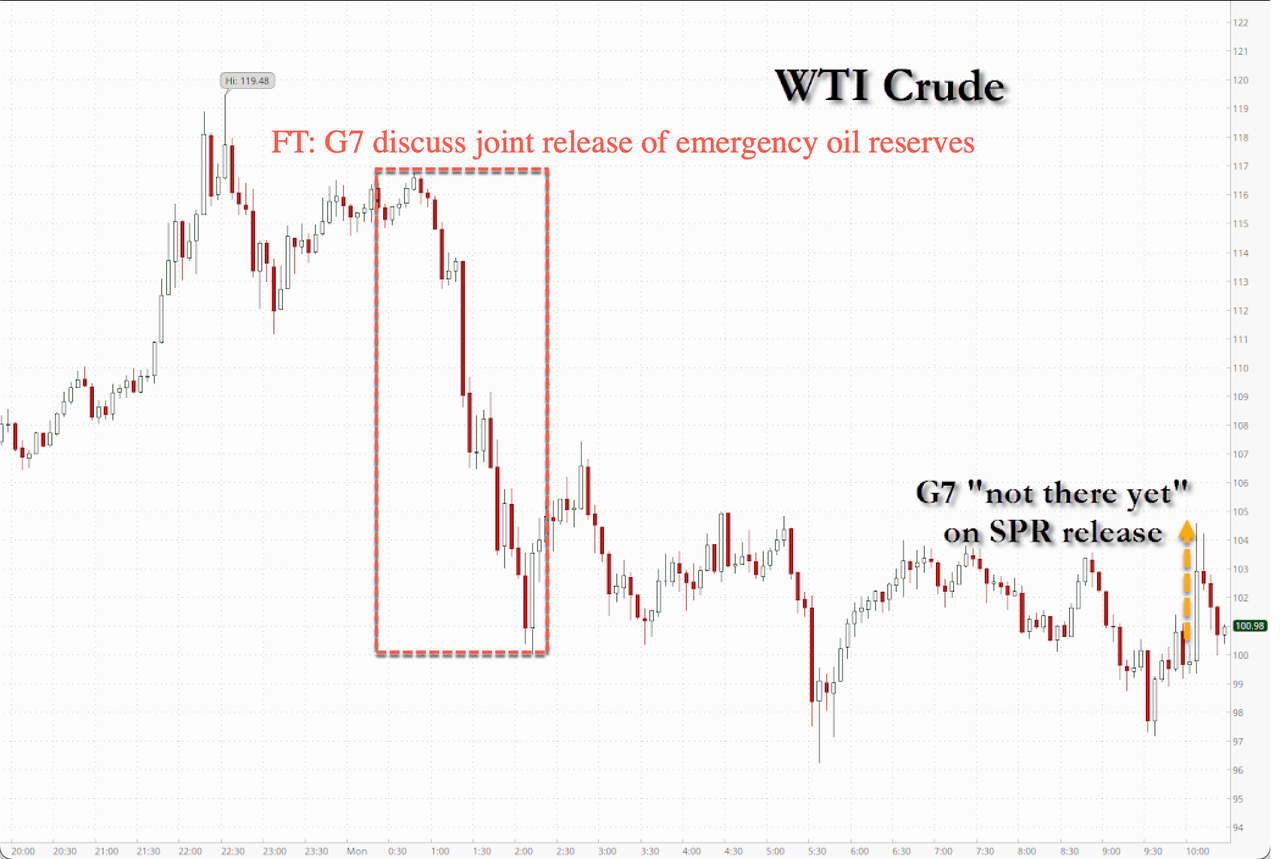
This desperate circus act by G-7 leaders suggests that the energy shock rippling through the system could be historic, especially as an IRGC spokesperson warned of $200/bbl crude prices.
At what price does the G7, in fact, release SPRs?
* * *
Asian and European equities traded lower, while U.S. equity futures fell 1% as Brent and WTI futures traded in triple-digit territory following the weekend escalation in Middle East tensions. The energy shock we have been warning about for the past week, citing top institutional desks from JPMorgan, UBS, Goldman, and others, is now staring G-7 leaders directly in the face as energy market panic erupts.
You know conditions are deteriorating very quickly when the Financial Times reports that G-7 finance ministers are set to hold an 8:30 a.m. New York time call to discuss a possible coordinated release of strategic oil reserves to combat runaway crude prices, as Brent crude hit $119/bbl overnight. Such a move to dump SPR on global markets shows just how afraid policymakers are that the oil shock could crush consumer sentiment and, in turn, hit economic growth.
There have been five coordinated SPR dumps onto the global market with the International Energy Agency. The last two occurred in 2022, in the early days of the Russian invasion of Ukraine, which sent energy prices through the roof. However, as we must note, dumping SPRs in 2022 did not work so well, and the market will likely look beyond current flows and focus on overall stockpiles being drained (read: here & here).
Hello @ENERGY it’s time to open the SPR
— zerohedge (@zerohedge) March 9, 2026
The scramble by G-7 leaders comes as Brent crude hit $119/bbl in Asia, up from about $72 before Operation Epic Fury kicked off more than a week ago, now in its second week. With the Strait of Hormuz effectively closed and Gulf producers cutting output as storage fills up, the worst-case scenario appears to be unfolding: an energy shock.
To cushion the shock, potentially bridging some of the supply gap of a short-term war (but definitely not a longer term or wider disruption) FT sources said world leaders could release 300 million to 400 million barrels, or about 25% to 30% of the 1.2 billion-barrel reserve.
Given the extreme moves, any announcement is likely to move prices (and indeed is already being somewhat discounted) but the question remain of whether that will actually impact the cost of pump prices in America (which are set to soar to $5 a gallon, however briefly, on a lagged response to WTI and RBOB price surges currently).
As Goldman’s Rich Privorotsky noted:
Such a release would buy time. If the disruption proves temporary, a coordinated SPR release makes sense. If the disruption persists for months, those reserves might arguably be more valuable at higher prices or in a more acute shortage
WTI is down $20 from its overnight highs on the report of the coordinated SPR release…
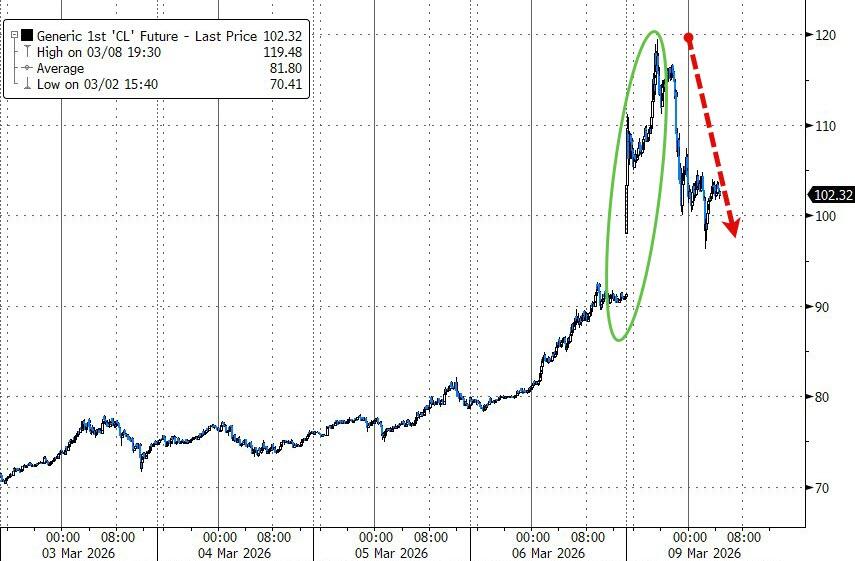
Late last week, JPMorgan’s top commodity strategist, Natasha Kaneva, did the ‘Hormuz Math‘ and warned that production shut-ins were imminent – hence the weekend production cuts by major Gulf states and Brent crude spiking into triple-digit territory.
Additionally, energy economist Anas Alhajji warned UBS analysts last week about SPR limitations:
“The impact of the U.S. SPR is limited. Saudi Arabia is completely out of the picture. All of that spare capacity in OPEC is out of the picture. So what do we do? We are then left relying on demand destruction to curb prices. And because of the panic buying, prices would go above $100 easily in this scenario.”
Even if the conflict in the Middle East ended today, Alhajji explained that returning Gulf oil and gas production to a ‘normal state’ would take two months because of logistical and technical issues. This only implies that an energy shock has begun. Deutsche Bank warned in recent days that this was an “existential threat” to airlines, and next could very well be a shock to consumers. The only question now is whether the shock is big enough to cause a financial blow to countries that are among the largest importers of crude from the Gulf region, such as China and other Asian countries.
Tyler Durden
Mon, 03/09/2026 – 10:55
ZeroHedge News
[crypto-donation-box type=”tabular” show-coin=”all”]