As the Space Force spends more time thinking about what it will need to look like in 2040, some of the service’s generals say they can lay the groundwork for Guardians launching and operating in orbit while still meeting the demand for space superiority now.
And during a panel discussion at AFA’s Warfare Symposium last week, experts warned that if the Space Force doesn’t pursue the idea, it risks ceding the advantage to China and its military-heavy spaceflight program.
“Unlike the United States’ separation of civil and military space efforts, China’s human spaceflight missions are conducted solely by active-duty service members under the purview of the [People’s Liberation Army],” noted retired Space Force Col. Kyle Pumroy, a senior resident fellow at AFA’s Mitchell Institute for Aerospace Studies. “With this in mind, a future long-term presence of Chinese military members operating from low-earth orbit to the moon will likely become a reality.”
Such a possibility represents a real threat, argued retired Army Maj. Gen. Tom Ayers, who currently serves as general counsel for Starlab Space and previously served as general counsel for the Department of the Air Force.
“We can’t allow a gap with China on many things. … It’s a less safe world if PLA taikonauts are the only persons in low Earth orbit or if they’re the only persons at a Lagrange point or the moon or whatever,” he said.
That future could be coming sooner than one might think. Pumroy noted that the Chinese have already established their own space station in low Earth orbit and set a goal of landing on the moon by 2030 and building a lunar research station by 2035, or less than a decade from now.
While these aren’t inherently military moves, veteran astronaut Andrew Feustel, now with Vast Space, argued that exploration leads to economic development, which leads to military requirements.
“If we don’t move forward, we’re going to be left behind in what is going to be, not only research now in LEO, but extraction of resources from asteroids, Moon, and Mars,” he said.
Space Force generals on the panel were more circumspect in addressing how China’s ambitions might require some sort of U.S. military response. But Maj. Gen. Robert W. Claude, director of Task Force-Futures on the Space Staff, did make clear that “China’s not going to wait for us.”
Claude was less certain that the U.S. must counter China by putting its own dedicated service members in orbit.
“I can’t sit here today and tell you that we will or we won’t have Guardians in space at any point in the future,” he said.
Count Vice Chief of Space Operations Gen. Shawn W. Bratton as a supporter of the idea—in January, he said at a conference that he doesn’t have a definite answer on the idea of military astronauts but “it’s on the to-do list.”
“Do we need to put Guardians in space? It would be tragic if that didn’t happen someday,” he added. “Is that day 2030, 2040, 2050? I don’t know the answer, but we owe work on that. But again, we’re very focused right now on the near-term body of work in space superiority.”
On the symposium panel, Brig. Gen. Matthew Cantore, deputy commander at Space Training and Readiness Command, said the short-term demand for space superiority and long-term considerations of Guardians in orbit won’t always be mutually exclusive.
“At some point, they are going to come together,” Cantore said. “It’s a question of when. As I look to the future, there will be a need for Guardians in space when there’s one of two things that happen; either there’s a need to control critical terrain, or the character of war shifts to the point where new technology requires that we go there to be able to maintain a military advantage.”
Ayers argued that such a need could eventually arise in low Earth orbit given the Space Force’s plans there for massive constellations transporting huge amounts of data for command and control of terrestrial forces.
“Thinking about latency, you can’t leave everything to AI and robots, if you’re going to have dazzled communications, degraded communications, and you might want a human agent making some decisions,” Ayers said. Latency refers to the lag time it takes to transmit data.
There’s also a deterrence element—Ayers noted the moral implications of putting a human being in orbit versus an unmanned system, and another Mitchell Institute fellow, retired Space Force Col. Charles Galbreath, argued in a paper last fall that doing so has the potential “to raise the threshold of acceptability for hostile actions that may be lethal to humans.”
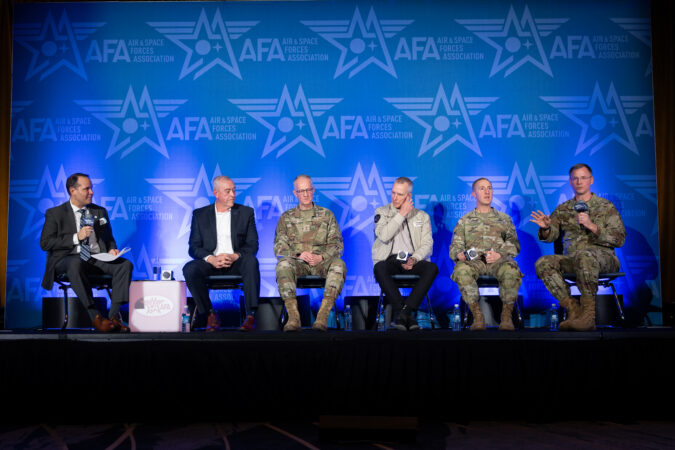
Photo by Jack Dempsey, for Air & Space Forces Association
While senior leaders debate when and how Guardians may be used in space, there are ways the Space Force can start preparing right now, panelists said. Claude called for the service to invest in dual-use functions that support USSF’s needs now while providing capabilities that could support manned operations in the future.
Those include the service’s work managing launch operations, manned and unmanned, alongside NASA and industry, and investments in space domain awareness, to track threats in orbit, Claude said.
There is also a “Guardian Liaison” office with NASA that is low-cost but high-impact, Cantore argued, exposing Guardians to creative problem-solving at the civil space agency and bolstering the institutional relationship between the two.
“We know that should we need to go into the domain, you can’t do that at the drop of the hat. It all depends upon relationships. And we have the initial starter seed, if you will, of that relationship, and we can scale that as needed,” he said.
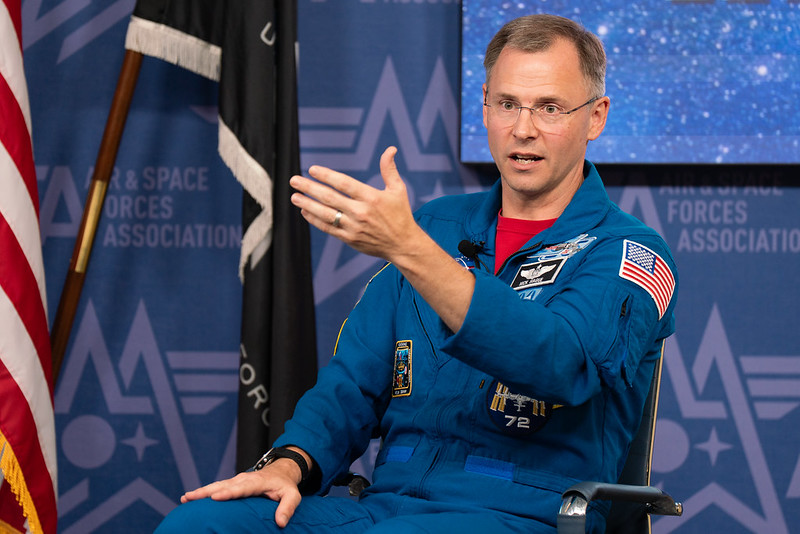
The relationship between NASA and the military isn’t one-way. Brig. Gen. Nick Hague, Assistant Deputy Chief of Space Operations for Operations, was the first Guardian to launch into space as a NASA astronaut, and he noted that NASA has historically relied upon military test pilots to fill out its astronaut corps.
“It’s not that I need a test pilot, but it’s the skillset that you get ingrained in you as part of the test community that makes you really adaptable to hard problems and managing risk and bringing complicated things together and working on small teams in pressure situations,” Hague said. “And that’s the skill set that you learn in the crucible going through a test pilot school, whether that’s the Air Force Test Pilot School or the Navy Test Pilot School.”
To that end, the Space Force established its own “Space Test Course” at the Air Force Test Pilot School in 2023—something Hague said could also be a dual-use answer to the service’s near-term and long-term needs.
“We didn’t create that course at Test Pilot School because we needed Guardians to be astronauts,” he said. “We need Guardians to be high-performing testers and contribute to helping us field capability quickly. It just so happens that you can get a twofer if you go there.”
The post USSF Eyes ‘Dual-Use’ Ways to Boost Space Superiority, Prep for Guardians in Orbit appeared first on Air & Space Forces Magazine.
Space, Warfare Symposium, Warfighter Training, Brig. Gen. Matthew Cantore, Brig. Gen. Nick Hague, Maj. Gen. Robert W. Claude, NASA, Space Training and Readiness Command, STARCOM, Test Pilot School, U.S. Air Force Test Pilot School
Air & Space Forces Magazine
[crypto-donation-box type=”tabular” show-coin=”all”]