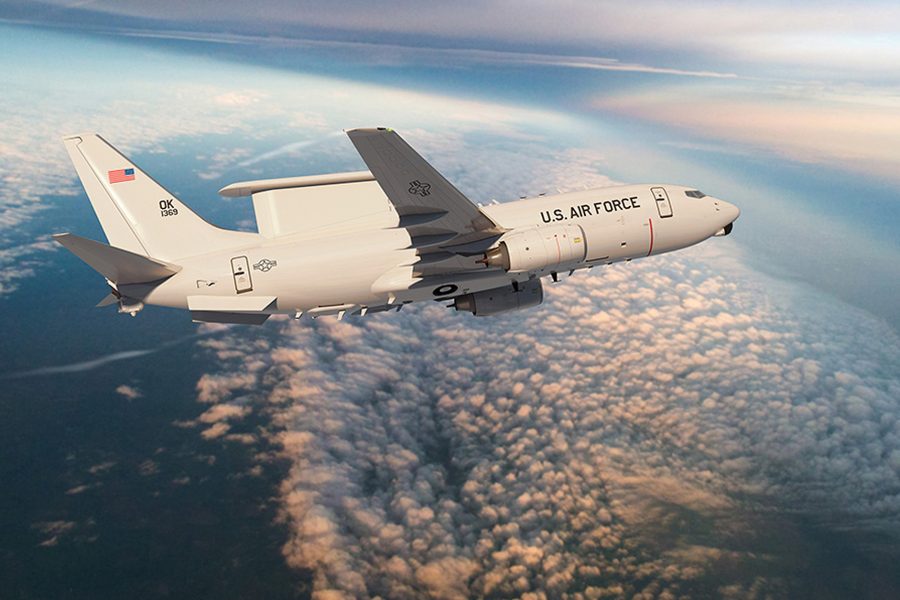
More than a third of the Air Force’s remaining E-3 AWACS fleet is deployed for the Iran war, demonstrating the Air Force’s unique airborne battle management contributions to the joint force at a time when the Pentagon remains cool to buying the E-7 successor to that aircraft.
But in a new research report from the Center for a New American Security, the author argues in favor of that acquiring the E-7 Wedgetail and other platforms like it. “Dedicated ABM aircraft should be treated as an indispensable asset for U.S. military operations today and for the foreseeable future,” author Philip Sheers writes.
Pentagon leaders sought to cancel the Air Force’s planned buy of 26 E-7As, proposing instead to buy four more E-2D Hawkeye aircraft operated by the Navy as a stop-gap measure and looking to future, unproven space-based targeting capabilities. The Navy propeller planes offer less sensing, less range, and less space for battle managers on board, however, than the jet-powered E-7 and its more powerful Multi-Role Electronically Scanned Array (MESA) radar.
Congress funded the E-2s and future satellites, but rejected efforts to cancel the E-7. Instead, lawmakers pumped $1.1 billion into the program to complete two prototype aircraft and asked for a study on the subect. Last week, Air Force Secretary Troy E. Meink sounded ambivalent when asked about the E-7 at AFA’s Warfare Symposium, declining to say if the planes would be in the fiscal 2027 budget request. He said the Pentagon and Congress still need to have a “discussion” about the program’s future.
E-7 critics argue that it is too expensive and that dedicated ABM aircraft are unsurvivable in contested airspace, as the U.S. might encounter in a war with China. Sheers acknowledged that, noting that in a potential conflict in the Indo-Pacific, “Chinese forces—its large fleet of fighters, dense network of maritime and ground-based air defenses, and missile forces—will concentrate on destroying U.S. ABM aircraft in the air and on runways.”
But the CNAS report concludes having dedicated ABM aircraft is too valuable to walk away from now, especially considering the top priorities of the new National Defense Strategy: defending the homeland and avoiding conflict in the Indo-Pacific. ABM aircraft offer a “middle tier” of command and control, he said, and combine the flexibility of an aircraft platform with the coordinating and processing power of an operations center to help bring order to a complex battlespace.
In the Indo-Pacific, “the depth of China’s counterair threat and the likelihood of communications disruptions [highlight] ABM aircrafts’ ability to identify threats early, retask aircraft in real time, and serve as a mid-level communications link fundamental to maintaining unity and continuity of effort,” Sheers asserts.
He also argues that ABM platforms are better equipped than ground-based radars to monitor “air-launched missiles as well as slower and low-flying, air-breathing threats” to defend the U.S. homeland, Sheers adds.
While the E-7 or other ABM aircraft are vulnerable, Sheers suggested they could be defended with escorts or unmanned Collaborative Combat Aircraft in the future.
Among potential alternatives to ABM platforms are targeting satellites, ground-based radars, and the sensing capabilities of advanced fighter jets, although those radars are optimized for the fighter’s use and are not equivalent to what is carried on the E-7.
Using satellites for air and ground moving-target indications is a promising, but not yet proven as solution, and leaders worry that latency—the potential delay in data transmission—could undermine performance. Beyond that, airborne platforms include human operators that manage command and control, while satellites only solve the targeting piece of the job.
“It must also be emphasized that satellite sensors are not battle managers, and battle managers will still be needed,” Sheers wrote.
Ground-based systems, meanwhile, are in fixed positions and therefore vulnerable to missile attack, in addition to struggling with some aerial threats. Fifth-generation fighter aircraft, while advanced, have less sensing power and fewer crew members to sort through signals than a dedicated platform, which limits their utility for battle management beyond small formations of CCAs.
Taken together, Sheers wrote, these alternatives are complementary to airborne battle management platforms, not near-term replacements.
“Without an airborne sensing and battle management layer, the DOD risks opening or worsening dangerous gaps in the Joint Force’s ability to manage threats and mount cohesive responses in priority scenarios,” Sheers concludes.
The need for air battle management, however, is running up against the realities of an aging, brittle, small E-3 AWACS fleet. The 16 jets left in the inventory average around 45 years old and a last-reported mission capable rate of 56 percent.
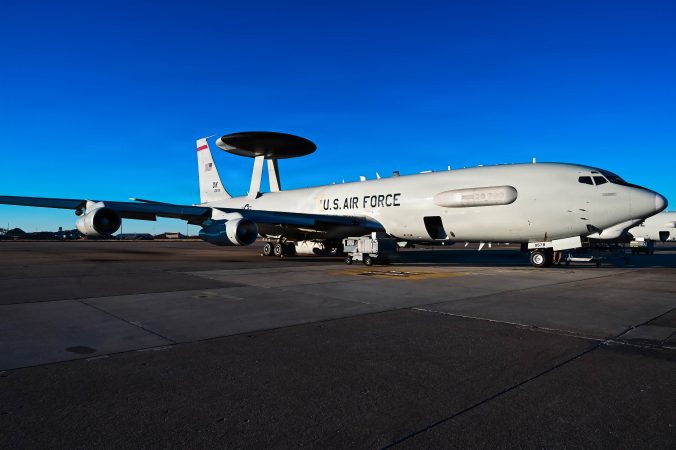
“Declining mission capable rates have shrunk the U.S. ABM fleet well below target, and a future high-intensity conflict would further divide the fleet between homeland defense and forward operations,” Sheers warned in his report.
Indeed, that scenario is playing out right now; six of USAF’s 16 AWACS aircraft have been spotted in the Middle East supporting Operation Epic Fury against Iran this week. Dedicating 37.5 percent of the fleet to the operation highlights the value Air Force operators get from the ABM mission—and how few assets the Air Force has to execute it.
CNAS recommends in its report that the Pentagon “reconsider its total warfighting requirement for ABM platforms … and build enough airborne capabilities to satisfy future sensing and battle management demand.” Congress, the report adds, should not accept the “stopgap measure” of more E-2s and instead “continue to authorize and appropriate funding for ABM programs to prevent capability gaps and create resiliency.”
Other recommendations in the report include more analysis on how airborne battle management would be used in the Indo-Pacific and how these systems can contribute to the Golden Dome missile and airborne defense shield for the homeland. CNAS also recommended increased investment to retain and develop ABM pilots and crew.
The post With E-3s Busy Over Iran, New Report Calls E-7 ‘Indispensible’ appeared first on Air & Space Forces Magazine.
Air, air battle management, Airborne battle management, CNAS, E-3 AWACS, E-7A Wedgetail
Air & Space Forces Magazine
[crypto-donation-box type=”tabular” show-coin=”all”]