Pentagon leaders insist they have a sufficient stockpile of munitions to continue the war in Iran amid reports that its supply of key weapons and interceptors was depleted in the first four days of conflict.
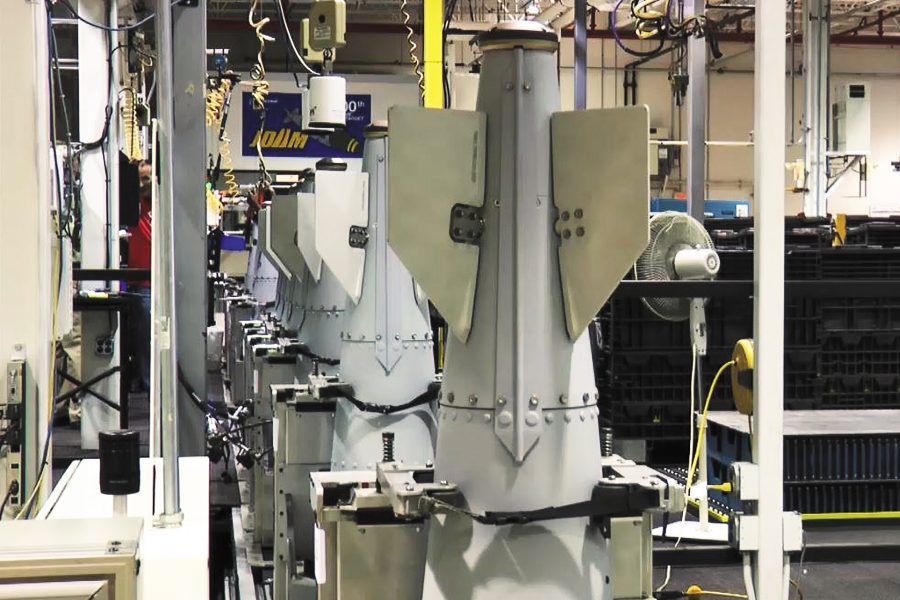
Defense Secretary Pete Hegseth and Chairman of the Joint Chiefs of Staff Dan Caine said in a March 4 briefing with reporters that the U.S. is switching from the precision-guided standoff munitions used in the opening days to stand-in weapons, like the Joint Direct Attack Munition, that are far less costly now that much of Iran’s air defenses have been destroyed.
Hegseth said the Defense Department has “a nearly unlimited stockpile” of stand-in weapons from which it can draw.
“We used more exquisite standoff munitions at the start, but no longer need to,” Hegseth said. “Our stockpiles of those, as well as Patriot [interceptors], remain extremely strong. The enemy can no longer shoot the volume of missiles they once did, not even close.”
Caine, who said U.S. forces have hit more than 2,000 targets since Feb. 28, insisted the department has enough precision munitions “for the task at hand,” adding that the Pentagon considers further details about weapons supply to be “an operational security matter.”
“This is a point of munitions transition,” he said. “The throttle is coming up, as the secretary said, as opposed to ramping down. This will allow us to maintain consistent pressure on the adversary over the coming days, disrupt their launch timelines, and impose costs every day around the clock.”
Meanwhile, President Donald Trump said in a March 3 Truth Social post that the U.S. military’s supply of “medium- and upper-medium-grade” munitions have “never been higher,” adding that the department has “a virtually unlimited supply of these weapons.” He acknowledged, however, that its stock of higher-end weapons is “not where we want them to be.”
Asked multiple times during a March 4 House Armed Services Committee hearing to respond to the president’s claims, Under Secretary of Defense for Acquisition and Sustainment Michael Duffey deferred to Caine’s earlier statement.
“I have great confidence in the professional military judgement of Gen. Caine, and he stated this morning, very clearly, that we have adequate munitions to support operations now and in the future,” he said.
Even as Pentagon officials worked to quell fears of weapons shortages, the White House was reported to be crafting a supplemental funding package to pay for operations in Iran. Reuters was first to report that several defense contractors were to meet with administration officials March 4 to discuss munitions production.
Undersecretary of Defense for Policy Elbridge Colby, speaking at the Council on Foreign Relations, acknowledged the possible need for supplemental funding.
“In terms of the cost, my understanding is that there may be additional requests,” he said.
The department has made several multi-year deals with munitions suppliers in recent months, seeking to increase production of key weapons, but Duffey said those efforts are aimed at increasing long-term supply, rather than providing for current operations.
In January, the Pentagon announced a seven-year framework agreement with Lockheed Martin to speed up manufacturing of Patriot PAC-3 interceptors, more than tripling production from 600 units in 2025 to 2,000 annually by the end of the decade. A second deal with Lockheed aims to quadruple production of Terminal High Altitude Area Defense interceptors, from 96 to 400 per year.
In February, RTX signed a deal with the department to increase production of five munitions: AMRAAMs, Tomahawks, and three variants of its Standard Missile series.
“We e are using multi-year procurement authority to provide a stable, clear demand signal to industry, to give them the confidence and stability to invest their own funds, leading to lower cost for the taxpayer and a more resilient and productive defense industrial base,” Duffey said.
To support expanded munitions production, Duffey said, the department announced in January it would invest $1 billion in L3Harris’ solid rocket motor business, giving it a minority stake in the company. Lawmakers, some skeptical of the Pentagon’s move to purchase equity in defense companies, requested further detail in the coming days about the metrics the department will use to ensure companies inject their own internal funds in areas prioritized by the department.
Duffey said the Pentagon has structures in place to monitor whether companies are holding up their end of the bargain.
“Part of the deal was, as we make an investment, they make a counter investment—multiples of ours—and then we have established milestones of when those investments will be made, so that we can ensure that investment is stimulating the growth that is required,” he said. “We are looking at this as an economic stake in the company. We are not pursuing control.”
Rep. Adam Smith, D-Washington, expressed concern, however, that such equity deals could potentially hurt competition among weapons makers.
“Obviously, more money can help,” he said. “But we also don’t want to discourage fair competition that encourages people to get into this space. If they think the government is going to come in and just put their thumb on the scale, it could discourage some of the investment we’ve seen.”
The post DOD Seeks to Quell Weapons Concerns, as White House Crafts Iran Supplemental appeared first on Air & Space Forces Magazine.
Air, Defense Secretary Pete Hegseth, Iran, JCSC Gen. Dan Caine, Joint DIrect Attack Munition, munitions production, Operation Epic Fury
Air & Space Forces Magazine
[crypto-donation-box type=”tabular” show-coin=”all”]