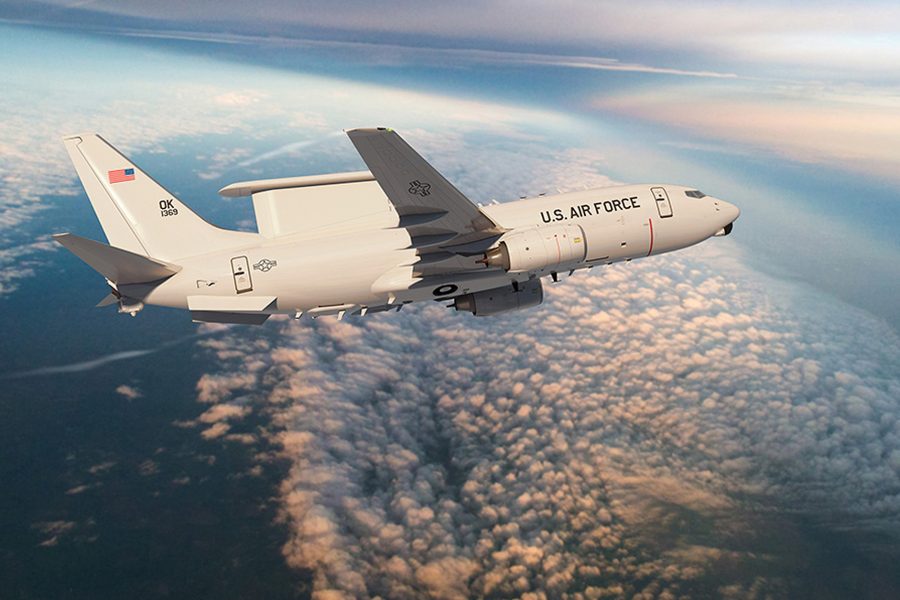
AURORA, Colo.—Air Force leadership needs to have a “discussion” with Congress on the long-term future of the E-7 Wedgetail, Secretary Troy Meink said, after lawmakers blocked a Pentagon plan to cancel the program in 2026.
Meink’s remarks, made during a roundtable with reporters at AFA’s Warfare Symposium on Feb. 24, leave open the possibility that the Defense Department will try to curtail the airborne early warning and control aircraft again in its forthcoming 2027 budget.
The Air Force inked a $2.5 billion deal with Boeing in 2024 to build two E-7 prototypes, planning at the time for a fleet of 26 E-7As to replace the iconic E-3 Airborne Warning and Control System, known as AWACS. But the Pentagon’s 2026 budget request put on the brakes, proposing to cancel the E-7 due to rising costs and the belief that satellites could assume the E-7’s targeting mission.
Former Air Force leaders sounded the alarm, however, winning over lawmakers in Congress, who blocked the cancellation in the 2026 defense policy and appropriations acts.
Congress instead appropriated $1.1 billion for the E-7 program for prototypes, more than five times the $200 million the Air Force requested to shut it down. Lawmakers also directed the Air Force to present a plan for “ongoing actions to streamline requirements and control costs on future production of the E-7 aircraft” and to transition to engineering and manufacturing development aircraft.
Responding to a reporter’s question, Meink did not commit to a long-term E-7 program. He pledged to execute the funding given for the rapid prototypes and to deliver the congressionally mandated plan to transition to EMD aircraft.
But then he added: “By the way, ‘deliver a plan’ does not mean we’re going to put it in the budget. We’ll deliver a plan of what it takes to do, and then we’ll have a discussion.”
Congress, however, seems committed to the program, setting up a point of future conflict. The National Defense Authorization Act explicitly bars the Air Force from shutting down or preparing to shut down the E-7 production line in 2026. And it describes its objective for the funds provided as being for “E-7 continued development and procurement.” A joint statement accompanying the appropriations bill “emphasizes the importance of the E-7 Wedgetail platform and the airborne early warning and battle management mission for the Department ofthe Air Force.”
Congress required the Pentagon to deliver its report within 90 days of the bill’s passage, which means early May—just about the same time the 2027 budget is expected to be released. That could set up another showdown over the Wedgetail’s future if Pentagon or Air Force leaders deliver the plan for future production but elect not to fund it, especially given that the 2027 budget request is expected to include tens of billions of dollars in extra funding for the Air Force.
Editor’s Note: This story was updated with a clarified quote for attribution to Secretary of the Air Force Troy E. Meink.
The post Meink Suggests E-7 Program Remains Unresolved appeared first on Air & Space Forces Magazine.
Air, Congress, Warfare Symposium, Air Force Secretary Troy E. Meink, E-7 Wedgetail, Troy E. Meink
Air & Space Forces Magazine
[crypto-donation-box type=”tabular” show-coin=”all”]