When U.S. Special Operations Command and the Air Force first developed requirements for its Armed Overwatch program planners envisioned a rugged, lightweight, low-cost combat scout aircraft capable of supporting counterinsurgency missions.
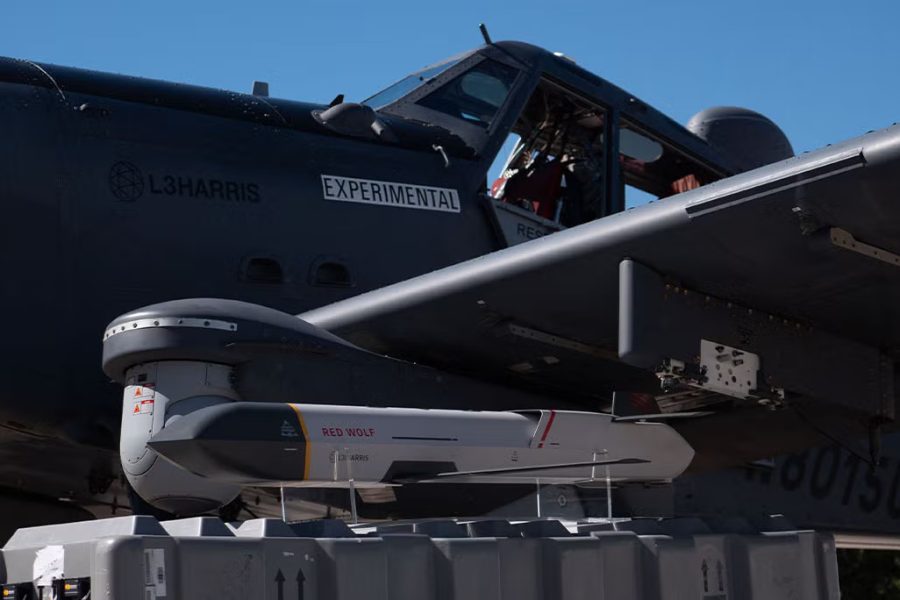
Now that they’ve acquired OA-1K Skyraider II, however, the command and its prime contractor are looking to up-arm their modified Air Tractor cropduster to carry low-cost cruise missiles.
L3Harris announced Feb. 9 that it recently integrated the Skyraider II to carry its new Red Wolf munition, one in a family of systems L3Harris unveiled last summer dubbed “launched effects vehicles.”
Red Wolf can operate as either a loitering munition or a small cruise missile, fly as far as 200 nautical miles, and deliver precision kinetic strikes. It can also be paired with L3Harris’ Green Wolf, a similar missile packed with an electronic attack payload.
L3Harris revealed few details, but touted the Skyraider II-Red Wolf experiment as demonstrating both systems’ “modularity and ease of integration for evolving mission requirements.”
Air Force Special Operations Command is looking at the concept and eyeing other low-cost missiles from other suppliers, as well. Just a year ago, in March 2025, AFSOC worked with Leidos to test launch its Black Arrow small cruise missile from an AC-130 gunship. AFSOC Commander Lt. Gen. Michael Conley told reporters just a month later that the idea held promise for the OA-1K, as well: “If you could use a gunship, or an MQ-9, or an OA-1K that had a small cruise missile that could go 400, 500, or 600 miles and hit a target, that seems like a capability that a combat commander could use.”
The L3Harris Red Wolf doesn’t match that range, but it does fit the profile otherwise.
Conley spoke of the idea again at AFA’s Air, Space & Cyber Conference in September, talking up “long-range standoff mission munitions” for the OA-1K among other aircraft.
Adaptingh such a weapon for the OA-1K gives a boost to both AFSOC and the aircraft. Originally conceived in the 2010s when AFSOC was focused on countering violent extremism in the Middle East, the rise of drones, loitering munitions, and other technologies employed widely now in combat in the Middle East and Ukraine have altered the battlespace and mission requirements.
Indeed, no sooner had AFSOC acquired the aircraft than some started to talk of its no longer being “relevant” or “survivable” in higher-threat environments. Beginning in fiscal 2025, SOCOM slashed its planned buy from 15 to 12 aircraft, and in 2026, SOCOM cut further, from 12 to six airframes.
But SOCOM has never waivered from its planned fleet of 75 aircraft and Conley predicted that AFSOC would make good use of the plane, even in the vast Indo-Pacific.
“Once we get the aircraft and we start flying it, our crew members and our maintainers will figure out novel ways that it will be relevant in the future fight as well as the current one,” Conley said in 2024.
The OA-1K’s rugged simplicity could prove useful for landing and taking off from rough expeditionary airfields and unprepared airstrips on Pacific islands, for example, and the ability to fire longer-range munitions could enable it to contribute to destroying smaller targets so that larger, more capable aircraft can focus on greater threats. Cruise missiles would, in effect, turn a close-in platform into a stand-of weapon system.
AFSOC has also experimented with arming its fleet of uncrewed MQ-9 Reaper drones as “motherships” for smaller drones and using cargo aircraft to deliver cruise missiles by means of dropping a pallet of weapons out its rear hatch, then launching the cruise missiles from the pallet.
The post L3 Harris Pitches Cruise Missiles for SOCOM’s Air Tractor appeared first on Air & Space Forces Magazine.
Air, AFSOC, Air Force Special Operations Command, L3Harris, OA-1K, OA-1K Skyraider II, Red Wolf, SOCOM, U.S. Special Operations Command
Air & Space Forces Magazine
[crypto-donation-box type=”tabular” show-coin=”all”]