Tyler Durden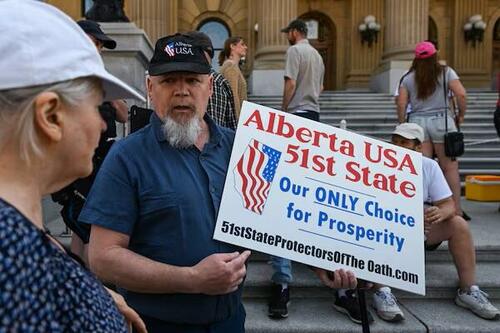
Alberta Sees Large Turnout For Petition To Separate From Canada
Crowds of Canadian citizens stood in long lines across Alberta for hours this week to sign a petition for a referendum on leaving Canada – officially titled “A Referendum Relating to Alberta Independence.” The petition requires at least 177,000 signatures in order to trigger the referendum, which would ultimately decide if the province will separate.
Petitions have 120 days to collect the signatures needed. Pro-separation groups say they could get as many as 1 million signatures, which would be a clear indication that Alberta will leave Canada. Alberta’s population is currently 5 million people.
Some petition locations reported as many as 10,000 signatures in a day and the public response is described as “concerning” by critics who want to remain part of Canada’s “constitutional monarchy.” Alberta is widely considered the most conservative province in the country and has been at odds with the far-left Canadian government (ruled by Ontario progressives).
The referendum would mean a simply Yes/No question for voters on separation. A majority (51% or more) would then lead to a legal process overseen by the Canadian federal government. Come polls indicate that 60% of Albertan citizens are still opposed to the measure, however, the recent turnout for the petition suggests the tide is turning. Recent conflicts with progressive elites in the Canadian government have driven Albertans to question their relationship.
Alberta fought against the leftist government’s pandemic lockdowns, church and business closures and draconian vaccination requirements. They remain in opposition to Canada’s new gun laws which are incrementally removing all firearms from private hands. They have also been at odds with the federal government over resource development, energy policy, carbon taxation and economic marginalization.
Essentially, Alberta is a different nation when compared to the Canadian norm. It is also a commodity treasure trove that Canada exploits to feed its coffers while rarely giving anything back to provincial citizens.
Wow, an absolute insane lineup of people – that goes entire city blocks – of people in Calgary waiting to sign a petition to make Alberta an independent sovereign nation. pic.twitter.com/HqB1xaJRs8
— Keean Bexte (@TheRealKeean) January 11, 2026
Canadian courts initially blocked a referendum question on separation, asserting that the implications of the question were too vague and did not align with constitutional requirements. Instead of appealing the decision, Alberta turned to the legislature. Within days, the legislature passed Bill 14, amending the Referendum Act to remove the requirement that referendum questions align with the Constitution. Separatists quickly got a revised referendum question approved, and the petition process resumed
Another obstacle to the separation is a lawsuit brought by the Sturgeon Lake Cree Nation goes far beyond provincial politics. The First Nation is seeking an urgent injunction to stop Alberta’s petition process. They say a separation would be in violation of their original treaty with the Crown. The claim sets up a possible loophole allowing the federal government to deny separation, but the notion that a Native treaty supersedes provincial law is rather thin. Alberta’s separation would simply mean that the Cree would have to negotiate a new treaty.
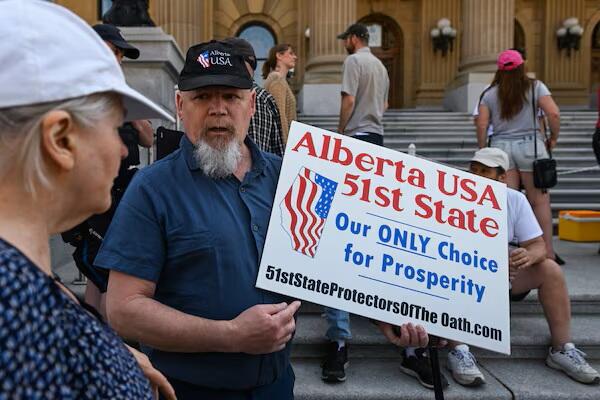
Arguments against the referendum say that Alberta is “landlocked”, which would make its separation economically disastrous. This is not entirely true. Their shared border with the US and newfound sovereignty would allow the province to establish more significant oil pipelines (pipelines which the Canadian government has consistently blocked in the past). This development along with greater resource exploration and an alliance with American interests would make Alberta one of the wealthiest regions in the western hemisphere.
Furthermore, Alberta stretches within 700 miles of the arctic, an area of the world which is quickly becoming central to geopolitics. Early warning systems and NORAD bases in Alberta are integral to US security. These bases could be shut down in the event that conflicts between Canada and the US escalate. A free Alberta could become vital to US defense.
The debate over US ownership of Greenland is only one element of a larger global shift to the North. Alberta’s exit from Canada and potential alliance with the US could have vast implications for international relations.
Tyler Durden
Thu, 01/22/2026 – 11:00
ZeroHedge News
[crypto-donation-box type=”tabular” show-coin=”all”]