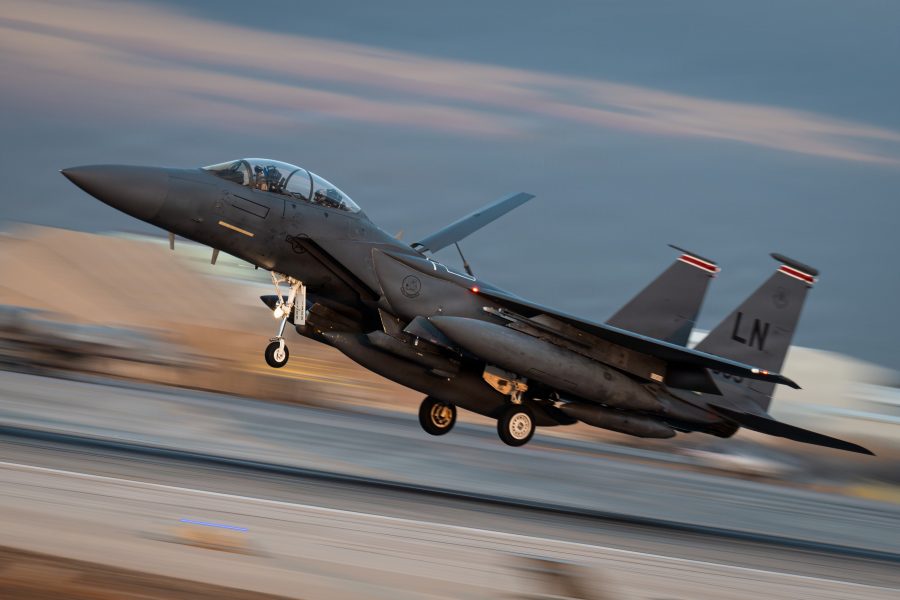
The Pentagon rushed more F-15E Strike Eagles to the Middle East in recent days as the U.S. military is reinforcing its airpower in the region amid high tensions with Iran.
A dozen F-15Es assigned to the 494th Fighter Squadron at RAF Lakenheath, U.K., departed on Jan. 18, headed towards the Middle East, supported by KC-135 Stratotanker aerial refueling aircraft, according to flight tracking data.
U.S. Central Command, which oversees U.S. forces in the region, confirmed the squadron’s presence in the Middle East with an official photo posted on social media Jan. 20. C-17 Globemaster III cargo aircraft have also flown from Britain to the Middle East, a deployment that appears to be in support of the fighter squadron’s deployment.
“The F-15’s presence enhances combat readiness and promotes regional security and stability,” CENTCOM wrote in a post on X accompanying the photo. The command did not offer any further comment.
The U.S. military has also dispatched an aircraft carrier, the USS Abraham Lincoln, to the Middle East.
A U.S. defense official declined to discuss CENTCOM’s force posture, citing operational security.
President Donald Trump has been weighing military action against Iran. Last week, Trump considered but declined to intervene to support weekslong, widespread protests against the Iranian regime and its Supreme Leader Ayatollah Ali Khamenei, according to U.S. officials. Many American and Arab officials expected Trump to intervene, and the U.S. temporarily evacuated some aircraft and personnel from Al Udeid Air Base, Qatar, its largest base in the Middle East and CENTCOM’s regional headquarters. Iran targeted the base with a ballistic missile salvo last June after Operation Midnight Hammer, the U.S. operation to strike Iran’s nuclear facilities.
The protests appear to have subsided amid accounts of a brutal regime crackdown, which has killed at least 3,000 people, according to activists, though some reports put the casualty figures much higher. The protests are the biggest demonstrations against the theocratic government of Iran since it came to power in the Iranian Revolution of 1979.
Speaking during a press conference at the White House on Jan. 20, Trump left open the option of some military action against Iran.
“We’re just going to have to see what happens with Iran. There’s a military option,” Trump said.
In recent days, Trump has also suggested he wants the Iranian regime to fall.
“It’s time to look for new leadership in Iran,” he told POLITICO Jan. 17.
The beefed-up American airpower could assuage fears that the U.S. does not have enough firepower in the region, particularly if even more aircraft are deployed. The U.S. diverted significant military assets to support operations in the Caribbean, including the aircraft carrier USS Gerald R. Ford, which was diverted from the Mediterranean Sea last fall. Air Force assets that deployed to Carribean included F-35A Lightning II and F-22 Raptor fifth-generation fighters.
With the addition of another F-15E squadron, the U.S. now has three Strike Eagle squadrons known to be deployed to the region, according to open-source flight tracking data and recent official U.S. military imagery.
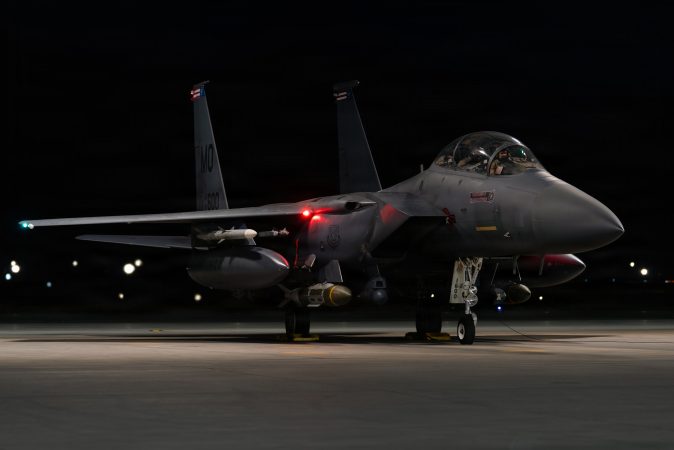
The F-15E squadrons that were already deployed to the Middle East are from Seymour Johnson Air Force Base, N.C., and Mountain Home Air Force Base, Idaho. Air Force F-16 Fighting Falcons and A-10 Thunderbolt II attack planes are also known to be deployed to the region.
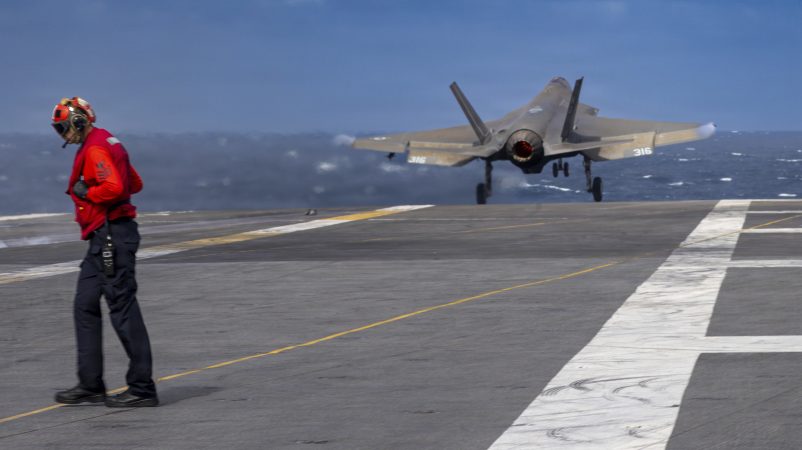
The Lincoln, which is en route to the Middle East via the South China Sea, is embarked with F-35C aircraft from the Marine Corps Fighter Attack Squadron (VMFA) 314, along with Navy F-18 Super Hornets fighters. The carrier also has a squadron of EA-18 Growler electronic attack aircraft, which can jam and strike air defenses.
The U.S. has used F-15Es during previous American military engagements with Iran. In April 2024, F-15Es were used to successfully blunt a large-scale Iranian drone and missile attack on Israel. Along with F-16s and U.S. allies, the F-15Es helped down over 80 drones. The American fighters that participated in that operation were primarily from the 494th Fighter Squadron, the same unit that deployed into the Middle East in recent days.
The two-seat fighters, which carry a pilot and a weapons system officer, used AIM-9 Sidewinder and AIM-120 AMRAAM guided missiles to take down the drones in that engagement nearly two years ago, and multiple fighters even attempted to drop laser-guided Joint Direct Attack Munition bombs on the drones, without success. Since then, the U.S. has employed cheaper and more plentiful laser-guided rockets against drones. F-15Es can carry dozens of rockets and have been pictured in the Middle East equipped with the APKWS pods, as the system is known.
Strike Eagles can also carry a large amount of ordinance and have participated in U.S. airstrikes this month in Syria against the Islamic State group, including dropping 2,000-pound bombs.
The Lincoln’s F-35s, meanwhile, have advanced sensors and radar-evading capabilities. U.S. Air Force F-35s were used to suppress Iranian air defenses and escort the seven B-2 Spirit bombers that participated in Operation Midnight Hammer. Israel has also used its own version of the jet, the F-35I Adir, to great effect in one-off strikes around the region and to degrade Iranian capabilities during its conflict with Iran last summer.
The post Pentagon Sends More F-15s to Middle East as Trump Weighs Action Against Iran appeared first on Air & Space Forces Magazine.
Air, 494th Fighter Squadron, CENTCOM, Donald Trump, F-15E, Iran, Middle East, U.S. Central Command, USS Abraham Lincoln
Air & Space Forces Magazine
[crypto-donation-box type=”tabular” show-coin=”all”]