 James Bond Stockdale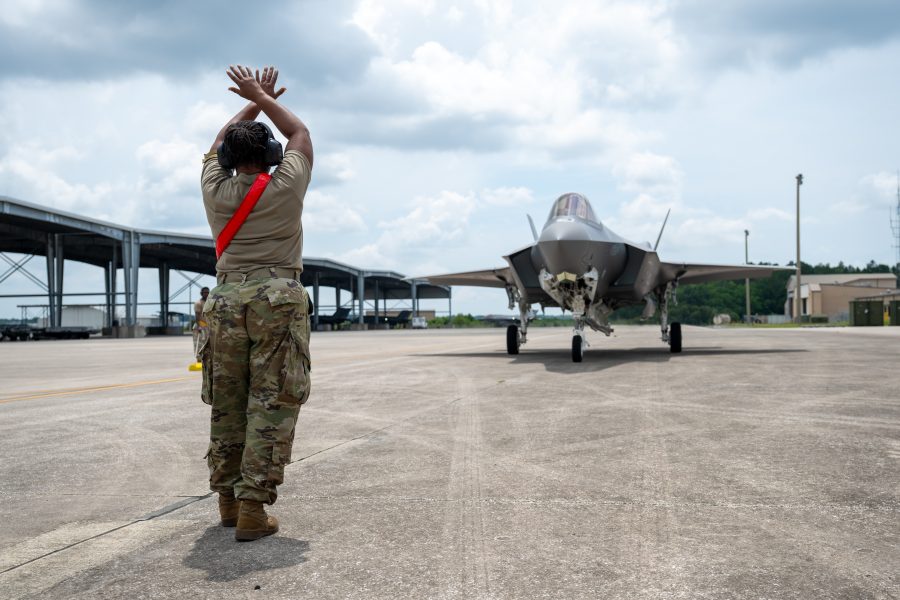
Lockheed Martin says it delivered 191 F-35 fighters in 2025—exceeding its self-imposed goal from the beginning of the year as the company works to clear a long backlog of jets.
Lockheed has said it can build 156 F-35s in any given year, but a backlog caused by a dispute with the government meant finished jets got backed up on runways for about a year waiting to be delivered. The 191 planes delivered in 2025 tops the previous highs, 142 aircraft in 2021 and 110 jets in 2024.
The yearlong hold on deliveries was imposed by the F-35 Joint Program Office and extended from July 2023 to July 2024. Jets being built included the Technology Refresh 3 update, while the Pentagon had yet to complete testing of that major upgrade.
Lockheed kept building F-35s and parking completed airframes while it worked with the government to stabilize a “truncated” version of the TR-3 upgrade so deliveries could resume. Lockheed and the JPO have repeatedly declined to disclose exactly how many jets went into storage, but sources indicate the number was just over 100.
The Pentagon estimated in spring 2024 that Lockheed could reach 20 deliveries per month as it attempted to clear the backlog, and by that October, company officials said they were nearing that rate. Then a year ago, Lockheed CEO Jim Taiclet predicted the company could deliver between 170 and 190 jets by year end. With 191 deliveries, revealed in a Jan. 7 release, Lockheed ultimately averaged just shy of 16 aircraft per month month. Assuming Lockheed hit its production rate of 156 fighters, 35 extra jets were cleared in 2025, on top of any that were cleared in late 2024.
It’s unclear how big, if at all, the remaining backlog is. Lockheed Martin declined further comment, citing a quiet period ahead of a Jan. 29 earnings call, and the F-35 JPO spokesperson could not immediately provide clarification.
Getting jets from storage to the field is complex. According to Lockheed Aeronautics president Greg Ulmer, each stored airplane gets four checks—two from the company and two by the government—before being delivered, and each received two of those checks before being put into storage. The withheld airplanes underwent power-ons and active care during storage and were not simply mothballed.
Lockheed used its Jan. 7 release to tout a “record-breaking” year for the F-35 program. Among other milestones it hit:
- 1 million flight hours across the fleet
- A new $24.3 billion contract for 296 fighters, in Lots 18 and 19
- F-35 contributions to high-profile operations, such as Operation Midnight Hammer over Iran and the downing of Russian drones over Poland
Still, the F-35 program had its challenges in 2025. The Pentagon in June slashed its F-35 buy for fiscal 2026 from 74 to 47 aircraft, and Congress has not altered that plan, instead investing funds for spare parts to boost the jets’ availability. While other fighter programs like the F-47 and F-15EX saw major funding increases in the mid-year reconciliation package known as the Big Beautiful Bill Act, the F-35did not—fueling angst over lawmakers’ commitment to future purchases.
What happens in 2026 is still to be determined. But President Donald Trump annoounced Jan. 7 his intention to propose a massive $1.5 trillion defense budget for fiscal 2027, a 50 percent increase over 2026. How that money might be spent is still far from clear, but more F-35s are a reasonable bet if the increase comes to pass.
The post F-35 Deliveries Soared to New Record in 2025 appeared first on Air & Space Forces Magazine.
Air, F-35 deliveries, F-35 Joint Program Office, Lockheed Martin
Air & Space Forces Magazine
[crypto-donation-box type=”tabular” show-coin=”all”]