Tyler Durden
$60 Oil Undercuts Trump’s ‘Drill, Baby, Drill’ Agenda
Authored by Tsvetana Paraskova via OilPrice.com,
-
U.S. shale producers are not embracing the “drill, baby, drill” mantra because current oil prices, which hover near or below their breakeven point, do not justify accelerating production.
-
Instead of drilling new wells, companies are boosting output through efficiency gains, consolidation, and utilizing drilled but uncompleted wells (DUCs) to preserve value for shareholders.
-
Industry executives, including those from TotalEnergies and ConocoPhillips, believe the U.S. shale industry will stagnate or decline if oil prices remain around the $60 to $65 per barrel range.
“Drill, baby, drill” is not the central theme in the U.S. shale patch despite President Donald Trump’s best efforts to back the American oil and gas industry with eased permitting and reversal of climate and export-restricting policies.
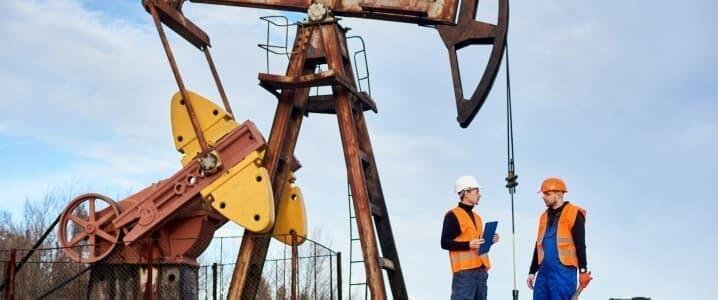
Most U.S. oil and gas producers are boosting production through consolidation and efficiency gains, instead of drilling additional wells. Many rely on drilled but uncompleted wells (DUCs) to raise output as the U.S. benchmark oil price has dipped by about 15% since President Trump’s inauguration in January.
The regulatory and permitting climate has rarely been so favorable for the oil industry, after President Trump rescinded many of Biden’s energy policies to allow again massive federal oil and gas lease sales, open the Arctic National Wildlife Refuge’s coastal plain in Alaska to drilling, and lift a moratorium on new LNG export project approvals.
However, the oil market and oil price reality this year is not in favor of “drill, baby, drill.”
No Drill, Baby, Drill
True, U.S. oil production has continued to grow to record highs this year, as output lags the global price moves with several months, and producers bet on efficiency and selective capital allocation to preserve value for shareholders at oil prices that are very close to, or even below, their breakeven price to profitably drill a new well.
Drilling activity is slipping, with the total rig count now down to 546, according to Baker Hughes, a decline of 39 rigs from this same time last year.
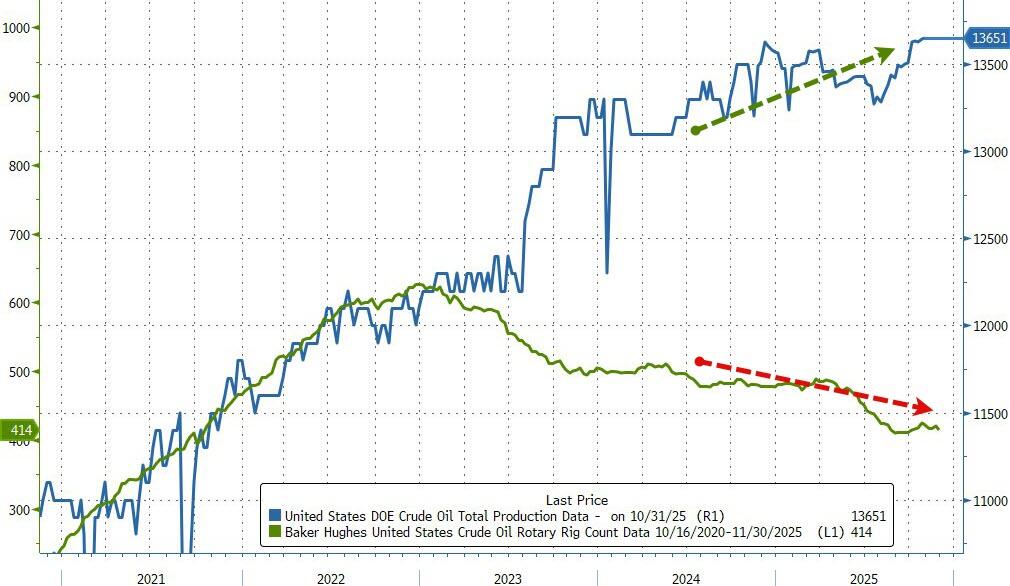
At the current price of oil, shale will stagnate or start to decline, industry executives say, while shale producers look to do more with less by raising efficiency in production and capital allocation.
“Fundamentally, the short-term market is a little bearish,” Patrick Pouyanne, the chief executive of supermajor TotalEnergies, said at the Energy Intelligence forum last month.
“There is a point at $60 per barrel where we’ll see the shale industry beginning to slow down,” Pouyanne said on the sidelines of the forum.
ConocoPhillips chairman and CEO Ryan Lance said that “At $60-$65 a barrel WTI oil prices, the US is probably plateau-ish.”
U.S. oil output could grow by between 300,000 barrels per day (bpd) and 400,000 bpd this year, Lance said.
“But if prices stay at $60 or go into the $50s, you probably are plateauing or slightly declining,” the executive added. WTI prices have traded just below or just above $60 per barrel in recent weeks, weighed down by forecasts of a major oversupply hitting the market within weeks.
Kaes Van’t Hof, CEO and Director at Diamondback Energy, this week told shareholders in his quarterly letter that the company, which is color-coding its activity levels to the colors of a stoplight, remains in the “yellow” zone today, while retaining all operational flexibility for green or red.”
The estimates of the looming oversupply range from less than 500,000 bpd at OPEC to nearly 4 million bpd at the International Energy Agency (IEA).
“As they say in Texas, ‘you could drive a truck between those two numbers’. Our best guess on the amount of oversupply lies somewhere in between, with our inherent cognitive bias leaning to support OPEC’s forecast. We also recognize we are unlikely to see positive price signals until this debate is resolved,” Van’t Hof wrote.
“Against this backdrop, we firmly believe there is no need for incremental oil barrels until there is a proper price signal,” the executive added.
“Until that time, we will put our head down and continue to work to lower our industry-leading oil price breakeven, reinvestment rate and cost structure so we can maximize Free Cash Flow to pay our dividend, buy back shares and pay down debt.”
Price Signal Outweighs Trump’s Support
For the U.S. oil and gas producers, the Trump Administration’s favorable policy is not the key driver of capital allocation and drilling activity. It’s the price of oil.
“In a word, ‘drill baby drill’ has been a flop,” Dan Pickering, chief investment officer at Houston-based Pickering Energy Partners, told the Financial Times.
“The industry is driven by economics and right now, the economics don’t justify accelerating production,” Pickering added.
While the American oil industry has praised the eased regulatory burden and the U.S. energy dominance policy of the Trump Administration, it has been rattled by the trade and tariff uncertainty and the President’s insistence that energy prices should be lowered.
“The U.S. shale business is broken,” an executive at an exploration and production company wrote in comments to the latest Dallas Fed Energy Survey in September.
“What was once the world’s most dynamic energy engine has been gutted by political hostility and economic ignorance.”
The previous administration vilified the industry and cheered when Wall Street walked away from shale, they added, but noted that “Now the current administration is finishing the job.”
“Guided by a U.S. Department of Energy that tells them what they want to hear instead of hard facts, they operate with little understanding of shale economics,” the executive said.
“Instead of supporting domestic production, they’ve effectively aligned with OPEC—using supply tactics to push prices below economic thresholds, kneecapping U.S. producers in the process.”
Tyler Durden
Fri, 11/07/2025 – 10:20
ZeroHedge News
[crypto-donation-box type=”tabular” show-coin=”all”]