 Tyler Durden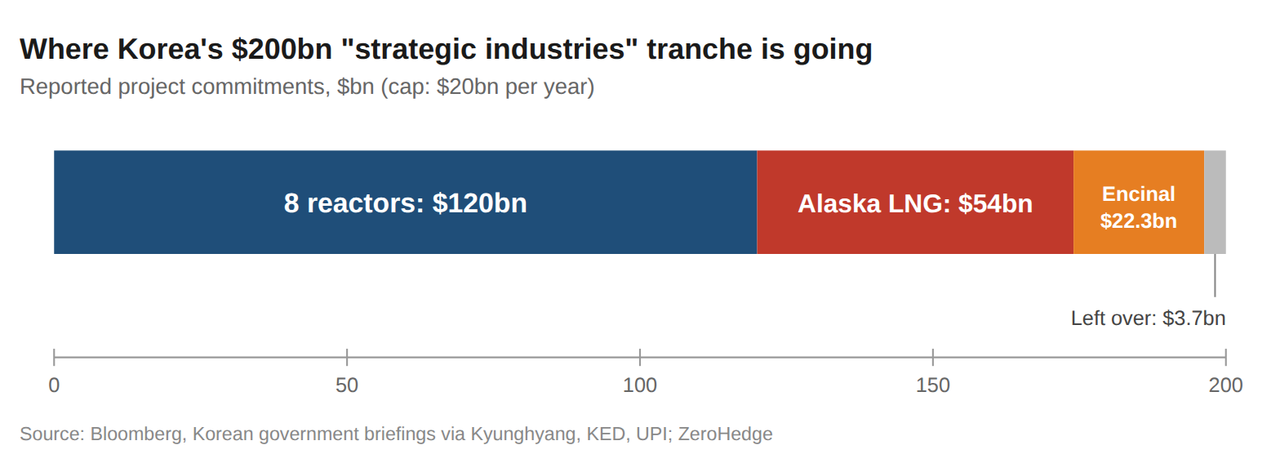
Trump’s $200BN Korean “Investment” Is A Gas Plant With No Customers, Eight Reactors With No Sites, And A Pipeline Seoul Calls A “Future Discussion”
A week ago, we wrote that South Korea had finally found a home for the first slice of the $350 billion it promised Trump: a $22.3 billion, 6.3GW gas plant in Encinal, Texas, with no customers, no PPA, and turbines that may not show up this decade. That left, as we put it then, “$328 billion to go.”
That number is about to get a lot smaller, if only on paper. According to Bloomberg, at 3pm ET, Trump will announce from the Oval Office that Korea is committing $200 billion to US energy projects: eight large nuclear reactors, the Encinal plant, and the long-suffering Alaska LNG export venture, which Bloomberg earlier reported would get $54 billion of Korean backing. A White House official described it as the first tranche of projects to win approval under last year’s trade deal.
One small detail: Seoul hasn’t publicly confirmed any of it. And according to Korean press, it doesn’t entirely agree.
The math adds up… a little too well
Recall how the deal is structured. Of the $350 billion, $200 billion is upfront capital for “strategic industries,” capped at $20 billion a year, with a separate $150 billion for shipbuilding. Now add up the three projects that have been floated:
- Eight reactors: about $120 billion, per Korea’s own government briefing (six Westinghouse AP1000s and two Korean APR1400s, per Kyunghyang Shinmun)
- Alaska LNG: $54 billion
- Encinal, Texas: $22.3 billion
Total: $196.3 billion. In other words, today’s announcement would use up about 98% of Korea’s entire strategic-investment tranche in one go, with $3.7 billion left over for bubble tea or whatever. At the $20 billion annual cap, just funding these three would take roughly a decade, which is convenient for a program that runs well past the next two elections.
Here is where it gets awkward. In its National Assembly briefings, the Korean government listed Encinal as the only approved first project. The eight reactors and Alaska LNG were both classified as “items for future negotiation,” according to SBS and Seoul Economic Daily. The latter notes that Commerce Secretary Lutnick is leading the announcement, flanked by Alaska Senator Dan Sullivan, while Korea’s own trade minister, Kim Jung-kwan, who actually negotiated the thing, is not expected to be there.
Kim was even more explicit on the nuclear piece, telling reporters that the plan “does not mean that the nuclear power projects will immediately proceed” until final arrangements and government reviews are done. So the $200 billion headline is roughly $22 billion that Seoul has signed off on and $174 billion that Seoul is still arguing about.
The midterm pipeline
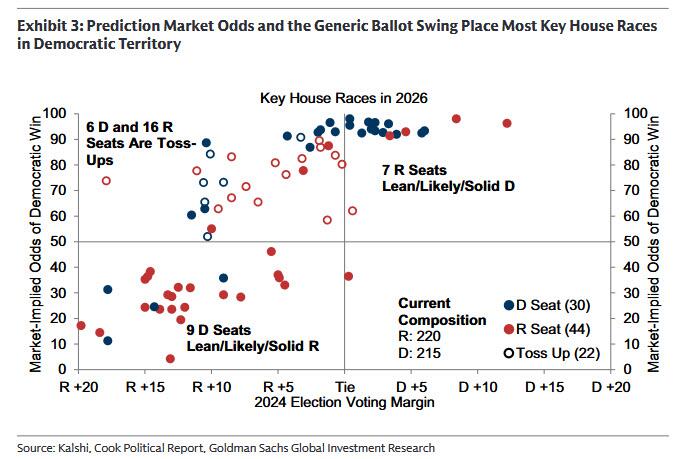
Bloomberg flagged the timing, noting that the announcement comes amid deep voter dissatisfaction with the cost of living and the risk that Republicans lose Congress in November. Goldman’s Alec Phillips relaunched the bank’s US Election Monitor this morning (full note available to pro subs) and his numbers are not great for the GOP: Democrats lead the generic ballot by 8.5 points, prediction markets give them a greater than 90% chance of winning the House, and better than 60% odds of taking the Senate. Phillips does caution that Senate polling has historically overstated Democratic performance at this stage, especially in red-leaning states.
Which brings us to Alaska. Per Seoul Economic Daily, Democrat Mary Peltola leads incumbent Sullivan 46.5% to 45%, with local fuel prices a big issue. Korean commentators are openly calling the Alaska LNG announcement a “midterm card.” As for whether a 740-mile pipeline that hasn’t reached FID will lower anyone’s gas bill before November 3, we had a thought on that last night:
*TRUMP TO UNVEIL $54 BILLION ALASKA LNG PLAN AMID MIDTERM WOES
Surely the LNG will be used to help US consumers and not be exported to Japan and Korea, right?
— zerohedge (@zerohedge) September 29, 2026
Recall that the whole point of Alaska LNG is to ship North Slope gas to Asian buyers, with some diverted for in-state power. When we last covered the project in October 2025, it was a $44 billion venture, and Asian buyers were quietly worried the costs were too high. Korea’s reported $54 billion commitment alone is now bigger than the whole project’s price tag was a year ago. That is some impressive cost inflation, even by pipeline standards. Glenfarne has signed preliminary deals with importers but still hasn’t taken FID; Korea’s money is supposed to unlock it.
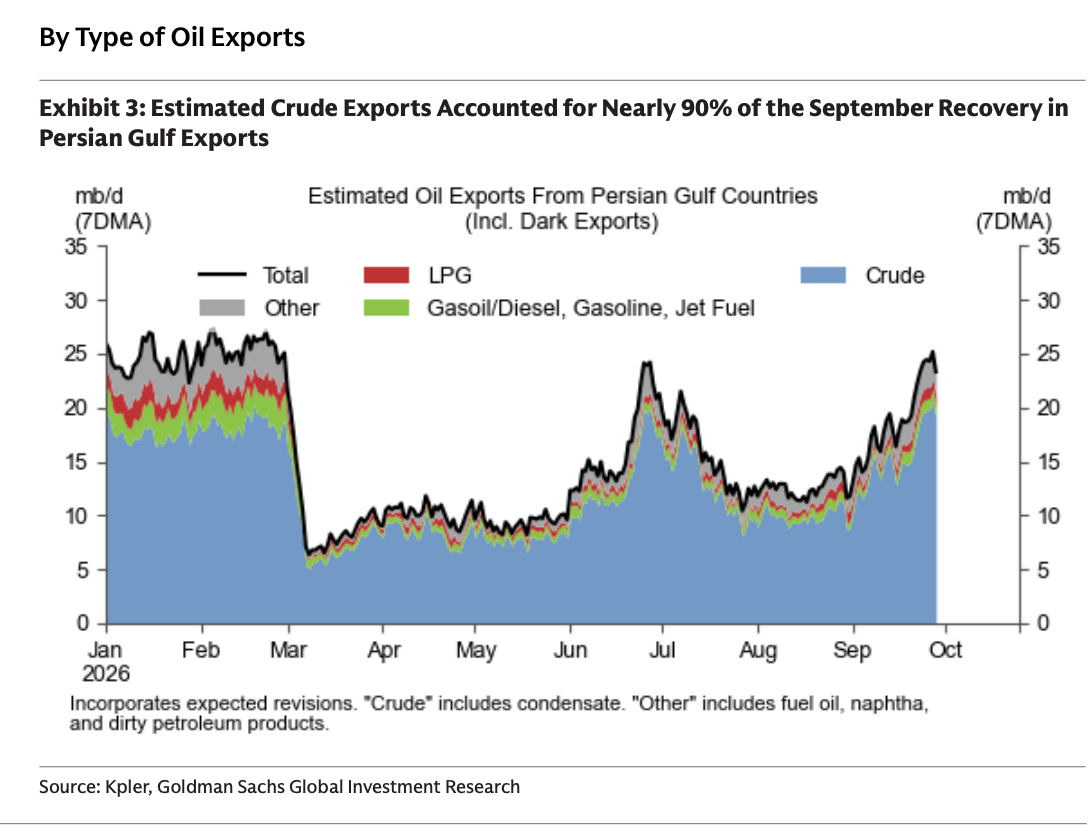
To be fair to Seoul, the timing isn’t crazy from an energy-security perspective. Goldman’s Samantha Dart wrote after Gastech last week that corporates across the LNG chain expect the Iran status quo to persist, and that without a meaningful recovery in Persian Gulf exports this winter, JKM will likely reach $35/mmBtu by year-end, versus a $24.85 base case. A supply source that doesn’t pass through Hormuz has obvious appeal for Asian importers. It’s also telling that KOGAS just approved roughly $1.26 billion for LNG Canada Phase 2, which is a project that actually exists. Meanwhile Goldman’s John Mackay listed “higher costs for new US greenfield capacity” among the key debates heading into Gastech, and few greenfield projects are more greenfield than a 740-mile trench across the Arctic permafrost.
Eight reactors, zero sites
The nuclear piece is the biggest part of the package and the least developed. What we know:
- Structure: $120 billion for eight units in three phases: two AP1000s first, then two APR1400s plus two more AP1000s, then two final AP1000s. A six-month gap is targeted between the Phase 1 and Phase 2 EPC contracts, and both sides agreed only to make “reasonable efforts” to keep to it (UPI).
- Sites: None yet, though talks favor federal land.
- Lead times: 54 months for reactor vessels, 57 months for steam generators and 65 months for coolant pumps. Seoul has floated up to $10 billion by year-end for advance equipment purchases, pending National Assembly approval, and DOE has separately authorized $17.5 billion in conditional loans for long-lead AP1000 gear.
- Per-unit cost: $15 billion per reactor. That’s ambitious given Vogtle’s two AP1000s came in north of $30 billion, but at least it’s within shouting distance.
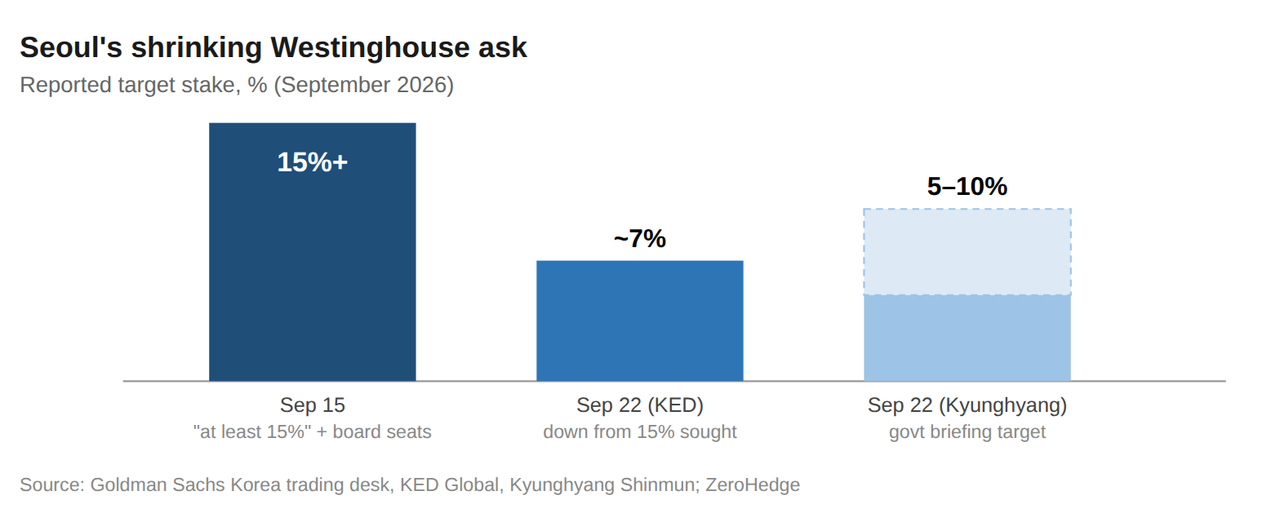
The real fight has been over who gets to design and own what. Goldman’s Seoul trading desk flagged on September 16 that the core disagreement delaying the talks was the nuclear leg, with the US “reportedly showing reluctance toward constructing Korean-designed reactors on its soil,” and not keen on handing Korea voting rights in Westinghouse. That friction shows up in the numbers: a day earlier the same desk reported Seoul wanted at least a 15% stake in Westinghouse plus board seats. By last week, KED had it at about 7%, and Kyunghyang reported a 5–10% target, with the government insisting voting rights “could be obtained even at” that level. We’ll see.
This is a saga we’ve been tracking for a while. Back in November 2025 the administration declared it a “national emergency” and said it would buy 10 large new reactors. By March, slow progress had pushed the administration to start talking with Westinghouse’s rivals. In August, the plan became a Korean problem:
According to reports, The U.S. govt has proposed that S. Korea acquire a stake in Westinghouse Electric Company as Washington pursues an $80 bn partnership aimed at breaking ground on 10 large-scale nuclear reactors by 2030. KEPCO(015760) is being considered as the acquisition…
— zerohedge (@zerohedge) August 24, 2026
And by Labor Day, “up to eight” reactors with a price tag of $120–130 billion. So in about ten months we went from 10 reactors for $80 billion to eight for $120 billion, which is the most nuclear thing about this whole story.
Longer term, the more interesting action may be in smaller units. Goldman’s Yuichiro Isayama noted this month that Japan’s third tranche under its own $550 billion pledge is likely to focus on SMRs (after about 10 units were already assumed in the second), and flagged Japan Steel Works (Buy) as the big winner because SMR primary components still need the same large forgings as full-size reactors. As we’ve argued for a while, modular reactors are the only long-term solution to the AI power crunch; Tokyo seems to agree, while Seoul is betting on the gigawatt-scale designs that made Vogtle famous for all the wrong reasons.
Who buys all this power?
As a reminder, Korea’s own case for Encinal assumes the power “can be sold to Big Tech at premium prices,” per a local report flagged by Goldman’s Seoul desk. The demand is certainly there. Goldman’s Power Up America team projects AI infrastructure capex of $1.3 trillion in 2027 and $2 trillion in 2028, which it says corresponds to 35GW and 57GW of new data center deployments, adding that “the physical grid could emerge as the ultimate constraint.” Against that, Encinal’s 6.3GW plus roughly 9.5GW of reactors that won’t be online until well into the 2030s is a rounding error… if it gets built at all.
And then there’s the behind-the-meter question. As we noted last week, Goldman’s Carbonomics team raised its outlook for BTM generation at data centers from 40GW to 67GW by 2030. If hyperscalers increasingly build their own on-site power (which we have long argued should be mandatory), then grid-scale plants that were financed on the premise of selling premium power to Big Tech may find Big Tech has already left the room. And with large gas turbines effectively sold out through 2030, Encinal and the BTM crowd are fighting over the same equipment anyway.
Bottom line
Japan went first in February with a $36 billion opening tranche, led by an Ohio gas plant whose sponsor, SB Energy, has since delayed its IPO. Korea is now doing the same thing, just bigger and faster: one gas plant Seoul has agreed to, $174 billion of projects it still calls “future discussion,” and a headline number that will do a lot of work between now and November 3.
Last week we said there was $328 billion to go. After today, Trump will say $150 billion. Seoul will probably say it’s still $328 billion. For once, both may be right.
Tyler Durden
Wed, 09/30/2026 – 14:00
ZeroHedge News
[crypto-donation-box type=”tabular” show-coin=”all”]