 Tyler Durden
UNCLASSIFIED
Futures Rip As Anthropic IPO Frenzy Revives AI Trade, Asian Chips Puke
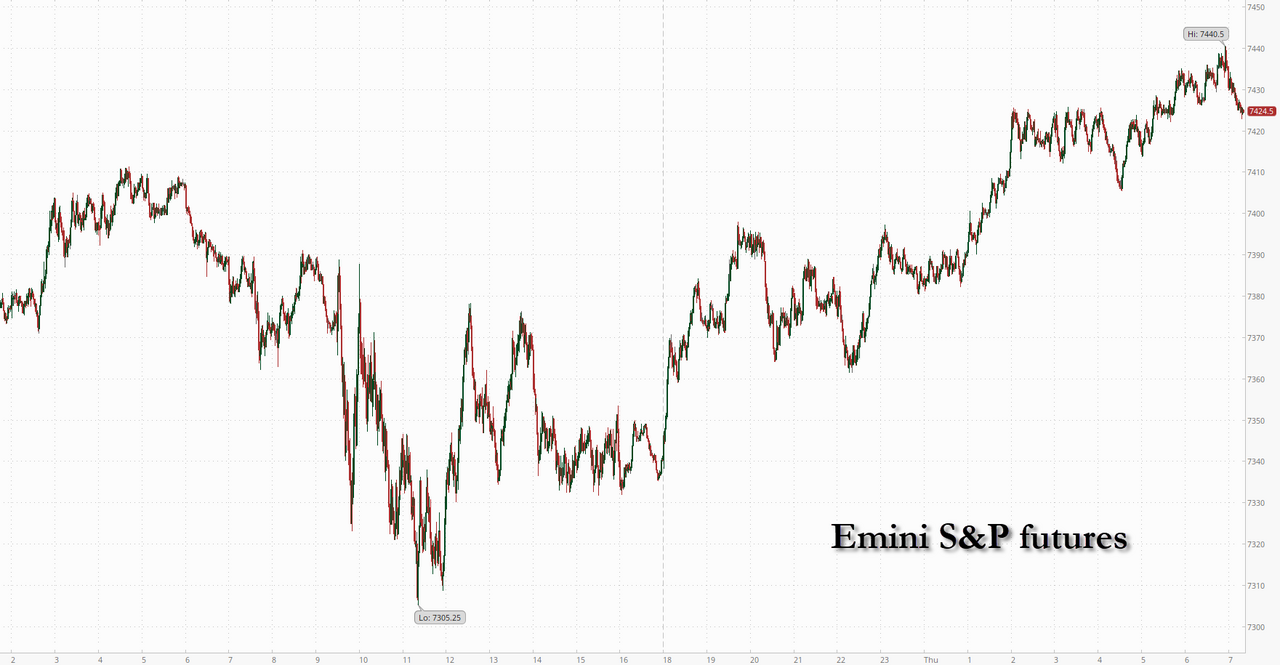
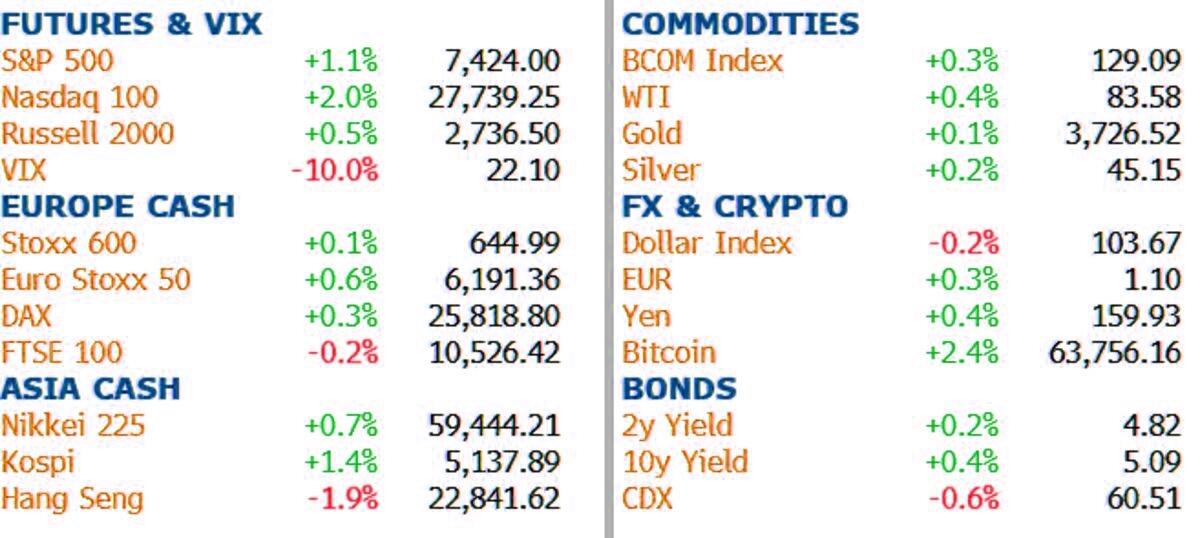
US futures are higher, with Nasdaq contracts ripping as much as 2% after Anthropic’s blockbuster IPO priced well above its marketed range and revived the battered AI trade, while traders shrug off a fresh round of Iran escalation (Trump is reportedly weighing new strikes and the IRGC claims two supertankers hit mines in Hormuz) and parse the first ever Trump-Xi-Putin trilateral in Shenzhen; as a result the S&P is set to snap a five-day losing streak just as it was precariously clinging to its 200-day moving average. As of 8:00am ET, S&P futures are 1.2% higher (trading around 7,424 earlier in the session) while Nasdaq futures jump 2.0% and Dow futures are +0.6%. The bounce follows Wednesday’s choppy session in which the S&P slipped 0.2% for a fifth straight decline while the Nasdaq 100 eked out a 0.4% gain, as Nvidia faded its post-earnings pop to close 3% lower despite a beat and raise. Premarket, all of the Mag 7 are higher, led by Alphabet (+4.2%) and Amazon (+2.5%); cybersecurity names are surging after Palo Alto (+9.5%) raised guidance and agreed to buy Applied Compute for $4.5 billion, dragging CrowdStrike, Cloudflare and Zscaler higher. The day’s driver is Anthropic: the Claude maker and its seven co-founders raised a record $107.3 billion in an upsized IPO and private placement, pricing at $83 a share against a $70-$78 range, for a fully diluted valuation of about $1.5 trillion, as we detailed last night; the stock is indicated 20% to 26% higher in gray market trading ahead of its Nasdaq debut. Treasuries are slightly weaker, with yields up 1-2bps across the curve and the 10Y at 5.085%, as the risk-on tone unwinds part of the overnight haven bid; traders still price about 27bps of Fed hikes in December after hawkish FOMC minutes showed almost all officials expect more tightening. The dollar is modestly softer, with the yen lagging (USD/JPY near 159.9) and the Aussie the worst G-10 performer after a big jobs miss. Oil is steady, with WTI up 0.4% to $83.59 and Brent at $92.27; gold is nursing losses near $3,730 after briefly dipping below $3,700, while copper hovers near multi-month lows after Wednesday’s near 6% plunge. Bitcoin trades around $63,700 after its pre-IPO liquidation slump. US economic data slate includes initial jobless claims and the November Philadelphia Fed survey (8:30am), the October leading index (10am) and the Kansas City Fed manufacturing index (11am). Fed speaker slate includes Hammack (8:50am), Jefferson (9:25am), Goolsbee (12:30pm), Barr (2:15pm), Barkin (4pm) and Paulson (6:30pm). We also get a $19 billion 10Y TIPS reopening at 1pm.
In premarket trading, Mag 7 stocks are all higher: (Alphabet (GOOGL) +4.2%, Amazon (AMZN) +2.5%, Nvidia (NVDA) +2.1%, Tesla (TSLA) +1.7%, Meta Platforms (META) +1.5%, Microsoft (MSFT) +1.5%, Apple (AAPL) +0.4%)
- Anthropic PBC (ANT) shares are indicated to open higher in gray market trading after the company’s $107.3 billion initial public offering and private placement.
Shares of tech stocks are broadly higher as investors looked ahead to the upcoming Anthropic IPO. - Bath & Body Works (BBWI) falls 2% after the retailer posted third quarter results.
- Everpure (P) rises 5% after the storage and data management company boosted its revenue guidance for the year.
- NetEase ADRs (NTES) fall 6% after the Chinese internet and video-game company reported disappointing 3Q results, with weaker-than-expected games revenue.
- Palo Alto Networks (PANW) jumps 10% after the cybersecurity firm delivered better-than-expected first-quarter results and raised its full-year outlook. It also agreed to buy the AI model platform Applied Compute in an $4.5 billion deal that’s expected to move the firm into the neocloud business and enable development of cyber-specific AI models.
In other corporate news, Palo Alto Networks went shopping again, agreeing to buy AI model platform Applied Compute for $4.5 billion (roughly 45x ARR, as JPM’s desk points out) in a deal meant to move the cyber firm into the neocloud business; Alibaba posted a stronger than expected 10% rise in revenue, while PDD’s third-quarter revenue of 108.34 billion yuan badly missed the 115.21 billion estimate; Lenovo tanked after reporting its first operating loss since 2017 as memory costs bite; Microsoft and Intel signed a long-term Azure infrastructure pact; UniCredit struck a deal with the German government on its Commerzbank takeover; AbbVie is targeting solid tumors in a deal worth up to $2.54 billion; Starboard sees more upside in Flowserve and Riot Platforms; Apollo scrapped a planned $2 billion loan to Manchester City’s owner, according to the FT; UGI will spin off its global LPG business; and Moody’s lowered its outlook on Nvidia’s credit to stable from positive, citing governance concerns, as the chipmaker’s headhunters reportedly approached Arm CEO Rene Haas about succeeding Jensen Huang.
Anthropic’s listing is being treated as an even bigger risk-clearing event than the midterms, with Bloomberg noting that a smooth, oversubscribed deal was just what a market that sent the Nasdaq 100 into correction territory since early October needed. With Nvidia earnings and the IPO now in the rearview mirror and Friday’s derivatives expiration about to reset positioning, the market moves into a relatively light event calendar into year-end, and the path to a year-end rally suddenly looks clearer. Of course, it was only on Wednesday that gold and crypto were dumped as investors raised cash for the very same mega-IPO they are now celebrating, and yields are still north of 5% with the Fed openly talking about hikes; but who needs a dovish Fed when you have a $1.5 trillion AI lab.
Commenting on the Anthropic-fueled overnight rally, Bloomberg Intelligence analysts Mandeep Singh and William Tong wrote that “Anthropic’s upsized IPO pricing reflects expectations that recursive self-improvement can help the company further optimize compute costs and expand into new markets such as drug discovery. First-party agent products remain central to sustaining its high net revenue retention and fending off competition from frontier models released by hyperscale peers, including Google’s Gemini and Meta’s Muse. Execution on enterprise adoption and API monetization will be key to supporting the valuation of around $1.5 trillion, about 12-13x expected 2027 sales, particularly as token-pricing pressure across frontier models intensifies.”
“The strong demand for the IPO is a welcome reminder that the AI theme is well and truly still alive,” said Jai Malhi at Vanda Research. “Now that we have seen the positioning de-rating in tech, this provides a compelling opportunity for dip buyers.”
Not everyone is convinced. Bloomberg Intelligence’s Mandeep Singh and William Tong note that Anthropic’s valuation works out to about 12-13x expected 2027 sales, and argue that execution on enterprise adoption and API monetization will be key to supporting it, particularly as token-pricing pressure across frontier models intensifies.
Morgan Stanley’s global head of macro strategy Matthew Hornbach warned that, for all the optimism returning to the AI space, the damage from a breach of AI safeguards is the biggest risk currently underpriced by markets.
Amundi Chief Investment Officer Vincent Mortier was also cautious: “Question marks are still alive regarding the monetization of it; the capacity of players like Anthropic, but also others, to monetize their huge investments… That’s why we believe it’s a bit excessive, even though this company in particular is, of course, of very good quality.”
Meanwhile, Goldman’s cross-asset team led by Christian Mueller-Glissmann is overweight both equities and government bonds as inflation cools, and sees the S&P reaching 8,700 in 12 months, 19% above current levels, alongside a 4.65% 10Y; they recommend shifting from companies building AI infrastructure toward those using it, and underweighting corporate credit, putting them in the same camp as Barclays and Morgan Stanley.
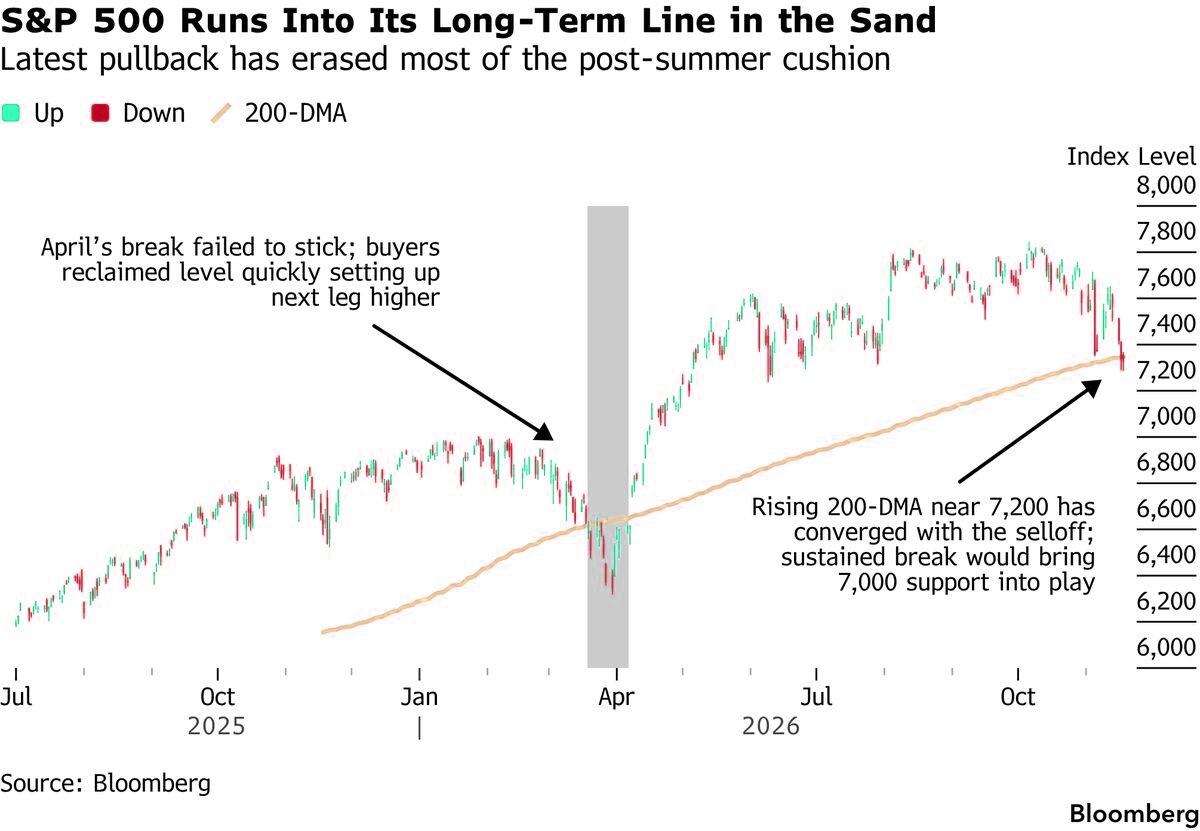
Timing matters: the S&P’s latest pullback has erased most of the post-summer cushion and pushed the index right into its long-term line in the sand.
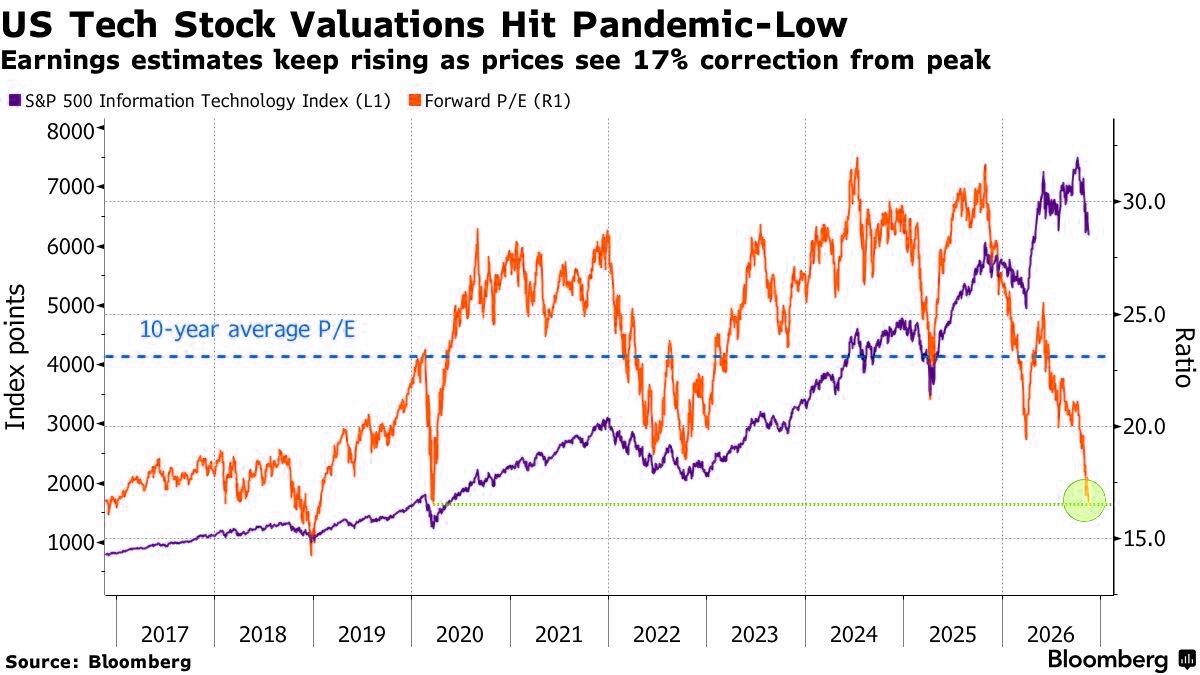
And with prices down 17% from the peak even as earnings estimates keep rising, US tech valuations have dropped to the lowest since the pandemic.
Goldman’s Rich Privorotsky calls today “pivotal.” Futures are sharply higher on the back of the Nasdaq after the US absorbed plenty of bad news on Wednesday, but Asia is struggling, with the TSMC-exposed basket down 8% as new BIS rules tightening AI chip licensing across parts of Asia and restricting offshore compute access for Chinese customers threaten delayed projects and excess capacity, a risk he says was clearly not fully priced in the region. The offset is positioning: two months of aggressive selling have left global semis valuations depressed, and it doesn’t take much good news to trigger a squeeze. On rates, he notes that despite a hawkish Waller, the Fed minutes and ECB noise, bonds rallied and the curve bull flattened, with the market increasingly pricing weaker growth as capex expectations come down and commodities roll over; he sees plenty of parallels to late 2018: the same late-cycle slowdown, with very different policy implications. With the S&P precariously holding its 200-day, VIX in the mid-20s and Thanksgiving next week, simple stabilization could be a meaningful tailwind; while there are myriad issues in AI, a lot is now in the price, and if rates play ball there is a very real bull case for equities. In hindsight, he concludes, the whole market changed when the Fed changed its posture, and it may well end the same way. His watch list for today: Walmart, claims, Philly Fed, the 10Y TIPS auction, and the yen as it approaches 160.
JPM’s Market Intel desk sees a “healthy rebound” led by the Mag 7 and broader tech, with Palo Alto’s strong earnings adding to the momentum on resilient cybersecurity demand. Fed pricing was little changed after Waller reiterated his 50bp call, though the recent repricing of the December and Q1 2027 meetings has been hawkish; the desk still sees a 50bp move in December as unlikely and says the bigger question for the equity bull case is how the market prices the Fed path through 2027. The team remains Tactically Bullish, arguing positioning is cleaner and entry points more attractive, and it prefers primary exposure to the Magnificent Seven with options to play a rebound in AI themes. On tech, JPM’s Brian Heavey notes that Nvidia ceding its premarket gains showed investor focus remains on the CEO and regulatory overhangs rather than the quarter, with AMD, Broadcom and Alphabet seen as share gainers while Nvidia is weakened; flows remain dormant, with the desk buying about $660 million vs selling $450 million in tech. JPM strategist Dubravko Lakos-Bujas reiterates his 8,000 year-end S&P target.
The Goldman desk adds that Wednesday’s tape was thin to the point of dysfunction: ES top-of-book depth averaged just $4.2 million, one of the worst liquidity sessions in the last four years, while the S&P implied move through Friday’s expiration is 1.55%. Positioning is about as clean as it gets: Fundamental L/S net leverage fell another 7.6 points month-to-date to the lowest in more than five years, below the Liberation Day lows, and hedge fund selling of global info tech over the past six weeks has been the fastest in a decade, according to Goldman’s Prime data. In London, Jonathan Lightowler describes flows as extremely light, with risk appetite at the lows, while the FOMC minutes were stale but tilted hawkish, with “a few” officials beyond the dissenters viewing the hold as a close call.
On the continent, bond yields are 1-3bps higher as the macro tone remains hawkish at the margin, with the Bundesbank’s Joachim Nagel saying a December ECB hike would send a clear signal and the ECB’s Martin Kocher saying further hikes may be needed, while the ECB’s Moulin warned inflation is still too high because of oil.
In Europe, the Stoxx 600 is up 0.2% at 645.04, set to snap a three-day decline as Anthropic’s IPO restores confidence in the AI trade, with 313 members up and 277 down. Technology leads, with semis rallying across the board, followed by basic resources and industrials, while consumer staples and real estate lag. JPM’s desk flags Semis, Momentum Long, EU Defence and Software as the top performing baskets, while UK homebuilders lag; the FTSE 100 is down 0.2% while the Euro Stoxx 50 gains 0.6% and the DAX 0.4%. Soitec soared as much as 16% after raising its Photonics-SOI guidance again, while Novartis slipped after trimming its medium-term sales growth outlook. Here are the biggest European movers:
- Semiconductor stocks rise across the board as investors look ahead to the public market debut of Anthropic, with the stock quoted higher in grey market trading.
- Soitec climbs as much as 16% after raising its Photonics-SOI guidance once again, with the French chip material company now expecting the platform to generate revenue in 2027 at more than three times its 2026 level.
- Babcock shares rally as much as 9% after the support services and defense firm beat expectations in the first half.
- Johnson Matthey rises as much as 4.7% after the chemicals company upgraded guidance and increased its dividend by 3%.
- Saipem shares gain as much as 7% after the Italian construction and drilling services company, which is in the process of merging with Subsea 7, saw revenue and Ebitda beat expectations in the third quarter.
- Halma rises as much as 3.8% after reporting a beat in pretax profit for the first half-year, particularly driven by photonics.
- Novartis shares slip as much as 2.7% as the Swiss drugmaker slightly pared its outlook for medium-term sales growth growth before its investor meeting.
- Close Brothers drops as much as 12% as RBC highlights a small 2027 downgrade for net interest margin from the specialized lender.
- JD Sports fell as much as 4.4% after it narrowed its adjusted pretax profit forecast for the full year toward the lower end of the previous range while posting third quarter results that broadly met analysts’ expectations.
- Breedon shares drop as much as 7.1% after the building materials company warned it will deliver underlying Ebitda at the lower-end of expectations this year as the firm struggles with rising energy costs.
- PZU drop as much as 5.1% after Poland’s largest insurer reported 3Q net income that missed estimates, with revenue growth unable to fully offset the rising cost of claims.
Asian stocks fell to a seven-month low as renewed selling in chipmakers showed investors remain wary of tech even after the sharp pullback, with the MSCI Asia Pacific Index dropping about 0.9%. Taiwan was the epicenter: the Taiex sank 4.4%, extending November’s losses to 15%, while the TPEx crashed 7.2%, its eighth-largest drop ever, prompting the FSC to tighten short-selling curbs yet again (proving once more that nothing stops a liquidation like banning the people who sell). TSMC and Samsung reportedly suspended shipments of certain chips to Chinese customers while they seek US export licences under the new restrictions. Goldman’s Sunil Koul said the memory trade in Asia had become very crowded both in positioning and multiples: Asian semis made up a quarter of global hedge fund exposure at the June peak, now down to 12-13%, with scope for further de-risking. The Hang Seng fell 1.9% as Tencent tumbled 6.5% after heavy AI capex pushed free cash flow negative and the balance sheet into net debt, with Alibaba and Lenovo both down 5.5%. Elsewhere, the Kospi rose 1.5% as South Korean exports topped $1 trillion for the first time, Japan’s Nikkei added 0.7% despite hawkish comments from BOJ Governor Ueda, and Australia’s ASX 200 slid 1.0% as miners slumped and unemployment jumped to a five-year high of 4.9%.
In FX, the Bloomberg Dollar Spot Index is down 0.1% and the DXY trades in a 103.66-103.97 range, having briefly topped Wednesday’s peak before fading as risk sentiment improved. The yen is the G-10 laggard, with USD/JPY rising to around 159.9 as the risk-on tone overwhelmed hawkish BOJ commentary, and yen options are the least bullish since April with spot near the 160 handle. The kiwi outperforms, while the Aussie is the worst performer after October employment fell 43.5k (vs +25k expected), sparking rate cut bets. EUR/USD is up 0.2% near 1.0995, while cable is flat near its yearly low after Wednesday’s cooler UK CPI.
In rates, Treasuries are slightly cheaper, paring an overnight bull flattening rally as Nasdaq futures soared and energy prices firmed, with the 10Y up about 1bp to 5.08%. Overnight, the long end had extended Wednesday’s gains, which were anchored by a 20Y auction that stopped on the screws at 5.459%; short-end yields have retreated some 10bps since peaking after last week’s hot CPI, even as Bloomberg Economics’ gauge of Fed commentary is at its most hawkish since 2023, a combination Bloomberg’s Garfield Reynolds reads as a haven bid outweighing the hawks. Traders are betting on about 27bps of hikes in December and roughly 80bps through next year, and today’s Fed speakers will be scrutinized for whether anyone joins Waller in calling for a 50bp move. Bunds are slightly lower after the ECB’s Kocher and Nagel kept rate hikes on the table, while gilts are steady ahead of BOE speeches. Supply today includes $115 billion of 4-week bills and $110 billion of 8-week bills at 11:30am and the $19 billion 10Y TIPS reopening at 1pm; on the IG front, Boston Scientific is boosting late-year supply.
In commodities, WTI December is up 0.4% at $83.59 and Brent January is up 0.4% at $92.27, with Brent trading in a $91.21-$93.09 range as traders weigh the risk of fresh US strikes on Iran against the outlook for a supply glut. The IRGC claims two “non-compliant” supertankers carrying more than 4 million barrels hit mines in the Strait of Hormuz, a report that oil largely ignored, while Xi, Trump and Putin agreed to boost supply of refined oil products, according to Chinese state TV, and Energy Secretary Chris Wright said the US is considering ramping up diesel and oil exports to Europe. Gold is modestly higher near $3,730 after briefly dipping below $3,700, near a 14-month low, and silver trades around $45. LME copper remains near multi-month lows after Wednesday’s near 6% plunge, its biggest drop since April 2025, as AI-linked bullish bets unwound. Privorotsky calls the breadth of the commodity weakness striking: precious and industrial metals, grains, gasoline and diesel are all under pressure, a broad disinflationary impulse that could materially change the rates narrative.
US economic data slate includes initial jobless claims (est. 198k), continuing claims and the November Philadelphia Fed business outlook (8:30am), the October leading index (10am) and the Kansas City Fed manufacturing index (11am). Fed speaker slate includes Hammack (8:50am), Jefferson (9:25am), Goolsbee (12:30pm), Barr on AI (2:15pm), Barkin (4pm) and Paulson (6:30pm). On the corporate front, Walmart and Williams-Sonoma report before the open, Intuit and Keysight after the close, and Anthropic makes its Nasdaq debut; conferences include Jefferies healthcare and JPMorgan European financials in London and Morgan Stanley European TMT in Barcelona.
Market Snapshot
Top Overnight News
- Xi Jinping, Donald Trump and Vladimir Putin agreed to increase production and supply of refined oil products at a trilateral meeting on the sidelines of APEC. The leaders also discussed preventing nuclear war and resolving conflicts including Ukraine and Iran: BBG
- Mideast tensions flared anew, with a Houthi missile attack damaging a Riyadh skyscraper home to Saudi Arabia’s sovereign wealth fund PIF: BBG
- Heavily armed insurgents in Iran’s restive borderlands are posing a new challenge to the embattled leadership in Tehran, carrying out an increasing number of attacks in recent months that have targeted regime security forces: WSJ
- President Trump is weighing plans for another round of extensive military strikes on Iran, taking into account new intelligence about Iranian capabilities and intensifying pressure from Israel to move quickly and aggressively, U.S. and Israeli officials briefed on the discussions said: NYT
- The world can end its energy dependence on the Strait of Hormuz if it invests about $240bn to develop alternative pipelines and new sources of energy supply, according to the International Energy Agency: FT
- California is being raked by a Pacific storm, prompting Los Angeles to warn of imminent evacuations if mud and debris begin sliding on fire-scarred hillsides: BBG
- The data-center moratorium in Texas has ended, and much earlier than expected. Texas regulators have begun approving permits for data center power sources, including a large off-grid natural gas plant owned by SPCX. Barron’s: GS
- US officials and cyber security experts have warned that a rush to fix software bugs identified by AI may be behind a recent wave of outages that have underlined the vulnerability of critical infrastructure: FT
- The US housing market is increasingly divided between equity-rich homeowners and underwater owners who owe more than their homes are worth. The divide may persist for decades as wealthier owners tap home equity to help the next generation: BBG
- Australia reported weak jobs data for Oct, with employment slumping 43.5K (vs. the Street forecast of a 25K gain) and a 20bp uptick in the unemployment rate to 4.9% (vs. the Street 4.7%): WSJ
- Eurozone monetary policy: The ECB might increase bank reserve requirements from 1% to 2% according to a Reuters report, a move that would drain liquidity from the financial system.: GS
- Bank of Japan Governor Kazuo Ueda signaled that weak consumption won’t derail plans for further rate increases. He expects spending to recover as wage gains broaden and inflation slows: BBG
- US President Trump said Democrats can send him any bills they want and that he would host Democrats at the White House, while he will work with Democrats on entertainment‑industry legislation, adds doing a bill on entertainment and motion picture business: Newsquawk
- US President Trump said outages are all individual events, adds he wants to upgrade the whole FAA system, not just pieces, adds want to give one contract to coordinate ATC system and will have the best ATC system in a couple of years: Newsquawk
- Moody’s said the US fiscal trajectory is unlikely to change materially following the midterm elections and that the economy has grown more strongly than initially expected in 2026. Expects Congress to raise or suspend the debt ceiling before the Treasury exhausts its borrowing capacity, potentially following protracted negotiations. Anticipates continued effective monetary policy under an independent Fed. Higher interest rates, elevated energy prices and a normalisation of the AI investment cycle are expected to contribute to slower US growth: Newsquawk
A more detailed look at global markets courtesy of Newsquawk
APAC stocks were mostly lower in indecisive trade following on from the choppy performance stateside, where the major indices finished mixed, and Nvidia wiped out its post-earnings gains, while the focus in the region turned to the APEC summit and the looming trilateral meeting between US President Trump, Chinese President Xi and Russian President Putin. ASX 200 retreated with the downside led by underperformance in the mining, materials, resources and energy sectors following the recent declines in underlying commodity prices, while weak jobs data and a five-year-high unemployment rate added to the downbeat mood. Nikkei 225 swung between gains and losses before ultimately edging higher, despite disappointing Machinery Orders and hawkish comments from BoJ Governor Ueda, who continued to flag further rate hikes. KOSPI flip-flopped throughout the session and traded both sides of the 5,000 level, while it failed to benefit from news that South Korea and China have substantially concluded negotiations on services and investment under their bilateral FTA. Hang Seng and Shanghai Comp traded lower with underperformance in Hong Kong as hyperscalers and platform companies were pressured following the disappointing earnings results from Tencent, which missed expectations and posted marginal profit growth amid increased AI spending.
Top Asian News
- India’s Economic Affairs Secretary said the government will examine extended‑term financing for manufacturing and urges industry to support a boost in urban demand.
- Taiwan FSC announces stock market stabilisation measures and widens restrictions on short selling, adds it will monitor international finance and adjust stock market stabilisation measures as needed. New short selling curbs are to start from Friday. Taiwanese stock fundamentals remain fairly solid.
European bourses are mixed but with a slight positive tilt. Focus will be on the Anthropic IPO (see more below). Sectors lack a clear bias. Tech tops the sector pile, with Industrials and Basic Resources rounding out the sector gainers. To the downside lies Optimised Personal Care, with Food, Beverages & Tobacco and Media following closely behind. Over in Asia, the sentiment was not as positive. In Taiwan, the TAIEX slumped over 4%, extending November’s losses to 15% as the long liquidation move continues. As a result, Taiwan’s FSC announced further controls to limit short selling. In China, Chinese chip designers fell after unverified market chatter stated that Samsung Foundry may halt production for some Chinese chip designers and tighten scrutiny on advanced Chinese chip orders following the new US BIS export restrictions. US equity futures are firmer across the board, with outperformance in the NQ as chip stocks that benefit from the AI trade jump. For Anthropic, the Claude-maker set the price of its IPO at USD 83/shr. Anthropic said to price IPO at USD 83/shr, according to Bloomberg TV. Anthropic (ANT) confirms offering totals 980mln shares of Class A stock, of which 956mln shares were sold by the company and 23.6mln shares were sold by certain stockholders, will list on Nasdaq on Thursday. Anthropic and backers are to receive around USD 81.3bln from the IPO, with the IPO share price at USD 83. TSMC (2330 TT) and Samsung Electronics (005930 KS) suspend shipments of certain chips to Chinese customers while seeking US export licences under new restrictions, FT reports.
Top European News
- UK Treasury opposes flagship plan to tackle youth unemployment, rejecting the proposal to lower employers’ national insurance contributions, according to FT.
- UK PM Burnham faces a battle with ‘Brexit zombies’ regarding the adoption of EU laws, according to FT.
FX
- DXY is a touch softer within a 103.66-103.97 range, having briefly topped Wednesday’s peak (103.91) before fading as risk sentiment improved, with US equity futures firmer ahead of Anthropic’s record-breaking IPO. Yesterday, the FOMC Minutes leaned hawkish, with a couple of participants saying a December hike of more than 25bps may be warranted if inflation data were unfavourable. Focus today is on the US-China-Russia trilateral, while US Initial Jobless Claims and several Fed speakers are due later.
- EUR/USD is firmer within a 1.0955-1.10 range, with sizeable option expiries at 1.0975 (EUR 1.75bln+) and 1.1000-05 (EUR 838mln) for today’s NY cut. ECB’s Moulin spoke this morning and said inflation remains too high as oil continues to have an upward impact.
- GBP/USD is flat within a 1.3120-1.3161 range, lingering near its yearly low following Wednesday’s cooler-than-expected CPI data.
- USD/JPY is higher within a 159.27-159.90 range, extending above Wednesday’s 159.65 peak as the improved risk tone weighs on the JPY, with hawkish comments from BoJ Governor Ueda overnight failing to support the currency.
- Antipodeans are diverging: NZD/USD outperforms within a 0.5483-0.5528 range, above Wednesday’s high, potentially benefiting from AUD/NZD selling, while AUD/USD lags within a 0.6662-0.6721 range after Australian unemployment rose to a five-year high of 4.9% (exp. 4.7%).
Central Banks
- Fed’s Kashkari (2026 voter) said interest rates can affect investment levels; Markets believe the Fed will need to raise rates more than Fed officials currently expect. The Fed has to ensure inflation expectations stay anchored. Elevated inflation has stemmed from a series of supply shocks. Job market is resilient. The strength of demand has been somewhat surprising. Fed is clearly missing on the inflation side of the mandate. Fed’s Kashkari said AI has been a primary engine of growth for the US.
- BoJ Governor Ueda said pace and timing of rate increases will depend on assessment of likelihood baseline projections materialising and associated risks. Japan’s economy is recovering moderately and noted consumption is resilient despite economic uncertainties, adds expect to keep raising interest rates given that monetary conditions are still accommodative. Underlying inflation is roughly consistent with the BoJ’s price target. There is risk underlying inflation may overshoot the BoJ’s target. Important to anchor underlying inflation around 2% to avoid risk of inflation overshoot from materialising. Our simulations suggest our policy and accelerated ETF sales can avoid inflicting a severe impact on BoJ finances. Rate increase would raise firms’ funding costs, but when considering impacts on the economy, must also take into account strong corporate earnings and rising wages. Will scrutinise how rates could impact corporate and household activity.
- ECB’s Moulin said there are no signs of second-round effects yet, but the ECB must remain vigilant; inflation remains too high as oil continues to have an upward impact.
- ECB’s Kocher said further rate hikes may be needed; deviations from 2% target must be temporary.
- ECB keeps capital requirements broadly stable for 2027; Overall Common Equity Tier 1 (CET1) capital requirements and guidance for 2027 remained broadly stable at 11.3% of risk-weighted assets, compared with 11.2% for 2026. Supervisory priorities for 2027-29 focus on banks’ resilience to geopolitical risks and macro-financial shocks, as well as on operational resilience to technology-driven risks.
- PBoC conducts CNY 768bln overnight reverse repo operation for a net injection of CNY 67bln, with the rate held at 1.25%.
- PBoC set USD/CNY midpoint at 6.7128 vs exp. 6.6684 (prev. 6.7118).
- Thailand central bank chief sees no rate change for now and said weak baht is in line with regional peers.
Fixed Income
- Global fixed benchmarks are mixed, but ultimately trading on either side of the unchanged mark. USTs (-4+ ticks) are off by a handful of ticks, with Bunds (-5 ticks) joining the slight negative bias; Gilts (U/C) manage to hold afloat.
- Overnight, USTs held an upward bias, but pared that strength towards the start of the European morning. Pressure facilitated by the risk tone, with the NQ (+1.9%) soaring ahead of the much anticipated Anthropic IPO (see equities for details). Also factoring in was a slight rebound in the energy space, with the complex flat during APAC hours, but gradually climbed as the session progressed. USTs currently hold within a 105-20 to 105-28+ range.
- Yields are firmer across the curve, albeit only modestly so; the belly appears to be outperforming a touch. The day ahead will include a number of Fed speakers, with participants looking out for whether any other members join Waller in showing openness to a larger 50bps hike.
- Bunds and Gilts trade lacklustre this morning, with pertinent newsflow lacking. For the former, ECB’s Kocher held a familiar tone by suggesting that further rate hikes may be needed; elsewhere, Moulin mentioned that inflation is too high. For the UK specifically, the FT reported that the UK Treasury opposes the flagship plan to tackle youth unemployment, rejecting the proposal to lower employers’ national insurance contributions. So, whilst PM Burnham could still decide to move ahead with the plan, but could then face financing obstacles for other government priorities later on.
- Spain sold EUR 5.4bln vs exp. 4.5-5.5bln vs exp. EUR 4.5-5.5bln 2.60% 2031, 3.75% 2034 and 3.20% 2035 Bono.
- France sells EUR 11.99bbln vs exp. EUR 10-12bln 0.00% 2030, 0.00% 2031, 3.25% 2032 and 3.00% 2034 OAT.
- UK sells GBP 1.25bln 0.50% 2029 Gilt via tender: avg. yield 4.755% (prev. 4.818%), b/c 3.83x (prev. 3.65x).
Commodities
- Crude benchmarks are modestly firmer, with focus today on the bilateral and trilateral meetings between the US, China, and Russia (rolling analysis available on the Newsquawk feed). Trump and Xi said they both feel strongly that oil should flow through the Strait of Hormuz during their bilateral, albeit this hardly impacted prices at the time. Gulf tensions also persist: a senior US official told N12 that Iran is prepared for escalation and that threats have increased significantly amid a US military build-up, while Sabereen reported an attack on a non-compliant vessel in the Strait of Hormuz. Elsewhere, Bloomberg reported major commodity firms are in talks with QatarEnergy to secure additional long-term Qatari crude supplies for 2027.
- WTI Jan’27 trades within a USD 81.69-83.11/bbl range (vs yesterday’s USD 81.20-84.77/bbl range), while Brent Jan’27 moves within USD 91.21-93.09/bbl (vs yesterday’s USD 90.34-93.54/bbl range). Dutch TTF outperforms within a EUR 81.21-84.33/MWh range (vs yesterday’s EUR 80.18-86.49/MWh range), rebounding after Wednesday’s slide, albeit without a clear fresh catalyst.
- Spot gold is modestly firmer within a USD 3,693.54-3,758.73/oz range (vs yesterday’s USD 3,720.02-3,857.61/oz range), nursing losses after briefly dipping beneath USD 3,700/oz, as the Dollar softens alongside the improved risk tone, although the recovery remains limited after the hawkish-leaning FOMC Minutes. Spot silver trades within a USD 44.54-45.89/oz range (vs yesterday’s USD 44.76-47.62/oz range). 3M LME copper is a touch softer within a USD 12,435.03-12,677.08/t range, remaining near multi-month lows and failing to benefit from the improved risk tone.
- Major commodity firms are reportedly in talks with QatarEnergy to secure additional long-term Qatari crude supplies for 2027, according to Bloomberg citing sources.
- Japanese PM Takaichi said that she will support building oil stockpile system among ASEAN states; will continue to build economic and energy resilience of Gulf countires.
- Marathon Petroleum (MPC) issues a force majeure for North Dakota oil deliveries.
Trade/Tariffs
- Chinese President Xi called the meeting with US President Trump, “positive and constructive”; should agree to make an action plan to develop stable and constructive strategic relations. China and the US should cooperate to address drug trafficking, repatriation of illegal immigrants and telecom network fraud. Momentum in China-US relations should be maintained through action based on the leaders’ consensus. China-US relations should build on positive momentum, with cooperation expanded and disputes reduced. China and US should expand areas of cooperation and narrow differences. Both sides should strengthen communication and coordination on trade, seek mutual benefits and address mutual concerns. China and US agree to formulate an action plan to develop stable and constructive strategic relations. US must handle Taiwan-related issues appropriately to avoid major setbacks in bilateral relations. The US must insist on doing the right thing (in regard to Taiwan) to avoid major setback in China-US relations. Both sides should cooperate to prevent AI safety risks and ensure AI remains under human control.
- China’s Commerce Ministry said Chinese and US trade teams maintain communication at all levels; the China-US Trade Council’s agricultural working group will hold its first meeting soon. Expresses strong concern and firm opposition to recent US economic and trade restrictions targeting China. Hopes the US will work with China towards common goals and continue strengthening communication.
- Japanese PM Takaichi said she will promote mutually beneficial ties with China, emphasising communication. Have been talking to China about rare earth export controls.
- Chinese President Xi said China remains committed to working with US President Trump. He’s willing to work with Trump to continue steering China-US relations on a correct course. China-US relations overall are stable and improving.
- US President Trump said he discussed chips and AI with Chinese President Xi, but did not talk to Xi about Jensen Huang, adds some people cannot be replaced and we have to take care of people like Jensen and Elon. Might have referred to Nvidia situations just briefly. Dismisses Huang affair as non‑security issue, adds haven’t heard she was a spy and called her a businesswoman. Could sell Blackwells in two to three years.
Geopolitics: Iran
- IRGC Navy claims two supertankers carrying over 4mln barrels of crude oil struck a naval mine and exploded while attempting to transit a restricted route in the Strait of Hormuz.
- US President Trump weighs possible new strikes on Iran as Israel urges action, although has not made a decision regarding Iran strikes, while new intelligence on Iranian capabilities is said to inform his options, according to NYT citing officials.
- Senior US official warns that Iran is prepared for escalation and threats have increased significantly amid a US military build-up in the region, according to Israel’s N12 TV.
- UKMTO said it received a delayed report of tanker hit by unidentified projectile near Oman’s Khasab, while crew are safe.
- Reports of an attack of a non-compliant vessel in the Strait of Hormuz, Sabereen reported.
Geopolitics: Ukraine
- Drones have reportedly attacked an oil storage in Russia’s Tartarstan, Ifx reported.
- Russia hits infrastructure in Ukraine’s port of Chornomorsk, while reported note power stations in Ukraine’s Odesa and Sumy were hit by Russian strikes.
Geopolitics: Other
- Saudi Arabia carries out airstrikes on Yemen’s capital Sanaa, according to Saba News Agency.
- “Saudi Arabia has escalated its operations on the Marib and Al-Jawf fronts in eastern Yemen”, Al Akhbar reported citing sources.
- Fire at an oil facility in Riyadh, Naya reported.
- NSA outage disrupts a key intelligence hub in Georgia which supports Middle East operations, according to sources cited by CNN.
- Saudi Defence Minister and US Central Command chief held talks in Riyadh on cooperation and regional security.
Crypto
- Bitcoin is a little lower this morning and trades around USD 63.5k; Ethereum is steady and sits around USD 1.8k.
US Event Calendar
- 8:30am: Nov 14 Initial Jobless Claims, est. 198k, prior 200k
- 8:30am: Nov 7 Continuing Claims, est. 1703k, prior 1697k
- 8:30am: Nov Philadelphia Fed Business Outlook, est. 20.1, prior 20.9
- 10:00am: Oct Leading Index, est. 0.0%, prior 0.0%
- 11:00am: Nov Kansas City Fed Manf. Activity, est. 11, prior 11
- 11:30am: $115bn 4-Week Bill and $110bn 8-Week Bill Auctions
- 1:00pm: $19bn 10-Year TIPS Reopening; $15bn 9-Day CMB
Central Bank Speakers
- 8:50am: Fed’s Hammack Delivers Opening Remarks
- 9:25am: Fed’s Jefferson Participates in Panel Event
- 12:30pm: Fed’s Goolsbee Speaks at Economic Club of Indiana Luncheon
- 2:15pm: Fed’s Barr Speaks on Artificial Intelligence
- 4:00pm: Fed’s Barkin in Fireside Chat
- 6:30pm: Fed’s Paulson Speaks at Money Marketeers
DB’s Jim Reid concludes the overnight wrap
Markets are still struggling to find a floor under the selloff, as the S&P 500 (-0.23%) posted a 5th consecutive decline yesterday, whilst most indices in Asia have also fallen overnight. Moreover, there are still plenty of jitters under the surface, as other sectors beyond tech have come under pressure as well. So it remains a difficult environment, with the risk-off tone increasingly spreading to other asset classes. For instance, yesterday saw fresh questions about how much the Fed could keep hiking rates, which saw the 10yr Treasury yield (-3.8bps) fall to 5.07%. Meanwhile, the concerns about economic demand also drove fresh losses across commodities, with Brent crude oil (-1.28%) falling to $91.95/bbl, whilst gold (-3.23%) hit a 14-month low of $3,725/oz. So it was another rough day, with little respite wherever you looked.
Once again, there wasn’t a single driver behind the selloff. Admittedly, fears of an AI-related slowdown remained in focus, with Nvidia (-2.89%) sliding again after its results on Tuesday night, extending the decline from its early October peak to -37%. However, across the broader tech space, the NASDAQ (+0.42%) and the Mag-7 (+0.50%) actually recovered after four consecutive declines. So it wasn’t just a tech story, and the equity losses have become increasingly broad-based over the last couple of sessions. In fact, the S&P 500 is now down -3.15% so far this week, which if sustained would be the biggest weekly decline since the Liberation Day tariff announcements in April 2025, when the index fell more than -9%. And in level terms, the S&P 500 now stands at a 5-month low, and it’s also down -6.33% from its October peak, making this the biggest peak-to-trough decline since March.
That trend has continued in Asia overnight, with most of the major indices falling back this morning. The Hang Seng (-1.83%) is leading the way, with the index currently on course for its lowest level since June. But that’s been echoed elsewhere, with the CSI 300 (-0.24%) on course for its lowest level since July 2025, whilst the Shanghai Comp (-0.29%) would hit its lowest since August 2025 as it stands. Meanwhile in South Korea, the KOSPI (-0.32%) has also lost ground, although Japan’s Nikkei (+0.48%) has seen a relative outperformance this morning. In Australia, however, the S&P/ASX 200 is down -1.04%, with matters not helped by an unexpectedly weak jobs report, which showed unemployment rising to a 5-year high of 4.9% in October (vs. 4.7% expected). Looking forward, S&P 500 futures (+0.60%) have recovered this morning, but a consistent theme of recent days has been that an initial recovery in US equity futures is followed by fresh losses around the cash open.
With the equity selloff showing few signs of relenting, the risk-off tone was also clear for sovereign bonds, with yields falling on both sides of the Atlantic as a result. Admittedly, things looked quite different earlier in the session, as Fed Governor Waller made another set of hawkish comments on CNBC. He said that “We have to be a little more aggressive in our rate hikes to try to get inflation down”, and that if the Fed didn’t signal that another hike was coming in January, “then you have to go 50 in December to put it in place and get it done.” But ultimately, the risk-off mood dominated, with 10yr yields (-3.8bps) ending the session at 5.07%, and this morning they’re down another -1.6bps to 5.05%.
Against that backdrop, we also got the minutes of the Fed’s October decision, when they kept rates on hold after the October hike. There were some hawkish takeaways, as it said “almost all participants” had a baseline that included higher rates. Moreover, it said “a couple of participants” thought a rate hike larger than 25bps “could warrant consideration at the next meeting if incoming inflation data were unfavorable.” But given that future rate hikes are already priced in, the release didn’t lead to much of a market reaction.
As all that was happening, there was some mild relief on the inflation side, as commodities continued to decline across the board. For instance, Brent crude oil (-1.28%) fell to $91.95/bbl, whilst WTI oil (-3.20%) came down to $83.26/bbl. Overnight, oil prices have stabilised after the New York Times reported that President Trump was considering plans for further strikes on Iran, although he was yet to make a decision. But there hasn’t been too much of a market reaction to that, with Brent crude only up +0.21% this morning to $92.14/bbl. Meanwhile in the metals space, prices (-5.30%) saw their biggest daily decline yesterday since July 2025 amid doubts over the AI investment boom, while agricultural commodities including corn (-2.34%) and wheat (-3.97%) also fell back sharply. So that took some of the inflationary pressures off, with the 1yr Euro inflation swap (-9.2bps) down to 3.00%, whilst the 1yr US inflation swap (-5.0bps) fell to 2.02%.
Whilst the market mood is clearly downbeat at the moment, this pattern fits into something I noted earlier this week (link here) on how some of the bearish risks are working to offset each other right now. For instance, as fears of an AI slowdown have gathered pace and equities have seen bigger declines, we’ve simultaneously seen sovereign bond yields come down (easing the short-term fiscal stress), and inflation pressures also decline (easing concern about rate hikes). So whilst there are plenty of prominent risks on the horizon, it’s important to remember these aren’t just additive, and it’s actually quite difficult for all the most bearish outcomes to happen at once.
Earlier in Europe, markets also struggled, with another risk-off move across the continent. That was clearest for equities, with the STOXX 600 (-1.03%) falling to a three-week low. Indeed, it marked the first time the index had back-to-back declines of more than 1% since March. And there was fresh pressure on the Euro itself too, which weakened another -0.21% against the US Dollar yesterday to $1.0975, marking its lowest close since April 2025. Then for sovereign bonds, we also saw a modest pullback in yields, with those on 10yr bunds (-0.7bps), OATs (-1.5bps) and BTPs (-0.4bps) all falling back.
Here in the UK, gilts saw a relative outperformance after the latest CPI print for October, with the 10yr yield (-8.2bps) falling to 5.29% by the close. The release showed headline CPI at a 12-month high of +3.6%, in line with consensus. But gilts rallied because the BoE staff projection was for a larger increase to +3.7%, so investors adjusted their expectations in a slightly dovish direction in response. For instance, the amount of rate hikes priced by September 2027 fell -6.8bps on the day to 86bps by the close. In addition, the dovish repricing also contributed to sterling (-0.45%) falling to its weakest level against the dollar in almost a year at $1.3149.
Looking at the day ahead now, data releases include the US weekly initial jobless claims, the Philadelphia Fed’s manufacturing business outlook survey for November, and the Kansas City Fed’s manufacturing survey for November. Central bank speakers include Fed Vice Chair Jefferson, the Fed’s Hammack, Goolsbee, Barr, Barkin and Paulson, ECB President Lagarde, and the BoE’s Dhingra. Finally, today’s earnings releases include Walmart.
ZeroHedge News